The article was updated on November 28, 2025.
Every great startup begins with an idea – but for founders in 2025 and 2026, the real challenge is turning that idea into a product users actually need before the runway runs out. Deciding which features to build first can make or break your early momentum. You can’t include everything in your MVP, so how do you choose the features that will wow early adopters and attract investors?
Recent research shows about 20% of startups fail within their first year, and up to 65% will have closed within 10 years. One of the most frequently-cited reasons: around a third (34%) of startups fail due to a lack of product–market fit, and another 29% say they ran out of cash or failed to raise new funds.
Prioritizing the right features for your MVP helps ensure you deliver real value to users without burning through limited resources. In this article, we’ll show you how to identify the must-have features for your MVP and present 11 proven methods to prioritize them. Read on to learn how to build a focused, fundable MVP that sets your startup up for success.
What is MVP feature prioritization?
MVP feature prioritization is the process of ranking and selecting the most important product features to include in your minimum viable product.
If you’re new to software development, let’s first clarify the concept of a minimum viable product (MVP). An MVP is an early, bare-bones version of a product built to test market acceptance and attract initial funding.
At the very least, building and testing an MVP early saves companies a lot of time and money. If your MVP gets positive feedback, those initial test users might become your first customers.
To stay focused and efficient throughout your MVP development, here is an MVP planning checklist covering all the key steps from idea validation to launch.
To produce the right impression on customers and stakeholders, your MVP’s feature set should clearly demonstrate why it’s unique and worth using. In other words, your MVP should showcase what makes it stand out from the competition. Feature prioritization is the process that helps you determine which core features to include.
Ultimately, selecting MVP features means separating the core functions from the non-essential ones. To do this, your team needs to understand the key criteria behind this critical decision.
Why is prioritizing MVP features important for startups?
Prioritizing MVP features ensures you focus on delivering unique value first – it differentiates your product, solves real user pain points, and conserves budget. Below are key reasons this process is crucial:
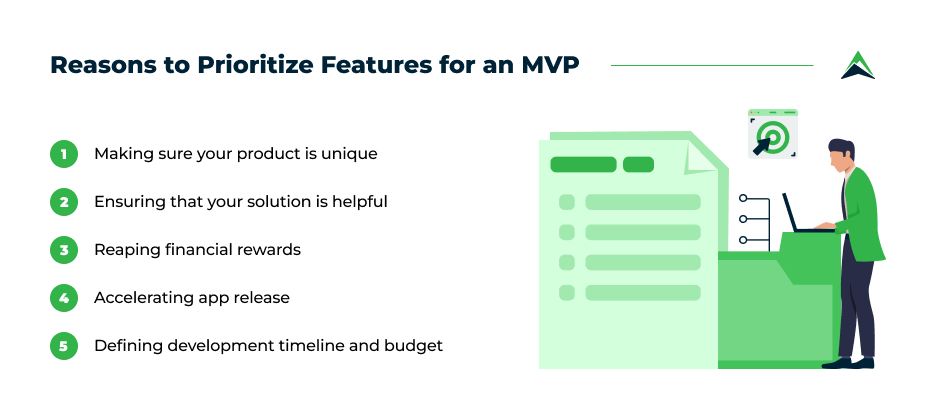
Making sure your product is unique
Chances are, a product like yours already exists – and you don’t want to create a copycat. Prioritizing features forces you to take a closer look at your competitors’ offerings.
Ensuring that your solution is helpful
To be in high demand, your product has to assist users in resolving their problems. The app feature prioritization procedure will help you understand your customers’ pain points and modify your offering accordingly.
Reaping financial rewards
This goal is tightly interconnected with the previous one: providing customers with unique solutions will ultimately account for excellent financial outcomes and help you generate revenue.
Accelerating app release
In today’s hyper-competitive market, launching early gives your product an edge. Smart feature prioritization can help you outpace competitors and attract early adopters by getting to market faster.
Defining your product development timeline and budget
Some features take much longer (and cost more) to implement than others. Knowing which features to prioritize allows you to map out a realistic development timeline and budget.
In short, feature prioritization ensures your MVP is unique, useful, financially viable, and delivered fast – all critical for startup success.
MVP trends in 2025 – 2026: how the landscape has changed
MVPs in 2025 – 2026 are increasingly AI‑native. Founders are embedding large language models (LLMs) to handle natural‑language queries and summaries, using off‑the‑shelf AutoML tools for fast experimentation, and building on no‑code platforms to iterate quickly. At the same time, new regulations such as the EU AI Act are pushing teams to consider explainability, bias mitigation and data‑privacy safeguards from day one. Prioritizing features now means balancing “wow‑factor” AI against ethical and legal responsibilities.
Modern product teams also use micro-MVPs: extremely small, high-signal experiments designed to validate one key assumption at a time. This approach helps reduce risk and ensures that development time goes only into features with real demand. As a result, MVPs in 2025 are more experimental, data-driven, and user-centric than ever before.
At Eastern Peak, we’ve seen these trends first-hand, as more founders ask us about AI integrations and lean validation techniques during MVP planning.
How to decide on your MVP features
How do you prioritize a list of product features? Deciding which ones should be included or excluded is not an easy task and requires in-depth industry insight. Below, we outline the key stages for effective MVP feature prioritization.
1. Get to know your users
To define your MVP’s feature set, you must know your audience so well that you can create distinct user personas representing your key demographics. This deep understanding will also help you craft meaningful user stories.
In 2025, product teams often complement traditional interviews with AI-assisted research tools that analyze patterns in user feedback, helping them form accurate personas faster and reduce guesswork early in the MVP phase.
2. Identify problems
Now that you have a clear vision of your audience, think about their common struggles. What issues are they facing every day? Further, define how your software solution will help users resolve these issues and make their lives better. Recent research shows that “no market need” remains the top failure reason, responsible for 34% of startup failures in 2025, highlighting how critical it is to focus on real user problems. (Source: FundediQ 2025)
Ask whether adding an AI‑driven feature will directly address a user pain point. If it doesn’t, it’s better to leave it out of the MVP – even if competitors are touting AI.
3. Learn how they are currently getting their needs met
Understanding how users currently solve their problems helps you identify gaps your product can address. In 2025 and 2026, this often includes a mix of manual workflows, spreadsheets, lightweight automation tools, or AI assistants. Analyzing these workarounds reveals where users struggle the most – and where your MVP can offer clear, immediate value without overbuilding complex features.
4. Study your competitors
Competitor research in 2025 and 2026 goes beyond listing direct and indirect alternatives. Modern analysis focuses on understanding how users switch between tools, which features drive differentiation, and how emerging AI-powered solutions reshape expectations. Look for gaps in usability, onboarding, speed, or automation – these often reveal opportunities where your MVP can stand out without needing to match every competitor feature.
5. Know your strengths
Now, define which characteristics set your product apart from other offerings on the market. Even small details (like an attractive design or smoother UX) can sway customer choice, so don’t overlook them.
Many productivity tools today include small AI-powered suggestions, such as automatic task categorization or smart reminders – subtle features that make the product feel more intuitive compared to competitors.
6. Come up with a value offering
Ask yourself why customers would choose your solution over others. What unique capabilities does it offer that no other app provides? Those are the features you’ll want to spotlight.
Always consider your customers’ needs when prioritizing features.
Not sure which features to prioritize?
Our product experts at Eastern Peak can help you evaluate your ideas and focus on what brings the most value. Feel free to get in touch for a free consultation.
AI-native features in modern MVPs (2025)
In recent years, many MVPs have started to include small AI-native elements designed to improve usability without increasing development scope. These features are typically lightweight, low-risk additions that help teams measure user interest early on.
Examples of AI‑native features that MVPs can test include: conversational chatbots built on LLMs to guide users through onboarding; recommendation engines that surface relevant content or products; generative design tools that draft marketing copy or UI layouts; automated document‑processing pipelines using computer vision; and predictive maintenance modules for IoT devices.
When prioritizing AI features for an MVP, it’s important to consider not only user value but also data availability, compliance requirements, and model accuracy. In many cases, a simplified or rules-based version of an AI feature is enough for initial validation. This approach allows teams to test assumptions quickly without committing to full model development from day one.
Top 11 MVP feature prioritization methods (frameworks)
The 11 feature prioritization frameworks we’ll cover are:
- Feature Priority Matrix
- Feature Buckets
- MoSCoW
- Kano Model
- Relative Weighting
- Effort–Impact
- Opportunity Scoring
- User Story Mapping
- RICE
- Opportunity Solution Tree
- Value–Risk Quadrants
1. Feature Priority Matrix
This simple tool helps you envision which features to prioritize in your app. The matrix has two axes, and the matrix rates features based on three factors:
- Effort – how resource intensive does the implementation of this feature appear.
- Impact – how valuable it is to your clients and how impactful it is from a business perspective.
- Risk – how potentially difficult it will be to implement this feature.
Next, place your MVP features in 4 categories:
- Must-haves – the absolutely necessary and the lowest-risk functions.
- Can-be-dones – the not-so-impactful ones that may be introduced in the later MVP versions.
- Nice-to-haves – not particularly impactful, these characteristics set your product apart from the others. The costs and risks of their development, however, render them improper for an MVP, so they should be included in the next version.
- Waste of time – both high-risk and low-impact features.
For example, a messaging app MVP might label end-to-end encryption as Must-have (high impact, low risk), dark mode as Nice-to-have (low impact, low risk), and an AI chatbot as High risk (needs more validation before including).
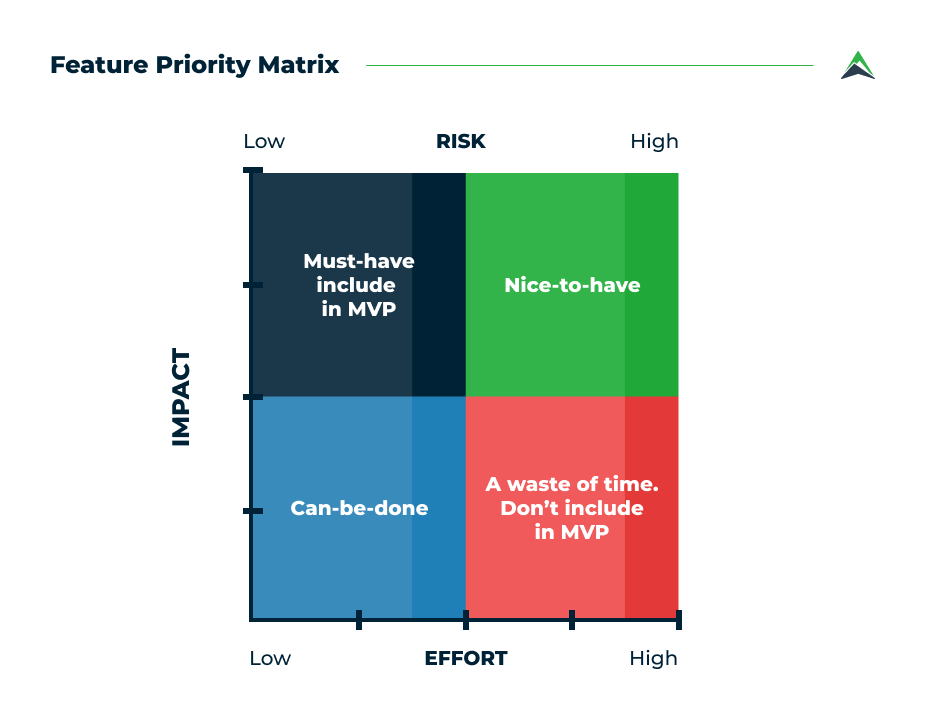
Surely, after the first MVP release, when you get users’ reviews, you may reconsider the features and place them in different categories.
2. Feature Buckets
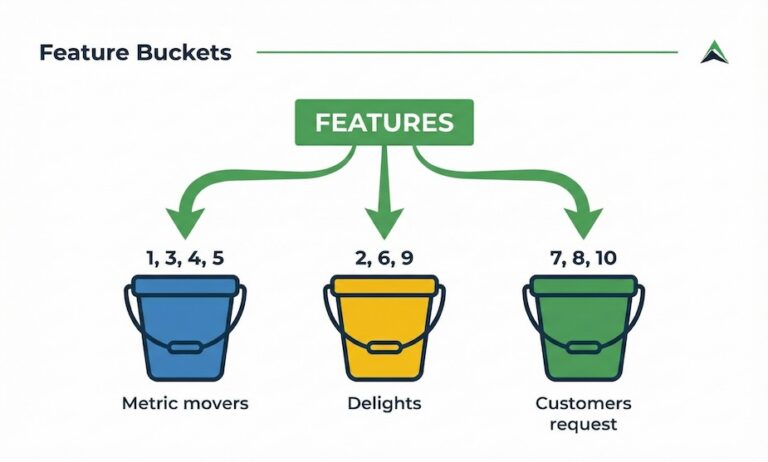
The Feature Buckets model groups potential features into three simple categories:
- Customer Requests – directly asked for by users, often based on real pain points.
- Metric Movers – features with clear impact on activation, engagement, retention, or revenue.
- Delighters – small enhancements that improve experience but are not essential to the MVP.
This model is helpful early on, but it works best when used together with more structured methods like RICE or Effort–Impact scoring (we will discuss them below).
3. MosCoW Matrix
This model is also frequently used for prioritizing features for an MVP. Just like the above models, it splits the product features into logical subcategories:
- Must-haves. These are the main features of your product that, basically, make it viable. Without these features, your app would not work, or their absence would compromise its security.
- Should-haves. Less critical, but still quite important functions. Your MVP will work without them, but still, you wouldn’t want to leave them out.
- Could-haves. These are the cute little add-ons that give your MVP a distinct personality, yet your early product version could easily do without them.
- Not this time. These are the features that you’re absolutely sure won’t appear in your MVP version, but you plan to implement them in the final version of your app.

4. Kano model
The user-oriented approach to prioritize product features on an MVP. The attributes it sets for defining the MVP features list include
- Threshold – features that ensure the operability of your app and are the ones most expected by users.
- Performance – these features aren’t mandatory but will substantially enhance user experience.
- Excitement – features that users do not expect, aimed to generate excitement.
To apply this model, you will need to run some customer surveys and do some research. The findings will enable you to apply the Kano model and prioritize the features of your MVP. Make sure you implement all the required threshold functionalities as well as some of the performance and excitement features. Exclude the factors that evoke dissatisfaction and indifference.

5. Relative Weighting Prioritization
This technique uses the combination of the two previous methods to define the value of each particular MVP feature. The value is calculated numerically, so the development team gets an instant understanding of exactly how important each feature is.
This method also takes into account the negative impact of not implementing a particular feature. More specifically, the factors, taken into account include
- Benefit – the advantages that implementing this feature would bring.
- Penalty – the negative implications of not implementing it.
- Cost – how much it will cost to develop this feature.
- Risk – potential challenges its development might entail.
The formula (Penalty score + Benefit score) / (Risk score + Cost score) is used to calculate the value of features. Each feature receives a score from 1 to 9. The application of this method, however, requires active input from both a client and a development team.
6. Effort and Impact
This technique analyzes features’ priorities by assessing the value and complexity of each feature. The features are assessed by defining the correlation between how challenging it will be to implement them and the value they are supposed to bring.
The challenges are divided into development complexities, risks, and financial overheads, and the value is estimated from both client and business perspectives.
Upon evaluation, the features are placed into the following categories according to their priorities:
- quick wins,
- major projects,
- fills-ins, and
- reconsider.

7. Opportunity Scoring
Opportunity Scoring is based on the idea that the best features to prioritize are those that users consider highly important but are currently dissatisfied with. Using the Opportunity Algorithm, you score each feature on two factors: Importance (how essential the outcome is to the user) and Satisfaction (how well existing solutions meet the need today). The formula:
Opportunity = Importance – Satisfaction
Features with the highest gap represent strong candidates for your MVP, as they address unmet needs that users genuinely care about.
8. User Story Mapping
This is one of the most popular techniques used to categorize features for your MVP. It is also one of the most efficient ones because it involves all the product’s stakeholders. To define the highest and the lowest priority features, they try to envision how their supposed users will be navigating their app.
They start by defining the user’s goals, for example, booking a hotel in a tourist app. This action is then split into substeps: picking the right hotel, submitting user details, and requesting a transfer, i.e., each of these steps is then written down as a user story: “As a user (user type), I want to (step) so that (value)”.
After this is done, the team maps user stories according to their goals and their significance. This method helps identify which product features are best included in the MVP and which in the next product release.

9. RICE Scoring
RICE is one of the most widely used prioritization methods among modern product teams. It helps compare features based on their expected impact and the effort required to implement them. The four factors include:
- Reach – how many users will be affected within a specific time period
- Impact – how strongly the feature will influence user behavior or business goals
- Confidence – how certain you are about your estimates
- Effort – the estimated amount of work required (usually expressed in person-months)
The RICE score is calculated by the formula:
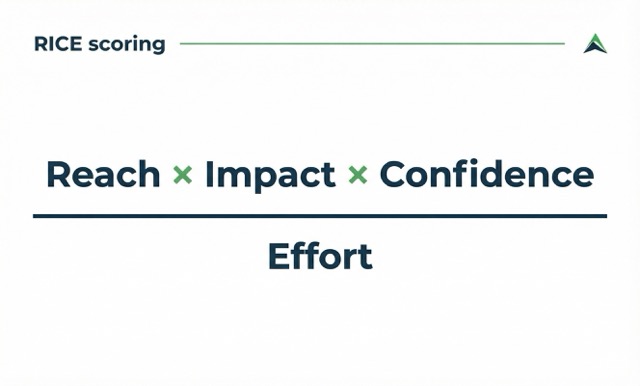
This approach helps teams stay objective when choosing which features should make it into an MVP and which should be postponed.
Pro tip: In our work with startup MVPs, we often combine the RICE and MoSCoW methods – RICE gives a quantitative view while MoSCoW ensures we don’t miss any must-haves. This blended approach helps our clients prioritize with confidence.
10. Opportunity Solution Tree
This method is based on Teresa Torres’ continuous discovery framework and helps teams identify the most valuable opportunities before deciding on solutions. It starts with a desired outcome (e.g., improving activation or reducing churn) and structures discovery in four steps:
- Outcome – the metric you want to improve
- Opportunities – unmet customer needs and problems
- Solutions – different ideas that could address these opportunities
- Experiments – small tests used to validate assumptions
An Opportunity Solution Tree provides a clear visual overview and prevents teams from jumping into solutions before fully understanding user needs.
11. Value vs. Risk Quadrants
This technique helps evaluate features by plotting them on a 2×2 grid, comparing:
- Value – the potential business or user benefit
- Risk – technical, data, or compliance uncertainty
The four resulting categories include:
- High value / low risk – top priority
- High value / high risk – requires validation experiments or a micro-MVP
- Low value / low risk – optional enhancements
- Low value / high risk – deprioritize
This approach is especially helpful when prioritizing AI-driven features, where risks and dependencies (data availability, model accuracy, regulatory concerns) can be significant.
To conclude
The vast choice of techniques may leave you confused, but you don’t have to apply all of them to be efficient. Regardless of which method you choose, make your end users a priority – after all, their acceptance will define your MVP success. Make sure your evaluation of MVP features is not one-sided, and include different people in your product discovery team to provide you with a broader outlook.
In 2025, with shorter product cycles and higher user expectations, the ability to quickly validate assumptions and focus on the right features is becoming even more critical. Surely, you may still be left with a lot of questions. Drawing on our experience helping startups, the Eastern Peak team can pinpoint which features will bring the most value to your MVP. Get in touch with us for a free, no-obligation consultation – we’re happy to help you build a successful product.
Read also:
- No-Code MVP vs Custom Development: The Risks Behind a Quick Launch
- Why Should You Choose Rapid App Prototyping Prior to Building Your MVP?
- How to Create an Online Marketplace MVP
- From Idea to MVP: How Startups Can Succeed with Custom Software Development
- 5 Essential Post-Launch MVP Activities for Your App
About the author:

Oleg Roberman, Chief of Delivery at Eastern Peak
With strong technical background and outstanding project leadership skills, Oleg helps Eastern Peak customers introduce competitive advantages and instill productive changes in every process by resolving complex business issues and managing multicultural teams through innovation and creative thinking.