Robotic Process Automation (RPA) in healthcare was valued at $2.8 billion in 2025 and is rapidly growing — with a 26.10% CAGR, it may well reach $22.56 billion by 2034. The demand for RPA in healthcare is driven by an increasing global population and healthcare needs, which strain human staff in organizations.
Healthcare companies that want to maximize patient satisfaction while maintaining the same quality of service should consider adopting RPA. Doing so is most effective right now, as integrating healthcare RPA can help businesses maintain a competitive edge, improve the job performance of their human workers, and preserve strong relationships with their patients.
This article dives into the concept of RPA in the healthcare industry, explains how it’s used, covers the core benefits of integrating it into healthcare processes, and outlines how to implement it while accounting for potential challenges.
What is RPA in healthcare?
Robotic Process Automation (RPA) in healthcare is the use of specialized software tools to automate repetitive, rules-based administrative tasks, such as data entry or medical billing, with the end goal of improving performance and redirecting human healthcare resources.
Types of RPA
The key RPA types (attended, unattended, and hybrid) are defined by their interaction with the human workforce and their level of operational independence.
- Attended. This healthcare process automation resides on a user’s workstation and is triggered by specific employee actions. To illustrate, an attended bot might help a receptionist instantly pull up a patient’s multi-provider history upon check-in. It acts as a digital assistant that requires human oversight to complete a task.
- Unattended. Unattended healthcare automation solutions run on a server and operate independently, based on a schedule or a data trigger. They are ideal for high-volume batch-processing tasks that don’t require human intervention, such as handling large volumes of billing records overnight.
- Hybrid. Hybrid RPAs combine human interaction with both attended and unattended solutions. For example, a bot might flag a complex insurance denial (unattended), then pass it to a human specialist for a decision (attended), and finally automatically file the corrected claim once the human provides input.
The table below summarizes how the three types compare at a glance.
| RPA Type | How it runs | Best for |
|---|---|---|
| Attended | Triggered by employee action on their workstation | Real-time patient-facing tasks (e.g., check-in lookup) |
| Unattended | Runs autonomously on a server, schedule- or data-triggered | High-volume overnight batch processing (e.g., billing) |
| Hybrid | Combines automated execution with human decision points | Complex workflows requiring expert judgement (e.g., claims appeals) |
The evolution: from task automation to RPA + AI
Although the basic technology behind RPA is simple and operates within the narrow confines of its instructions under specific conditions, its integration with AI has been a key factor in its growth. The industry is moving toward intelligent automation for healthcare, which merges the execution power of RPA with the capabilities of artificial intelligence.
Previously, automated solutions could handle structured information and follow simple written logic. Today, they can work with unstructured data and complex rules.
For organizations considering the move from rules-based automation toward AI, an AI readiness assessment is a practical way to see which processes are ready.
How is RPA used in healthcare?
RPA use cases in healthcare help staff automate high-volume administrative workflows, thereby reducing manual data entry errors and improving the patient journey.
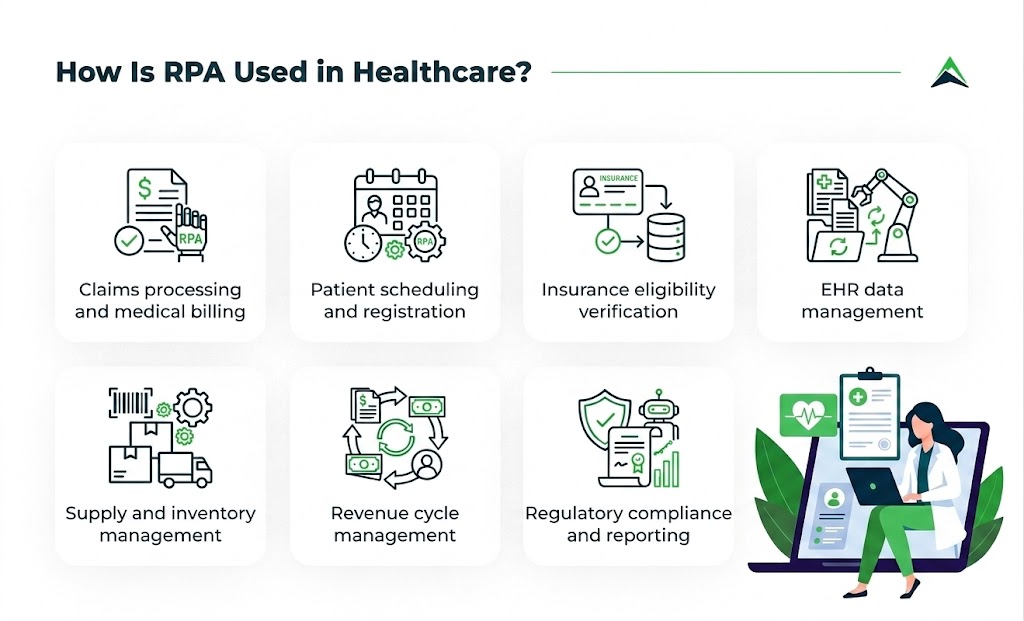

- Claims processing and medical billing. Companies use RPA in medical billing to automatically scrub claims for errors and submit them to payers without human intervention. Adding RPA and AI for healthcare claims automation cuts processing time by 90%. Businesses that move repetitive data entry from their human specialists to software can achieve faster reimbursement cycles.
- Patient scheduling and registration. Healthcare institutions use healthcare automation software to synchronize patient requests with available providers and reduce manual booking. RPA can trigger automated reminders and notifications and update patient records in real time, making it faster and more effective. Recent studies show that the median time for process appointments with RPA was 3.9 minutes compared to 7.5 minutes for manual entry.
- Insurance eligibility verification. RPAs instantly verify patient insurance coverage and co-pay requirements by querying payer portals before the point of care. By doing so, companies prevent surprise billing and reduce the administrative burden on front-desk staff. RPA services for healthcare benefit patients as well, since they receive fewer claim rejections: in some case studies, claims adjudication accuracy increased from 82% to 94%.
- EHR data management. RPA serves as a digital bridge that migrates and synchronizes patient data across disparate Electronic Health Record (EHR) systems without manual entry. In particular, the implementation of an RPA/ML workflow successfully updated patient records on an EHR portal with more than 80% accuracy. Medical institutions use RPA to continuously track emerging disparities or errors in EHRs.
- Supply and inventory management. Healthcare providers use RPA to track inventory levels in real time and trigger automated reorders when supplies reach a predefined threshold. This automation in healthcare helps organizations prevent critical stockouts while minimizing overspending from excessive purchases.
- Revenue cycle management. RPA automates the end-to-end flow of financial transactions, which allows it to track the revenue cycle. By automating the follow-up on aged accounts, bots ensure that no revenue is left on the table due to administrative oversight. Since this approach means smarter spending and better accountability, such automation in revenue cycle management can increase net patient revenue by improving capture and reducing leakage.
- Regulatory compliance and reporting. Healthcare workflow automation automates the collection and formatting of data required for HIPAA, GDPR, and other regulatory reports to ensure full legal compliance. RPA’s main benefit for organizations seeking to maximize transparency is that it provides a permanent digital trail. This proactive approach significantly mitigates the risk of heavy financial penalties arising from incorrect reporting.
What are the benefits of RPA in healthcare?
RPA delivers measurable value by converting error-prone administrative workflows into high-speed processes that decrease manual input and improve care quality.
Lower administrative costs
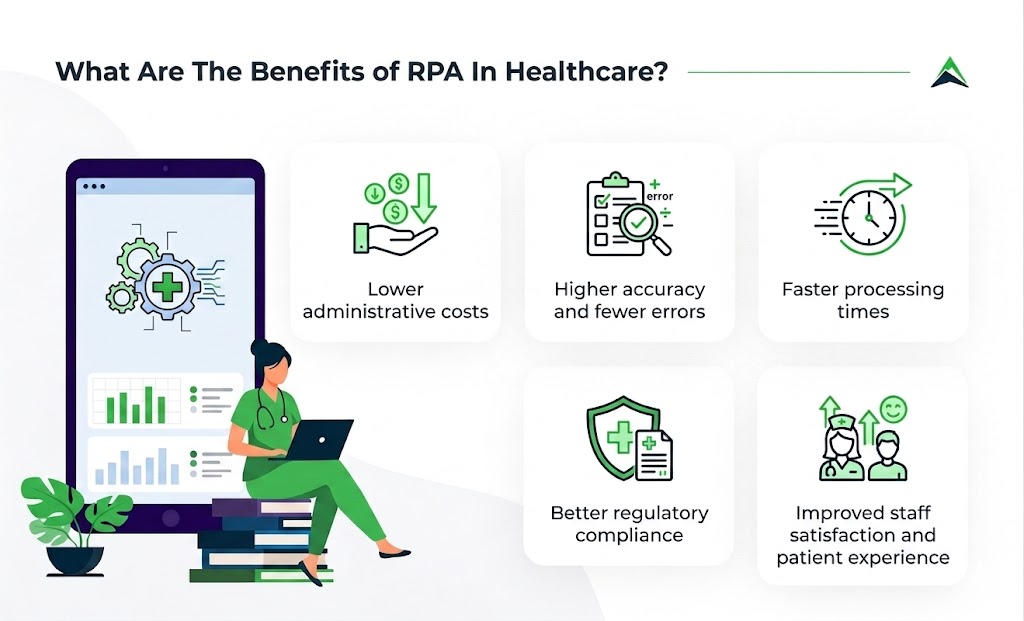
Healthcare organizations can achieve a significant cost reduction by automating repetitive administrative tasks. The CAQH Index Report suggests that companies and organizations in the industry can decrease expenditures by 22%, or $20 billion. The application of RPA in healthcare gives providers an opportunity to cut operational spending while scaling operations without hiring additional administrative staff.
Higher accuracy and fewer errors
Workflow automation in healthcare improves data entry and migration accuracy, reducing human errors. Early adoption of RPA has already demonstrated that, even during onboarding, businesses can reduce compliance errors by 32%. Because bots follow strict, unvarying rules, they eliminate “fatigue-led” mistakes in critical areas like medical coding and prescription entry.
Faster processing times
RPA can execute administrative tasks faster than human staff, which fosters procedural efficiency. The data suggest that automation can save up to 12 minutes for medical providers and up to 8 minutes for dental providers.
Better regulatory compliance
RPA improves compliance accuracy by maintaining an unalterable, time-stamped digital audit trail of every automated action. Automated systems can reduce compliance-related reporting costs and ensure audit readiness for HIPAA and GDPR reviews. By standardizing how information is handled, RPA reduces the variability that can lead to data breaches.
Improved staff satisfaction and patient experience
Automating routine paperwork can reduce clinician burnout and improve patient satisfaction by increasing human-to-human interactions and reducing repetitive data entry.
For example, Seoul National University Hospital, which used RPA as an isolated test, reported a 76.5-hour reduction in work, allowing staff to focus on more fulfilling tasks. When the administrative friction is removed, both the provider and the patient experience a more human-centric care journey.
How to implement RPA in healthcare
Implementing RPA in a healthcare organization requires planning and prioritization, collaboration with the right partner, piloting, and continuous growth.
1. Identify high-impact processes
Successful RPA deployment begins with auditing existing workflows to identify high-volume, rules-based tasks that currently cause significant bottlenecks. To identify the weakest points in your system, map each workflow and observe where data stalls or where human error most frequently occurs.
Healthcare organizations should begin with the areas most likely to struggle without automation: claims, scheduling, eligibility checks, and revenue cycle. These comprise a significant chunk of the daily workload and can pose a resource challenge.
2. Find the right technology partner
Selecting a vendor involves evaluating their experience with healthcare-specific data standards and a strong portfolio. A specialized team understands the nuances of integrating with legacy Electronic Health Record (EHR) systems.
Aside from balancing pricing and strategy, healthcare organizations need to choose a company that understands long-term scalability and potential concerns rather than one that seeks to sell a one-off software license.
3. Start with a pilot
A pilot program allows the IT team to test product performance in a controlled, non-critical environment before it goes into full-scale production. It helps to check a specific department to measure how RPA performs. During this stage, it’s critical to identify potential bugs and friction points to improve the tool’s efficiency.
4. Ensure compliance from Day 1
Compliance must be baked into the bot’s architecture from the start to ensure every automated action adheres to the necessary security protocols. This means each bot interacts with the specific datasets necessary for its task and generates a full log of its activity.
Healthcare organizations need to ensure RPA meets the existing regional and national standards, such as HIPAA and GDPR.
5. Scale and optimize
After a successful pilot, scale and optimize medical RPA adoption across multiple departments. Regularly gather feedback from staff who interact with the bots to identify new opportunities for improvement. Strategic scaling and optimization enable your business to handle increasingly complex, unstructured medical data in the future.
What are the challenges of implementing RPA in healthcare?
- Legacy system integration. Interoperability is one of the top implementation barriers: RPA must often bridge gaps between decades-old software and modern cloud-based Electronic Health Records (EHR). That’s why many healthcare organizations have fragmented IT infrastructures that weren’t designed for third-party automation. This technical fragility calls for a careful maintenance strategy, ensuring that a single update doesn’t halt critical workflows.
- Data security and HIPAA compliance. Adopting RPA can pose significant security and compliance challenges, as each bot has access to sensitive information, and a compromise can lead to a data breach. Bots must adhere to strict encryption standards and generate immutable audit logs to satisfy all legal requirements.
- Staff resistance/training. Employee resistance and training difficulties can delay RPA implementation. Gartner states that 79% of staff do not trust change. Rather than trying to inspire employees, organizations need to make change as smooth as possible and provide easy training and onboarding.
How can a reliable tech partner help you adopt RPA?
A reliable technology partner bridges the gap between complex healthcare legacy systems and modern automation and knows how to ensure a secure and compliant digital transformation. With the right team, healthcare organizations can amplify robotic process automation benefits without an expensive infrastructure overhaul.
Our team at Eastern Peak helps organizations adopt RPA that fits their unique systems with no disruption. If you’re interested in improving your organization’s performance while eliminating repetitive tasks, connect with us to look into healthcare automation solutions.
RPA in healthcare is the application of specialized software to automate repetitive and rules-based administrative tasks to boost efficiency and accuracy. RPA for healthcare is applied for claims processing and medical billing, patient scheduling, insurance eligibility verification, EHR management, supply and inventory management, revenue cycle management, and regulatory compliance and reporting. RPA is used to move data according to specific, strict rules, while AI automation in healthcare can process unstructured information and make complex predictions.Frequently Asked Questions
What is RPA in healthcare?
What are the main use cases for RPA in healthcare?
What is the difference between RPA and AI in healthcare?
Read also: