In 2025, users downloaded 142.2 billion apps and games worldwide. The Apple App Store has 1.96 million apps, and Google Play offers 2.87 million more. That is an enormous amount of competition for any new product entering the market.
Building a great app is only part of the equation. Without a clear mobile app marketing strategy, even well-designed products get buried under millions of alternatives. And here is what most founders and product owners discover too late: the most effective app marketing tactics are not things you bolt on after launch. Referral systems, push notification infrastructure, analytics tracking, deep linking, and onboarding flows. These are features that need to be architected into the app during development.
At Eastern Peak, we build mobile apps for startups and established businesses across fintech, on-demand services, e-commerce, and more. We have seen firsthand that the most successful launches happen when marketing strategies for apps inform the development process from the start.
This guide walks you through every stage of mobile app marketing, from pre-launch preparation to paid acquisition and retention, with a focus on what needs to be built into your product to make each strategy work.
What is mobile app marketing, and why does it matter?
Mobile app marketing is the process of promoting a mobile application throughout its entire lifecycle: awareness, acquisition, engagement, retention, and revenue.
Unlike web marketing, app marketing operates within unique constraints: app store gatekeepers, install friction, notification permissions, and limited organic discovery.
The numbers paint a clear picture of why this matters. Mobile apps generated over $935 billion in revenue in 2025, yet the average app loses 77% of its daily active users within the first three days after install. The gap between downloading an app and becoming a loyal user is where most products fail.
A strong app marketing strategy closes that gap by addressing every stage, from the moment a potential user first hears about your app to the point where they become a paying, returning customer.
What makes app marketing different from other types of digital marketing is how deeply it connects to the product itself. Many of the most effective growth channels, including referral programs, in-app messaging, and smart push notifications, require specific features and infrastructure that must be planned during development.
How do you create a mobile app marketing plan?
A mobile app marketing plan is a roadmap that covers every stage of your app’s go-to-market strategy. It starts before development is complete and continues well after launch. The plan should define your target audience, competitive positioning, channel strategy, budget, and success metrics.
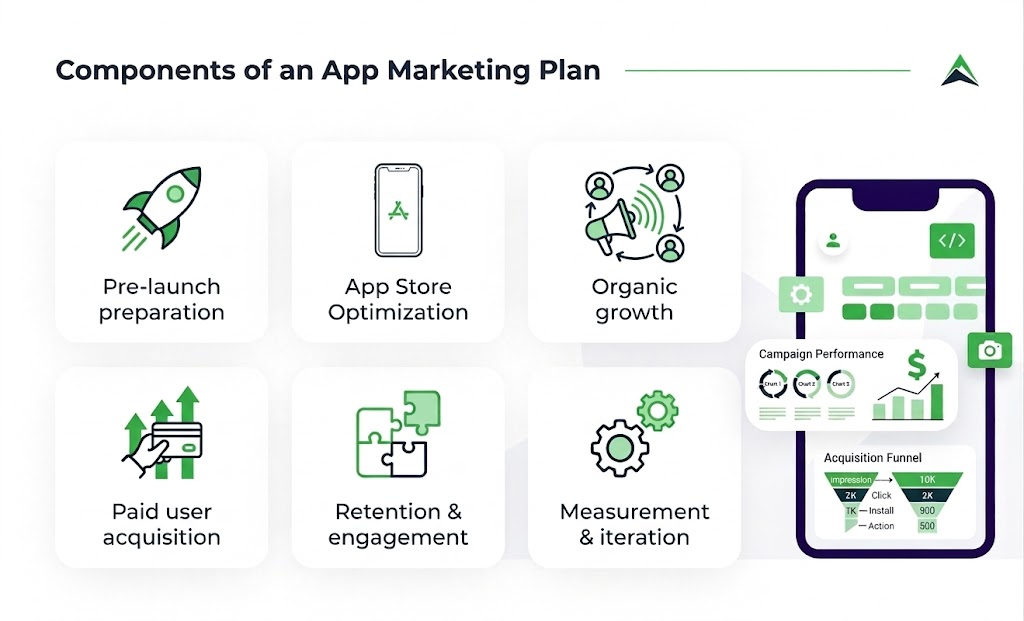
At a high level, an effective plan includes six components:
- Pre-launch preparation: building awareness, collecting early interest, and running beta tests.
- App Store Optimization (ASO), which is your most important free discovery channel.
- Organic growth through content, referrals, and community building.
- Paid user acquisition across platforms like Apple Search Ads, Google, and Meta.
- Retention and engagement strategies that keep users coming back.
- Measurement and iteration based on real data.

But regardless of category, one principle holds true: a large portion of what goes into a marketing strategy for an app’s plan is actually product and development work. Referral tracking, analytics SDKs, onboarding personalization, and notification logic. These are engineering tasks, not marketing tasks. When you work with a development partner like Eastern Peak, these considerations are part of the product discovery phase, before a single line of code is written.
A critical early step is defining user personas for your app. Go beyond basic demographics: identify what problems each persona faces, which devices and platforms they use, what competing apps they have tried, and what would motivate them to switch.
Research confirms 40% of smartphone users browse app stores for apps, but a larger percentage discover apps through social media, ads, or word of mouth. Your persona research tells you where to meet them.
Conduct surveys, run interviews with power users if you can, and validate your ideas with real data. These personas will inform every decision that follows, from which marketing channels to prioritize to how your onboarding flow should work.
Mobile app marketing at a glance: key strategies compared
| Strategy | Avg. Cost | Time to Results | Best For | Impact |
|---|---|---|---|---|
| App Store Optimization (ASO) | Free – $5,000/mo | 2–4 weeks | All apps | +12% organic downloads |
| Content marketing & SEO | $1,000–$5,000/mo | 2–6 months | B2C, SaaS | 10× lower CAC vs paid channels |
| Paid user acquisition (UA): Meta | CPI $2.00–$5.50 | Immediate | Scale-ups | Largest mobile ad reach |
| Paid UA: TikTok | CPI $1.75–$4.00 | Immediate | Gen Z / consumer | Lowest CPI among major social platforms |
| Paid UA: Google App Campaigns | CPI $2.65–$3.50 | Immediate | Cross-platform | Search + Display + YouTube reach |
| Apple Search Ads | CPI $1.50–$3.00 | Immediate | iOS-first | 65% of installs from App Store search |
| Influencer marketing | $500–$50K/campaign | 1–4 weeks | Consumer apps | 61% trust influencers over brands |
| Referral programs | Low (reward cost) | 2–8 weeks | Network-effect apps | Viral coefficient >1.0 = organic growth without ad spend |
| Push notifications | Free (built-in) | Immediate | Retention | 3–10× engagement vs email |
What should you do before launching your app?
Pre-launch is where development and marketing overlap the most. An effective app launch strategy can build a waitlist, generate press coverage, and collect real user feedback, all before your app goes live.
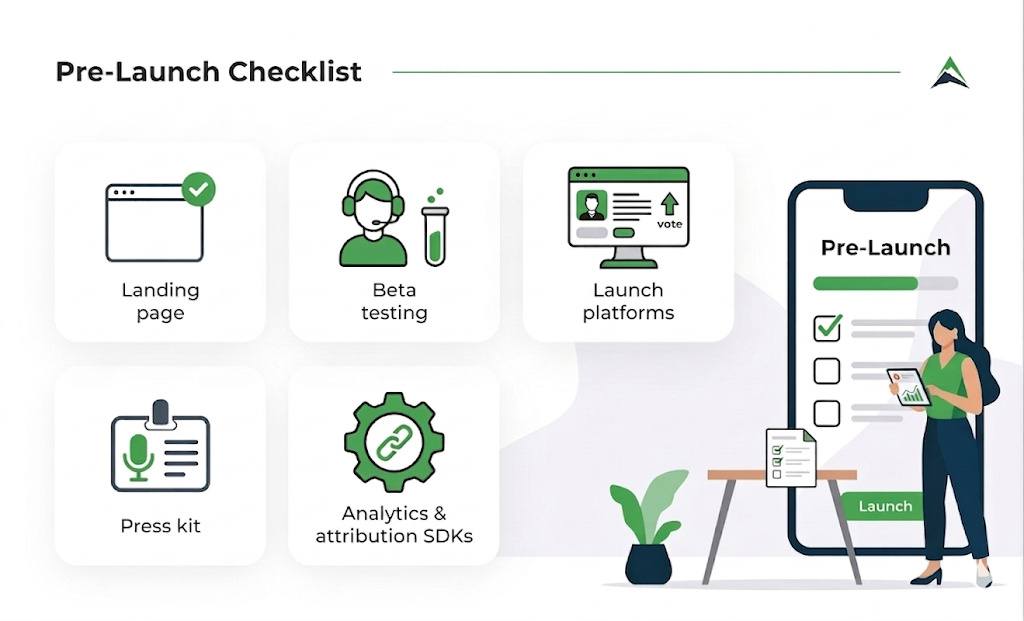
Pre-launch checklist
- Build a landing page early. Your app landing page should go live months before launch. A simple page with your value proposition, mockup screenshots, and an email signup form is enough. Start collecting emails from people who want to know when the app is ready.
- Run a beta test. Use TestFlight (iOS) and Google Play’s closed testing tracks. Beta testers fix UX issues before launch and often become your first reviewers and advocates.
- Launch on Product Hunt and startup directories. A well-executed Product Hunt launch can generate thousands of signups in a single day. Build community relationships beforehand, prepare high-quality screenshots and a demo video, and launch on a Tuesday or Wednesday when competition for attention is lower.
- Prepare a press kit. Include app screenshots, a demo video, a one-page product summary, and founder bios. Pitch niche tech blogs and industry publications first.
- Integrate analytics SDKs before launch. Launching without analytics means losing data from your most critical early users.
At Eastern Peak, we include landing page development, beta testing coordination, and analytics integration as part of our project workflow, so these pre-launch steps are built into the how to launch an app process from the start.
How does App Store Optimization (ASO) work?
App Store Optimization is the practice of optimizing your app store listing to rank higher in search results and convert more visitors into downloads. Since 65-70% of app installs come from app store search, skipping ASO means you are invisible to the majority of potential users.
App store keyword research
App store keywords are the foundation of ASO. Start by analyzing what terms your competitors rank for, then use tools like AppTweak, Sensor Tower, or Apple Search Ads’ keyword suggestions to find relevant terms with reasonable search volume and low competition.
Keywords appear in different places depending on the platform. On iOS, they go in your title, subtitle, and a dedicated keyword field. On Google Play, the full description is indexed, so keyword placement matters throughout your listing text.
Optimizing your listing
Your app store optimization checklist should cover several elements:
- The title and subtitle need to include your primary keyword while remaining memorable.
- Screenshots and video previews create first impressions, so highlight three to five core features with clear captions.
- The description should be written for humans on both platforms, even though Apple does not index it for search.
- The app icon should be simple, distinctive, and recognizable at small sizes.
Ratings and reviews
Apps with ratings of 4.5 stars and above convert significantly better than those below 4.0. The timing of your rating prompt matters. Ask users to rate the app after a positive experience, like completing a task or reaching a milestone, not immediately after they open it for the first time.
Responding to reviews also signals to the app stores that you are an active, engaged developer.
ASO impact: what the data says
| ASO Action | Measured Impact | Source |
|---|---|---|
| Full listing optimization | +20–60% conversion rate | AppTweak, 2025 |
| Rating improvement (3.6 → 4.2) | +60% conversion rate | Business of Apps, 2026 |
| Video preview + better screenshots | +10–30% conversion rate | AppTweak, 2025 |
| Custom Product Pages (Apple) | +5.9% CVR avg (+8.6% generic) | AppTweak, 2025 |
Benchmark: 90% of featured apps on the App Store and 85% on Google Play are rated 4.0+ (Business of Apps, 2026).
The development connection
ASO success depends on technical decisions made during development. App discoverability improves when your app supports localization, because localized metadata increases visibility in non-English markets.
Deep linking infrastructure lets you drive users from web pages, social posts, and ads directly to specific in-app screens, which is critical for conversion. Smart review prompt timing, where the app detects moments of user satisfaction before requesting a rating, needs to be coded into the user flow.
What are the best organic channels for app marketing?
Organic growth channels let you acquire users without paying per install. They are slower to scale but tend to attract higher-quality users with stronger retention rates.
Content marketing and SEO
Blog content that targets problems your app solves can drive consistent, qualified traffic over time. YouTube tutorials and app demos also perform well. The key is to tie every piece of content to your app’s core value proposition rather than creating content for its own sake.
Referral programs
Built-in app referral program mechanics are among the highest-ROI growth channels. Dropbox famously grew through its invite-friends-get-storage model. Revolut and Uber used similar loops. The pattern is straightforward: existing users invite friends, both parties receive a reward, and the cycle repeats.
But here is the critical point: referral tracking, reward distribution, and invite link generation all need to be built into the app. This is a development feature, not a marketing campaign.
Push notifications
Push notification marketing remains one of the most underused retention channels. Triggered notifications, such as abandoned cart reminders, milestone achievements, or new content alerts, consistently outperform generic broadcast messages. Properly implemented in-app messages can increase retention by up to 30%.
Your permission strategy also matters: when and how you ask users to enable notifications affects opt-in rates. Some apps ask immediately at first launch, but a better approach is to demonstrate value first and then explain why notifications will enhance the experience before requesting permission.
Social media and community
Platform choice depends on your audience. B2B apps perform better on LinkedIn, while consumer apps often gain traction on TikTok and Instagram. Short-form video content, especially app demos and feature walkthroughs, tends to drive engagement. User-generated content and community building around your app’s purpose can also create organic app installs over time.
Influencer marketing
Partnering with influencers is an increasingly effective way to build awareness and drive installs, particularly for consumer-facing apps.
61% of consumers are likely to trust influencers, rather than brands (38%). Look for creators whose followers align with your target user persona, not just those with the largest following. A niche fitness influencer with 50,000 engaged followers will drive more qualified installs for a workout app than a general lifestyle creator with a million.
From a development perspective, consider building features that make your app inherently shareable: screenshot-friendly results screens, share-to-social functionality, and referral codes that influencers can distribute to their audiences.
Email marketing
Email is one of the highest-ROI channels in app marketing, but most app teams skip it entirely. Building an email list through your pre-launch landing page, your website, and in-app signup prompts gives you a direct communication channel that does not depend on algorithms or ad budgets.
Use email for launch announcements, feature updates, re-engagement campaigns for lapsed users, and personalized offers based on in-app behavior.
The most effective app marketing emails are triggered by user actions rather than sent on a fixed schedule:
- a user who added items to a cart but did not complete a purchase,
- a subscriber approaching their renewal date,
- a user who has not opened the app in two weeks.
Each of these is an opportunity for a well-timed, personalized email. This requires event tracking and email automation infrastructure, which need to be integrated during development.
How does paid user acquisition work for mobile apps?
Paid user acquisition gives you immediate scale that organic channels can’t. But it only works if the cost of acquiring a user is lower than the revenue the user generates over time.
Channel selection
- Apple Search Ads: highest intent (users already searching). High conversion rates.
- Google App Campaigns: automated distribution across Search, YouTube, Play, and Display.
- Meta (Facebook/Instagram): strong audience targeting, especially for consumer apps.
- TikTok Ads: increasingly cost-effective for younger demographics.
Cost per install (CPI) by ad platform: 2026 benchmarks
| Platform | Typical CPI (global) | High-competition verticals |
|---|---|---|
| Apple Search Ads | $1.80 median; $4.00+ in the US | Sports $26+, Games $12+, Finance $8+ |
| TikTok Ads | $0.50–$1.80 | Gaming and apps $1.50–$5.00 |
| Google App Campaigns | $1.00–$5.00 | Gaming, finance, tech $10+ |
| Meta (Facebook/Instagram) | $1.00–$5.00 (high volatility in 2025–2026) | Gaming, finance $10+ |
| Unity Ads | $2.00–$3.00 | iOS US $2.37 vs Android global $0.44 |
Sources: AppTweak Apple Ads Benchmarks 2026, SplitMetrics Apple Ads Report 2026, Stackmatix TikTok Ads Cost 2026, Business of Apps CPI Networks 2026, SuperAds Facebook Ads Cost Per App Install, Unity CPI Glossary.
Retargeting and re-engagement
App retargeting brings back users who installed your app but went dormant. This requires proper attribution and event tracking setup, which means SDK integration. These SDKs must be implemented during development. Without them, you cannot measure which channels drive installs, which users are at risk of churning, or which campaigns generate actual revenue.
Effective re-engagement starts with smart segmentation. Examples by app type:
- Dormant users: Target people who were active but have not opened the app in 14+ days with a personalized welcome-back offer or a reminder of what they are missing.
- E-commerce: Retarget users who browsed products but did not purchase with a time-limited discount.
- Subscription apps: Reach users whose trial is about to expire with a message highlighting features they have not tried yet.
The more specific the segment and the more relevant the message, the higher your return rate.
How do you keep users engaged after they download your app?
Retention is where development and marketing become completely intertwined. The average Day 1 retention rate sits around 25%, meaning three out of four users never come back after their first session. By Day 30, that number drops to roughly 5.7%.
Every percentage point you improve at Day 30 compounds significantly over time, because those are the users who become paying customers and advocates.
Key retention tactics
- Progressive onboarding. Let users experience core value quickly, then introduce features over time.
- Personalized onboarding. Ask preferences and tailor the experience to increase habit formation.
- A/B testing. Test onboarding flows, paywall placement, and CTA copy using Mixpanel, Amplitude, or Firebase. These must be set up during development.
- Conversion rate optimization. Retrofitting analytics after launch means losing data from your most critical early users.
2026 retention benchmarks by app category
| App Category | Day 1 | Day 7 | Day 30 |
|---|---|---|---|
| Finance / Banking | 30% | 18% | 12% |
| News & Media | 33% | 14% | 8% |
| Shopping (Marketplace) | 34% | 16% | 9% |
| Shopping (General) | 25% | 11% | 6% |
| Games (Casual) | 29% | 10% | 3% |
| Health & Fitness | 20% | 9% | 4% |
| Education | 14% | 6% | 2% |
| Cross-industry average | 25% | 12% | 6% |
iOS retains approximately 24% of users on Day 1 vs Android’s 21% (Business of Apps).
Which app marketing metrics should you track?
Tracking the right mobile app KPI metrics gives you visibility into what is working and what needs to change. Without proper measurement, you are making decisions based on assumptions instead of data.
- Acquisition: total downloads, cost per install (CPI), install-to-registration rate, attribution by channel;
- Engagement: DAU/MAU ratio (a ratio of around 20% is considered good; above 25% is exceptional), session length, session frequency, feature adoption;
- Retention: Day 1 / Day 7 / Day 30 retention, churn rate, cohort analysis;
- Revenue: ARPU (average revenue per user), LTV (lifetime value), the LTV-to-CAC ratio, and payback period (healthy apps: 3-6 months).
What are the biggest app marketing mistakes to avoid?
After working with dozens of app projects, we have seen certain patterns repeat. These are the mistakes that cost the most time and money.
- Treating marketing as a post-launch activity. By the time you launch, you should already have a waitlist, beta feedback, and ASO metadata in place. Apps that launch cold, with no pre-existing audience, face a steep uphill climb from zero.
- Relying on a single channel. The strongest growth strategies combine multiple channels that reinforce each other: ASO captures high-intent search traffic, paid ads drive initial volume, referral programs turn users into advocates, and content marketing builds long-term authority.
- Ignoring ASO. App store search is the primary discovery channel for most categories. If you have not optimized your title, subtitle, screenshots, and keywords, you are invisible to the majority of potential users who are actively looking for what you offer.
- Spending on acquisition before fixing retention. If your Day 1 retention is 15%, spending aggressively on installs means 85% of your budget goes to users who will never return.
- Not building marketing features into the app. Referral systems, deep links, analytics, push notification infrastructure. If these features are missing from your app, your marketing options shrink dramatically.
- Launching without analytics. If you cannot measure what is working, you cannot optimize anything. Analytics SDKs should be integrated and tested before your app goes live, not added three months later when you realize you have no data on user behavior.
How can a development partner help with your app’s growth?
A development company that understands marketing can build growth infrastructure into the app from day one. This matters more than most founders realize. The difference between an app that is ready to grow and one that needs months of rework often comes down to decisions made during the initial architecture phase.
At Eastern Peak, we help startups and established businesses build mobile apps with growth architecture from the start. If you are planning a mobile app and want to make sure it is built for growth, get in touch with our team to discuss your project.
Mobile app marketing is the process of promoting an app throughout its full lifecycle: awareness, acquisition, engagement, retention, and revenue. It differs from general mobile marketing by dealing specifically with app store discoverability, install friction, and in-app engagement. Day 1 and Day 7 retention rates, install-to-registration conversion, and session frequency. These tell you whether your product works before you invest in scaling. Build a landing page early to collect email signups, run a beta test, prepare a press kit for niche tech blogs, and plan a Product Hunt launch. Make sure analytics and attribution SDKs are integrated before going live. ASO involves optimizing your app’s title, subtitle, keywords, screenshots, and description to rank higher in app store search and convert more listing visitors into downloads. Global CPI benchmarks by platform: Apple Search Ads $1.50–$3.00, TikTok $1.75–$4.00, Google App Campaigns $2.65–$3.50, Meta $2.00–$5.50. iOS installs cost roughly 50% more than Android ($3.70 vs $2.50 globally). Finance apps on Apple Search Ads have the highest category median at $8.23 per install.Frequently Asked Questions
What is mobile app marketing?
What app marketing metrics should startups focus on first?
How do you market an app before launching it?
How does app store optimization work?
What is a good cost per install (CPI) for a mobile app?
Read also: