The article was updated on February 27, 2026.
Rapid technological advancements have brought new capabilities that were inconceivable just a decade ago. Apps have become deeply integrated into how people make money, entertain, communicate, and live. Technologies have transformed the app development industry and many other industries, if not all.
Within the last decade, customers began to expect a mobile-first experience with any brand they engaged with. The global mobile application market reached an estimated $298 billion in 2025 and is projected to grow to $330 billion in 2026, expanding at a CAGR above 15%. Total app downloads hit approximately $149 billion in 2025. Mobile devices now account for over 50% of global web traffic.
Because consumers now have numerous alternatives, a cut-and-dry approach doesn’t adequately meet their preferences and expectations. Companies must tailor their offerings to correlate with specific customer groups. The landscape has shifted considerably since 2024. On-device AI is running directly on smartphones. Cross-platform frameworks have matured to the point where framework choice shapes entire product strategies. Privacy regulations in the EU and the US are rewriting how apps collect and process data.
Whether you are a startup founder, a product manager, or an enterprise technical leader, this review covers the top trends in mobile app development to help you build stronger, more inclusive customer relationships and tap into new income flows.
How is AI changing mobile app experiences in 2026?
AI has moved from a backend feature to the core architecture of mobile apps. On-device models, AI-powered personalization, and generative interfaces are now standard expectations for users and investors.
Since its launch, this technology has redefined various fields and businesses. Around 60% of mobile apps now integrate some form of AI feature.
As AI continues to progress, its capabilities in mobile app development are expanding:
- AI-powered personalization. Neural networks can analyze user behavior, favorite options, and interactions to adapt content to individual purposes. For example, many shopping apps now offer AI-based recommendations that suggest items users might like based on their browsing history.
- Intelligent chatbots. AI powers virtual assistants in many mobile applications. These systems can understand natural language, respond to complex queries, and even complete simple tasks on the user’s behalf.
- Generative AI. Another notable trend in mobile apps is that they allow the creation of photorealistic images, videos, speech, text, and code that are indistinguishable from reality. It is used to generate content for mobile applications, especially in gaming, entertainment, and social media. In 2026, generative AI powers smart compose features, in-app image generation, document summarization, and AI-assisted content creation. These capabilities have shifted from novelty to user expectation in productivity and creative apps.
- Image recognition. It enables apps to detect and recognize objects, scenes, emotions, and more in images. Visual analysis capabilities are growing all the more important, among others, for medical applications. Using the technology, healthcare professionals can identify, evaluate, and track various health problems with greater accuracy.
- On-device AI. Apple Intelligence, Google Gemini Nano, and similar models enable certain AI tasks to run directly on smartphones. Frameworks like Core ML, TensorFlow Lite, and MediaPipe allow developers to deploy machine learning models locally, reducing or eliminating cloud dependency for tasks like image classification, text prediction, and voice processing. This means faster inference, stronger privacy, and offline functionality.
Eastern Peak’s mobile development team integrates AI capabilities, from on-device ML models to generative AI features, into custom apps across industries, including healthcare, fintech, and e-commerce.
How is AI transforming the mobile app development process itself?
The adoption of AI in mobile app development workflows marks the biggest productivity leap since modern IDEs became mainstream. In fact, the 2025 Stack Overflow Developer Survey shows that 84% of developers now use or intend to use AI coding assistants in their day-to-day work.
Tools like Cursor and AI-assisted testing frameworks accelerate coding speed, improve code quality, and help smaller teams deliver at the pace of larger organizations.
However, AI tools cannot replace the strategic thinking, user empathy, and architectural decisions human developers provide. It takes seasoned, hands-on expertise to align a new feature with a long-term business goal, design truly inclusive experiences, and scale a system securely. Ultimately, AI handles the mechanics of the ‘how,’ but human developers must still dictate the ‘why’ and the ‘what.’
Low-code and no-code platforms: where they fit in 2026
Low-code and no-code platforms now handle a significant share of internal business apps and MVPs. They speed up prototyping and reduce costs for simple use cases, but custom development remains necessary for apps that require complex integrations, custom UX, or enterprise-grade security.
- Where low-code works well: internal dashboards, simple CRUD applications, MVPs for stakeholder feedback, and workflow automation.
- Where it breaks down: complex business logic, custom UI/UX design, third-party integrations at scale, regulatory compliance, and apps under heavy load.
A hybrid approach is gaining traction: using AI to speed up development and employing solid engineering to ensure scalability.
Read also: Lovable vs. Custom Development: How Far Can AI App Builders Take Your MVP?
Cross-platform app development
Cross-platform frameworks have matured significantly in 2026, and framework choice now shapes entire product strategies. Flutter, React Native, and Kotlin Multiplatform (KMP) enable teams to build for iOS and Android from a single codebase, cutting development time by 30–40% compared to fully native approaches.
For most apps, cross-platform development delivers the best balance of speed, cost, and quality. Fully native development remains the right choice for apps that push hardware limits – games, AR experiences, and apps relying on cutting-edge platform APIs.
The decision depends on your product requirements, team expertise, and long-term maintenance strategy.
At Eastern Peak, we help clients choose the right framework based on their product goals and technical constraints. Our teams have delivered both cross-platform apps and native apps across various industries.
The rise of voice user interfaces and zero-UI
Voice and conversational interfaces have moved well beyond simple voice search. In 2026, they are a core interaction layer in mobile apps across e-commerce, healthcare, automotive, and accessibility. The global voice user interface market was valued at $7.23 billion in 2025, growing at a CAGR above 32%.
Driven by AI and ML, voice assistants’ abilities to process human language are improving, enabling them to understand more nuanced commands and multi-turn conversations.
More “competent” voice assistants for mobile apps mean handling a more comprehensive range of tasks. Users can speak naturally, and VAs can grasp their intent, take appropriate actions, and provide more tailored responses based on the user’s prior behavior.
Incorporating voice user interfaces into smartphone apps is also among the latest app trends. It allows for a convenient, hands-free experience. Users can speak to navigate menus, enter data, complete purchases, or access various app features. This is excellent when users are on the go or their hands are occupied. The tech also expands access to apps for visually impaired users.
What has changed in 2026
The biggest shift is accuracy. Speech recognition models like OpenAI’s Whisper and Google’s Universal Speech Model now handle accents, dialects, and noisy environments with far fewer errors than earlier systems. On-device speech processing (running locally on Apple Neural Engine or Google Tensor chips) means voice commands work without internet connectivity and without sending audio to the cloud.
Voice-enabled shopping alone is projected to grow by $55.68 billion between 2023 and 2026. Ride-sharing apps integrate with voice assistants for hands-free booking. Healthcare apps use voice for patient intake, symptom logging, and medication reminders.
Zero-UI: beyond voice
Zero-UI refers to interfaces that require no screen interaction at all. This includes gesture controls, gaze tracking, haptic feedback, and ambient awareness. The Apple Watch’s double-tap gesture and Google’s Motion Sense radar are early examples. For mobile developers, the trend means designing app experiences that work across multiple interaction modes: touch, voice, gesture, and eventually brain-computer interfaces.
Security is becoming the top priority in mobile app development
Stricter privacy regulations and rising breach costs have made security a core product feature. The global average cost of a data breach reached $4.44 million in 2025, while US breaches averaged $10.22 million. Apps that treat privacy as an afterthought face regulatory fines, app store rejection, and user churn.
Biometric authentication evolution
Bio-identification, another application development trend in 2026 worth mentioning, is becoming progressively in demand as a secure way to verify users’ identities. This incorporates unique biological features like fingerprints, face ID, voice, and more to confirm users are who they claim to be.
- Fingerprint scanning. It’s currently the most widespread biometric method. Smartphones have built-in fingerprint sensors that authenticate users when they open an app. The fingerprint data is stored locally on the device to protect users’ privacy.
- Facial recognition. It uses a phone’s front-facing camera to scan a user’s face. It creates a 3D map of the face by gauging traits like eyes, nose, and mouth.
- Voice recognition. The tech analyzes a user’s unique voice patterns, pronunciation, accent, and tone to verify their identity. Users record their speaking by repeating a specific phrase as a “voiceprint.”
In 2026, passkeys are rapidly gaining ground across both iOS and Android. The FIDO2 standard has achieved broad adoption, with Apple, Google, and Microsoft unifying behind a shared authentication framework. At the same time, behavioral biometrics, including typing patterns and device handling, add passive security layers that work without interrupting the user experience.
IoT and wearables
Mobile apps remain the primary control interface for IoT ecosystems. The wearables market continues to grow, and apps that integrate health data, smart home controls, and industrial IoT sensors are seeing strong adoption and retention.
In 2026, IoT and wearables will be more integrated into mobile applications than before. Forecasts say the number of devices networked with each other will continue to mount persistently.
If you are on the hunt for opportunities in IoT and wearables, here are the key areas to watch:
- Digital home. The systems like Nest and Ecobee are gathering momentum. You can also build mobile applications to control home devices, enabling users to remotely manage everything from security cameras to automatic blinds. The Matter protocol is now driving standardization across the smart home industry, and apps serve as unified control hubs for multi-brand devices.
- Sport and health trackers. Fitbit and Garmin are famous for tracking workouts and wellness metrics. You can create companion apps to sync with these devices, giving users a centralized place to view all their health stats and set new goals. In 2026, Apple Watch, Galaxy Watch, and specialized medical devices offer deeper integration. FDA-cleared health monitoring and remote patient monitoring are growing rapidly.
- Augmented reality. As the latest mobile app development trend, AR wearables impact retail, schooling, healthcare, and more. You can offer mobile AR apps to provide a deeply captivating experience when paired with smart glasses. For example, an app for surgeons could display patient scans directly within their field of view during an operation.
- Industrial IoT. Mobile apps for fleet management, equipment monitoring, and predictive maintenance represent a growing enterprise market. Field workers use tablets and ruggedized smartphones as their primary interface with complex industrial systems.
IoT and wearables can enhance human capabilities when thoughtfully integrated into mobile applications.
Discover our IoT apps portfolio
Take a closer look at the advanced and scalable Internet of Things solutions for different industries from our portfolio that connect physical and digital worlds.
AR and VR in mobile apps
AR features in mobile apps, such as product visualization, navigation overlays, and interactive manuals, are gaining real commercial traction. Full VR remains niche on mobile, but Apple Vision Pro and Meta Quest have expanded the spatial computing ecosystem that mobile developers need to understand.
As devices become more powerful and 5G infrastructure matures, users can expect more immersive experiences.
Businesses keep utilizing these technologies to create
- engaging shopping apps,
- interactive catalogs,
- 3D product configurators and more.
A realistic assessment: most mobile apps will not need AR or VR. The strongest ROI exists in specific verticals: retail (virtual try-on), real estate (virtual tours), education (interactive 3D models), and industrial training.
5G, edge computing, and the future of app performance
5G is now an established infrastructure rather than a standalone trend. The technology boasts exponentially higher speeds with minimum response time and higher throughput. This means advanced functionality and the ability to handle more data.
5G networks are now commercially available in over 90 countries, and 5G-enabled smartphones represent the majority of new device sales globally. 5G’s share of mobile data traffic reached 43% in 2025 and is projected to reach 83% in 2031. For mobile app developers, 5G means significantly lower latency, higher bandwidth, and the ability to offload processing to edge servers located closer to users.
Edge computing, combined with 5G, enables real-time features that were previously impractical on mobile: multiplayer cloud gaming, real-time collaborative AR experiences, high-definition live streaming with interactive overlays, and instant AI inference on large models without on-device constraints. Apps in telemedicine, autonomous vehicles, and industrial automation stand to benefit the most.
For most consumer apps, 5G’s impact is incremental rather than transformative – faster downloads and smoother streaming. The biggest opportunities lie in enterprise and vertical-specific apps that can take advantage of network slicing and edge infrastructure.
On-demand mobile apps keep climbing
It is not a very new trend in mobile app development, but it is persisting in 2026. Demand-based mobile applications connect customers with services they need right away. The traction of these applications has skyrocketed in recent years and shows no sign of stopping, as today’s consumers prefer to get many products and services delivered right to their cart or doorstep.
In 2026, on-demand apps are evolving with AI-driven matching, predictive demand forecasting, and deeper personalization. Key verticals include:
- Food and grocery delivery apps. Quick commerce (delivery under 15 minutes) has become a major battleground. Apps like Instacart and DoorDash are integrating AI-powered recommendations and subscription models to improve retention.
- Ridesharing apps. Leading ridesharing services such as Uber and Lyft can seize new markets or add additional features.
- Home services apps. On-demand applications for services like cleaning, laundry, lawn mowing, pet care, and more are convenient and practical and will proliferate.
- Fuel and logistics. On-demand fuel delivery, last-mile logistics, and fleet management apps represent a growing enterprise segment powered by IoT sensors and real-time tracking.
Learn how we can help you build on-demand apps
Find your place in an extremely diverse market with a tailor-made on-demand service app!
From gathering requirements to developing an on-demand app to launching it on the market, we will guide you through all the steps of the on-demand service app development process.
Mobile commerce and payment innovation
Mobile commerce accounts for approximately 57–59% of global e-commerce sales, with projections reaching 63% by 2028. In 2024, worldwide mobile e-commerce revenue reached $2.07 trillion.
As more consumers embrace mobile payments and shopping, businesses keep developing intuitive m-commerce apps to meet demand and gain a competitive advantage. Sales and purchases made using smartphones and laptops have steadily grown as a proportion of total e-commerce.
Social commerce and embedded finance
TikTok Shop, Instagram Checkout, and similar features have turned social media feeds into storefronts. Buy-now-pay-later integration, in-app insurance, and micro-lending are becoming accessible to non-fintech apps through APIs like Stripe and Plaid. Mobile payments transaction volume reached $8.1 trillion in 2024, representing a 9.4% annual increase.
Read also: The Future of Fintech: How to Integrate Embedded Finance into Your Business
Super apps in Western markets
Super apps are admired in China and may gain more traction in Western countries over the coming years. They make a multitude of services available in one place. However, cultural preferences, regulatory scrutiny, and a market structure favoring specialized apps have slowed Western adoption.
Just like WhatsApp introduced convenient payment options, you can ask mobile software developers to enhance the capabilities of your existing application, turning it into an all-in-one solution. This approach can expand your user pool and improve your customers’ mobile experience.
Hybrid monetization models
The days of choosing a single revenue model are fading. In 2026, the most successful apps will blend multiple monetization strategies tailored to their user base and category.
What’s working in 2026:
- Freemium + subscriptions. Free core functionality with premium tiers for power users.
- In-app purchases + rewarded ads. Common in gaming but increasingly adopted by utility and fitness apps. Users opt into ads in exchange for premium features, creating a win-win.
- Embedded commerce. Apps that integrate transactional features (payments, bookings, subscriptions) as native experiences rather than external redirects see higher conversion rates.
- Alternative app store payments. With the EU Digital Markets Act enabling sideloading and alternative billing on iOS, teams have new flexibility to reduce platform commissions and offer competitive pricing.
The key is matching monetization to user behavior.
2026: Year of opportunity for your business
The trends highlighted here are a glimpse of what’s to come in app development in 2026. With many new technologies on the horizon, this year is shaping up to be a tremendous opportunity for those ready to embrace it.
An alliance with Eastern Peak, a global mobile app development company, allows you to create custom applications using the latest industry innovations. Our specialists keep their sharp eyes on trends such as IoT, artificial intelligence, voice interfaces, extended reality, etc., and know how to apply them to maximum effect.
Do you have an idea for a new app that makes your head spin? Contact us to help you turn your idea into a tangible, money-making business.
Frequently Asked Questions
What are the biggest mobile app development trends in 2026?
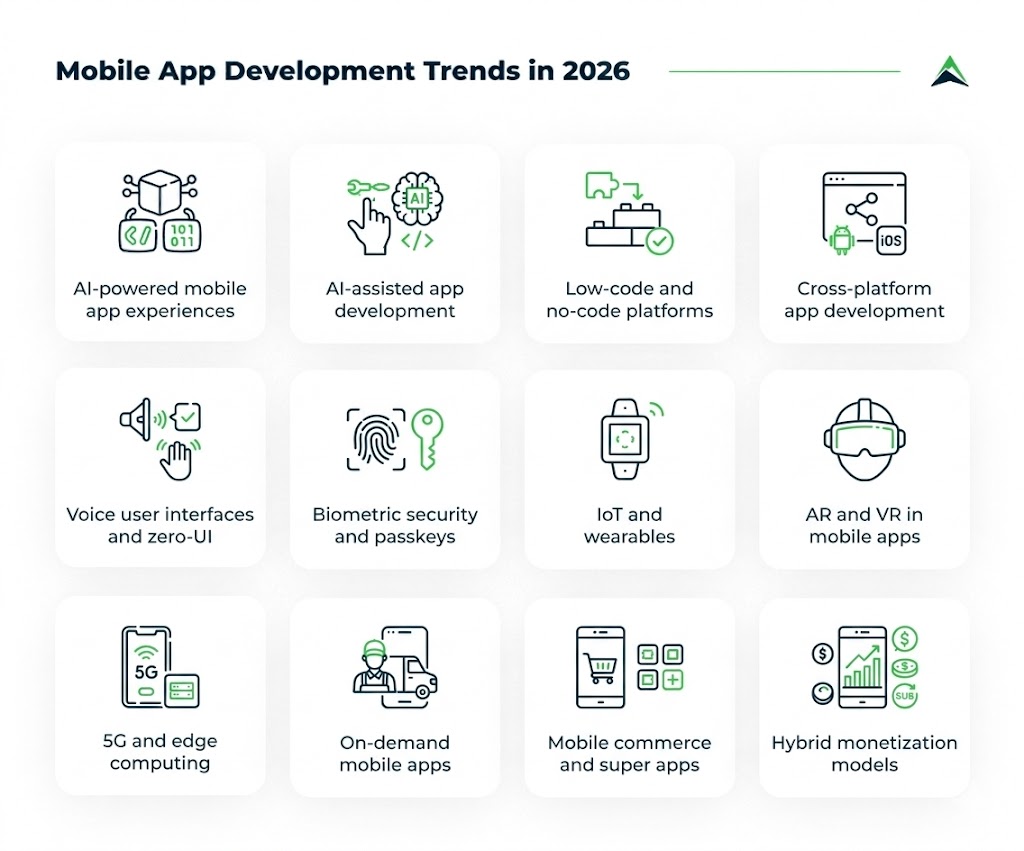
The most impactful trends include on-device AI and edge intelligence, cross-platform frameworks, low-code/no-code platforms, privacy-first security with passkeys and zero-trust design, IoT and wearables integration, AR and spatial computing, mobile commerce with embedded finance, and cloud-native edge computing.
How to create a successful mobile app in 2026?
For startup entrepreneurs, business owners, and investors looking to build an impressive smartphone application, the path to success in 2026 requires foresight that stems from the mobile app industry trends.
At the same time, they must provide real value to users through appealing design and functionality that enhances their lives.
How much does it cost to develop a mobile app in 2026?
Mobile application development costs depend on many factors, such as application features, total scope of work, technologies used, team size, and commitment period.
Will AI replace mobile app developers?
While AI has made tremendous progress in recent years, it cannot handle the complexity of modern app development that requires creative, analytical, and social skills.
AI tools like GitHub Copilot and Cursor accelerate development and improve code quality, but they cannot replace the strategic thinking, user empathy, and architectural decisions human developers provide. AI is a productivity multiplier, not a replacement.
Read also:
About the author:

Oleg Roberman, Chief of Delivery at Eastern Peak
With strong technical background and outstanding project leadership skills, Oleg helps Eastern Peak customers introduce competitive advantages and instill productive changes in every process by resolving complex business issues and managing multicultural teams through innovation and creative thinking.