Manufacturing software is one of the faster-growing segments in industrial tech. The global manufacturing operations management software industry is booming: already having exceeded $23 billion in 2026, it’s expected to more than double by 2031, reaching $52.59 billion.
The need for such technology has grown amid rising operational costs and unstable supply chains. Manufacturing software improves efficiency, helps maintain equipment, tracks production resources, and reduces downtime. Businesses that want to boost overall manufacturing output and ensure stable schedule management while maintaining quality will want to invest in a system that does it for them.
Below, we cover the main types of manufacturing software, its benefits, challenges, and how to build such a tool.
What is manufacturing software development?
Manufacturing software development is the structured process of designing, building, and maintaining custom software solutions that manage floor operations, optimize the supply chain, improve production, or do several of these at once.
Because every production business has its own needs, personalized manufacturing software can solve the exact issues a company faces. This client-centric tailoring creates a centralized data point for all manufacturing procedures, integrates smoothly with the business’s software, and offers far greater flexibility. Custom software can also change when processes do, something off-the-shelf tools rarely allow.
What are the main types of software used in manufacturing?
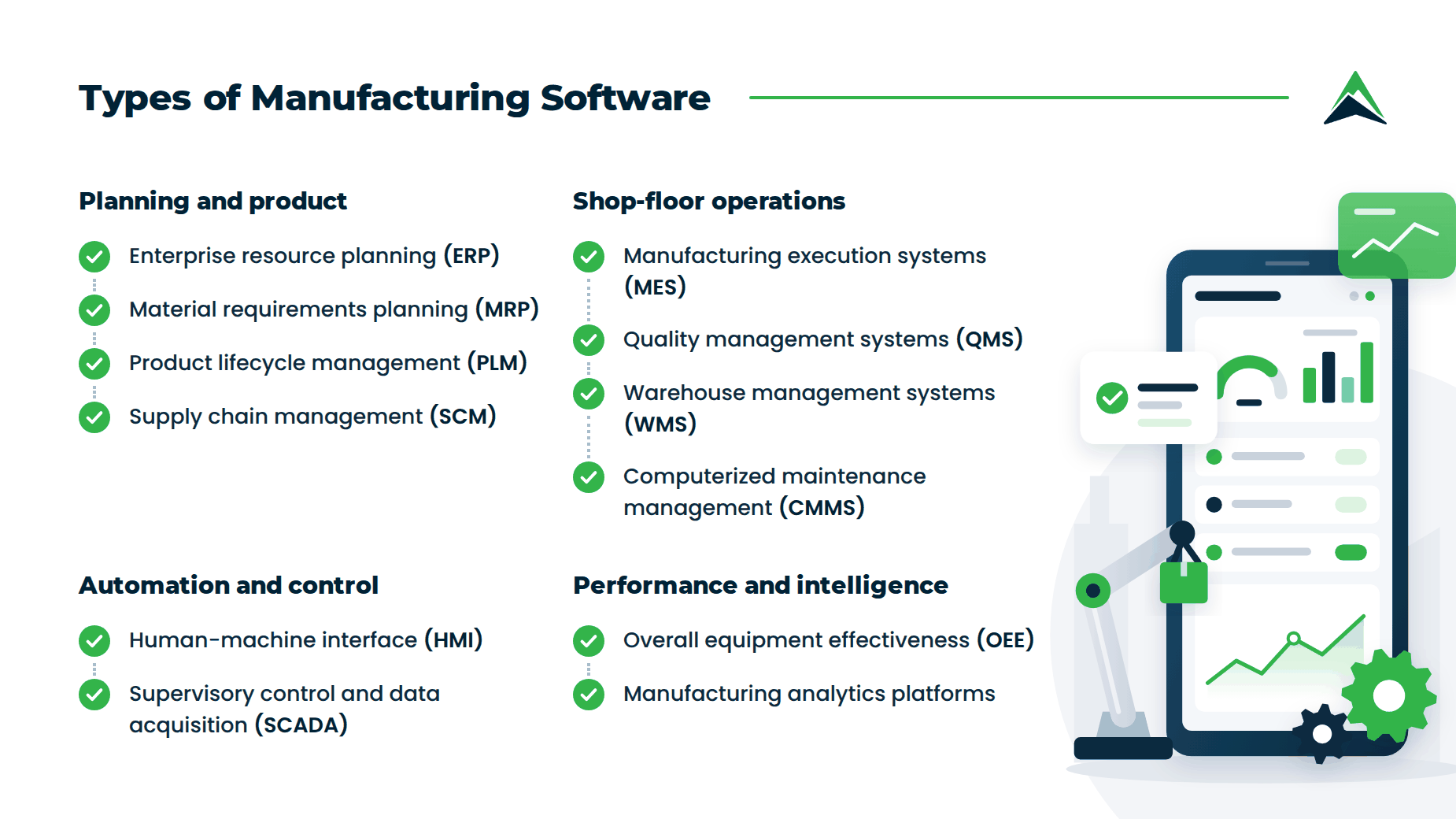
Manufacturing software falls into four groups by function: planning and product, shop-floor operations, automation and control, and performance and intelligence.

Planning and product
- Enterprise resource planning (ERP). ERP centralizes necessary financial, operational, and production data across the entire business and stores it in a unified system. Already, the manufacturing ERP market is valued at $6.36 billion in 2026 and is projected to reach $10.17 billion by 2031 — the numbers are much higher for the broader ERP industry. Manufacturing software development services help businesses build tools that provide end-to-end visibility into production, cash flow, resource movement, and more, depending on their needs.
- Material requirements planning (MRP) and production scheduling. These systems calculate material needs based on sales forecasts and stock levels and schedule production. The MRP software market is $7.7 billion in 2026. It is estimated to almost double to $14.9 billion by 2035. This technology reduces extra spending and ensures that production aligns with what a business needs. This is valuable during unstable supply chains and shifting demand.
- Product lifecycle management (PLM). This manufacturing software manages a product’s entire lifecycle from beginning to end (concept, design, sale, and retirement). The PLM software market is expected to grow from almost $30 billion in 2026 to $55.61 billion by 2034. Businesses implementing PLM tools reduce rework time, speed time-to-market, and achieve far superior manufacturing outcomes.
- Supply chain management (SCM). SCM tracks procurement, logistics, and supplier arrangements to ensure safe, timely delivery of materials and products. Although numbers for manufacturing SCM systems aren’t available, the larger market for such software is vast — more than $36 billion in 2026. In manufacturing, SCM gives teams access to vendor metrics and real-time freight status, so they can plan around late shipments before they stall a line.
Shop-floor operations
- Manufacturing execution systems (MES). Industrial development builds systems that track production in real time directly on the factory floor. The MES market is $18.61 billion in 2026 and is expected to reach $56.65 billion in 2034. By implementing MES, enterprises get real-time updates on each procedure, operator output, and job completion.
- Quality management systems (QMS). They evaluate batch quality and standardize compliance checks, helping businesses identify defects and respond quickly if errors occur. Since companies already need tools to address this painful error, the market size of $11.73 billion comes as no surprise. QMS reduces liability risks and lowers customer return rates, essentially protecting business reputation and reducing scrap costs.
- Warehouse management systems (WMS). WMS enhances internal storage by tracking locations and handling pick-and-pack and delivery procedures. While the WMS market is $4.77 billion in 2026, its CAGR of nearly 18% is expected to reach nearly $11 billion in just 5 years. By managing inventory and optimizing routes, WMS reduces labor costs and prevents shipping delays — one of the key priorities for any manufacturer.
- Computerized maintenance management systems (CMMS). This software centralizes all maintenance operations within the manufacturing facility. With a size of $1.62 billion in 2026, CMMS will grow to $3.82 billion by 2034. CMMS addresses a significant issue in manufacturing — equipment downtime and high repair costs. With CMMS, enterprises can take measures to maintain their tools before they break down. This moves maintenance from simply reactive to predictive.
Automation and control
- Human-machine interface (HMI). It ensures human-machine communication by letting operators interact with equipment through touchscreens, panels, and other control tools. The HMI industry is steadily growing as the technology improves: from $5.82 billion in 2026 to $8.29 billion in 2031. This technology reduces human error on the assembly floor and simplifies machine operations by minimizing the learning curve for complex machines, improving safety and control.
- Supervisory control and data acquisition (SCADA). This software monitors and controls industrial processes using sensors and controllers across the plant. The market for SCADA exceeds $12 billion in 2026; it’s projected to reach $18.58 billion by 2031. This solution gives plant managers full control over the factory’s systems and operational stability, while they can keep track of safety and performance risks.
Performance and intelligence
- Overall equipment effectiveness (OEE) software. It analyzes equipment performance and productivity, supporting long-term reliability. In 2023, the OEE industry size was evaluated at $67.5 billion and is projected to exceed $122 billion by 2028. With this tool, plant owners can tap into equipment performance and quickly learn when it fails.
- Manufacturing analytics platforms. This solution gathers information from MES, SCADA, ERP, and IoT sensors to maintain a comprehensive understanding of production performance, errors, and quality. It reached $16.64 billion in 2025 and has a CAGR of 24.1% — an acceleration promising centralized monitoring for manufacturing. Such a platform provides historical data and helps project expenditures, predict failures, and invest in specific points across the entire manufacturing process.
Benefits of custom manufacturing software
Although existing manufacturing software solutions come at a lower price, they do not provide the benefits a custom technology provides: greater control over functionality, seamless connection, and unlimited growth potential.
- Real-time production visibility. Plant managers have 24/7 access to production performance, so they see how equipment and crews perform together. Real-time data is far superior to generic monthly reports: custom solutions show what works and what fails without complex analysis. This helps plant managers prevent severe errors. They can reorganize operators’ shifts or pinpoint moments of equipment issues before production stalls. A customized solution taps specifically into the features each manufacturing plant has and prioritizes metrics relevant to a business.
- Less unplanned downtime. Machinery is less likely to break down because the software tracks component health and flags abnormalities. With custom technology designed for your business, the entire analysis process is built around your workflows. Manufacturing software developers build a tool that understands the abnormalities of each manufacturing plant and accounts for trends an off-the-shelf program might miss.
- Fewer defects. Quality management tools and real-time tracking devices minimize human error by logging warning signals across the entire ecosystem rather than relying solely on manual inspection. Custom software integrates automated sensor checks and system input where a business owner wants it, based on where and how critical equipment is stored and where the problem is suspected.
- Audit-ready traceability. Custom manufacturing software gives full ownership of production data with end-to-end digital traceability and supports industry-specific compliance. It gives a full-depth view of every product, from data on raw materials to operator actions. Because manufacturers in different industries need specific compliance documentation, a custom solution is built with those regulations in mind.
Technologies powering modern manufacturing software
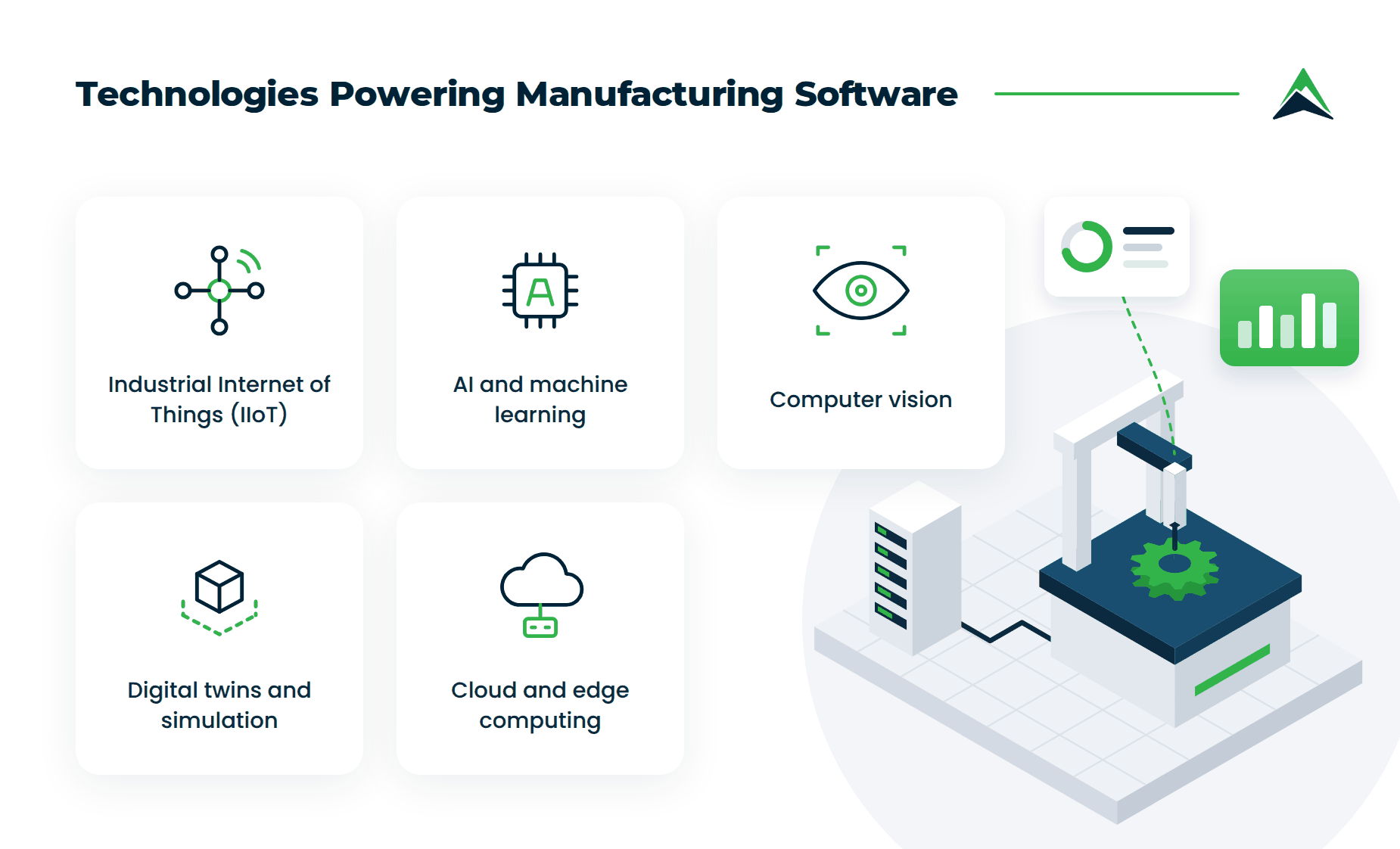
Today, software for manufacturing is powered by layers of technologies that maximize productivity and production quality.

Industrial Internet of Things (IIoT)
IIoT connects all the sensors, dashboards, machines, and other equipment into one database. Deloitte’s survey of 600 manufacturing companies’ executives in the U.S. found that, already, 46% of them use IIOT at the facility or network level.
This access to data powers predictive maintenance and gives a clear baseline for energy and labor use.
Artificial Intelligence (AI)/Machine Learning (ML)
AI and ML cover a broad range of uses in manufacturing: they analyze historical data to help with demand forecasting, automate production schedules, predict machine breakdowns, and even deploy autonomous agents for specific tasks.
All of these tools are being used in manufacturing. To illustrate, Gartner forecasts that 40% of all enterprise applications will embed task-specific AI agents by the end of 2026 — this is a surge from 5% in 2025. This data reflects changes growing in manufacturing as well.
The overall increasing integration of AI/ML into manufacturing already makes the system more adaptable and responsive.
Computer vision
Systems using computer vision utilize high-resolution cameras and deep learning visual models to inspect products’ (or their parts’) quality on the assembly line. This significantly shortens evaluation time and helps identify defects, flaws, or structural variances.
By catching sub-surface micro-cracks or tiny errors instantly, these systems help plant owners prevent entire product line recalls and minimize scrap volumes.
Digital twins and simulation
A digital twin is a virtual replica of an existing machine, production line, or factory. It simulates performance under realistic stress, testing how it will fare against real-life challenges.
This solution is especially vital in manufacturing, where simulation can prevent multiple million-dollar errors by letting teams safely test specific equipment or conditions.
Cloud and edge
Cloud architecture provides scalable data storage, and edge computing lets operators process information locally to reduce latency for real-time decisions. Deloitte’s report states that 57% of the U.S. manufacturers it surveyed used cloud computing since it allows fast scaling and is perfect for storing and managing immense volumes of information.
At the same time, edge computing has become irreplaceable for many because it keeps assembly lines running even during internet outages.
How to build manufacturing software: step-by-step
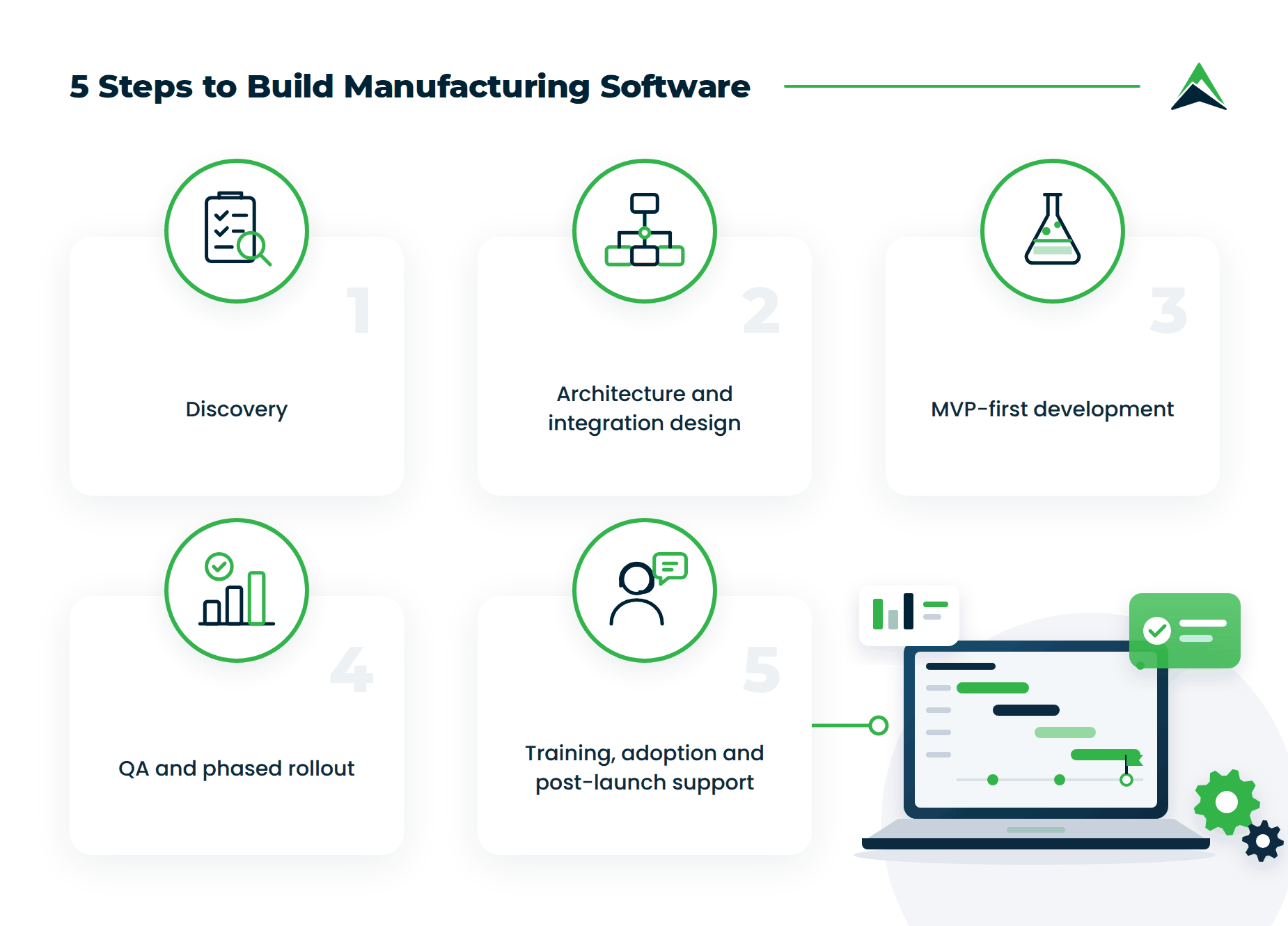
- Discovery. During this phase, the team identifies the core problem, defines a specific solution, maps the shop-floor workflow, and sets technical requirements. Engineers and analysts observe production lines, document material flow, and examine legacy software. This goes beyond just having an idea — it defines measurable project KPIs and decides on the product’s ROI.
- Architecture and integration design. Software architects define the system’s overall structure, select cloud and edge setup, and design secure APIs. Doing so will determine the long-term resilience and scalability of the system, so this step makes sure it functions and connects well.
- MVP-first development. Developing a minimum viable product (MVP) means building the main functions first and testing them on a single production line or facility before committing to factory-wide deployment. An MVP deploys the main features to a controlled environment to test how effective the solution is.
- QA and phased rollout. Here, developers test software stability in simulated and live environments. Any error on a manufacturing line can paralyze an entire plant operation or schedules, so QA requires continuous load testing, simulations, and user acceptance testing (UAT) with machine operators. A phased rollout, in turn, lets executive teams retain rollback capabilities and supports a gradual transition for the entire plant.
- Training, adoption, post-launch support. Post-launch success depends on operator training, ease of adoption, and long-term software support. On-shift help during the first weeks and regular maintenance after launch keep the system in daily use.

Challenges to plan for
When investing in new custom software for manufacturing, manufacturers need to account for specific issues related to integration of new technology into the industrial processes, operators’ schedules, and legacy machines, all while ensuring quality and security.
Connecting legacy machines with no digital output
When introducing manufacturing software, manufacturers must coordinate the installation of external sensors, industrial gateways, and edge protocol converters to connect legacy machines with new solutions.
It’s not viable to simply replace heavy capital machinery just because it lacks native digital connectivity. Instead, businesses need to learn to extract actionable data from decades-old equipment while preserving its efficiency.
Operational technology (OT)/IT security and network segmentation
Connecting OT on the shop floor with IT enterprise networks creates significant cybersecurity risks. For instance, around 90% of manufacturing organizations are concerned with security associated with cyberattacks alone.
Integrating new tech is associated with exposing the entire system to multiple risks, including unauthorized network access, malware and ransomware threats, and supply chain vulnerabilities. Once physical plant controls connect to the cloud or corporate network, they expose the whole system. Network segmentation, zero-trust access for third-party vendors, and continuous threat monitoring become necessary.
Operator adoption on the floor
Workers may resist new technology or struggle with adapting to it. Executive leaders should anticipate this and be ready to provide training and support, as well as ensure that the technology is easy to adapt to.
Data quality and standardization across plants
Scaling software introduces data governance challenges because of different reporting standards or inconsistent tech usage. Standardizing data governance guidelines is vital — this includes defining metrics, standardizing data schemas, and calibrating technology according to specific benchmarks.
Making this adjustment early on will build a reliable system that handles data with the necessary accuracy.
How much does manufacturing software development cost?
The cost of software for manufacturing companies depends on particular features of a manufacturing plant, the technology behind the solution, and team specifics.
- Type and complexity of the system. A tool with one function costs less than a solution that covers multiple functions across all plant levels. While the price of specific types of software is determined by the developer team, the scope of the solution can provide a good estimate of whether the desired tool will require more expenses.
- Number of facilities/lines. Expanding across multiple plants will undeniably cost more than launching the software across a single line — the more locations are involved, the more costly a project will be. Each additional workstation or PLC adds to the cost of the development.
- Integrations. The more integrations are needed, the higher the development spending will be.
- Hardware and sensors. Manufacturing depends on plenty of hardware, and the more a plant requires, the higher the price. Systems that process real-time telemetry, high-speed computer vision feeds, or digital twin models are costly since they require specialized hardware and local server configurations.
- Compliance. If the company operates in a highly regulated industry, there must be budget for strict security compliance and validation documentation.
- Team location. The location of the manufacturing software development company determines pricing. Sourcing development specialists in North America or Western Europe costs more, while finding skilled tech companies in Eastern Europe costs far less.
Manufacturing and industrial solutions in Eastern Peak’s portfolio
Eastern Peak builds software and connected hardware for manufacturers and industrial technology companies. A few examples from our portfolio:
- Control-system design software for Industry 4.0 engineering. An engineering SaaS company needed a platform where engineers design and program the control systems that run industrial facilities, such as power plants and water systems, in plain English instead of code. Working as a dedicated team over a long engagement, we built the design software, including logic verification and an embedded emulator, so engineering teams get to market faster.
- IoT retrofit module for industrial pumps. A manufacturer of non-electric volumetric pumps used in agriculture and water sanitization had equipment in the field with no way to control it remotely or collect usage data. We designed an IoT retrofit module that adds remote monitoring and control to the existing pumps.
- Mobile apps for a battery-free IoT sensing platform. A semiconductor company building passive, battery-free chips for IoT needed apps that detect nearby tags and show their sensor data. We built the iOS and Android apps that find the tags and pull their readings from the cloud. Because the tags need no batteries, the model scales to tracking goods and assets across large sites, factory floors included.
Unlocking your digital advantage
As the manufacturing industry accelerates, so should software solutions. Manufacturers that want to keep pace need software built around their own processes and the standards their markets now expect.
Reliable manufacturing software that meets a company’s needs delivers more than a competitive advantage — it helps business owners build an agile, scalable enterprise that uses the practices and tools of a market leader.
Deciding where to begin the upgrade? Contact us — we’ll review your current systems and design a solution that solves your unique pain points.
Frequently Asked Questions
What is manufacturing software?
Manufacturing software is a technological solution designed to monitor and improve production operations, scheduling, and asset management.
What types of software are used in manufacturing?
Manufacturers use different software for different jobs.
The most common are ERP for business resources and orders, MES for tracking production on the shop floor, PLM for product data, QMS for quality, CMMS for maintenance, WMS for inventory, and SCADA and IIoT platforms for monitoring equipment. Many plants also add analytics or AI tools for OEE tracking and predictive maintenance.
How much does it cost to develop custom manufacturing software?
Prices for custom manufacturing software vary depending on tool complexity, number of integrations, security factors, and team location.
Should manufacturers buy off-the-shelf software or build custom?
It depends on what they need. While an off-the-shelf solution can be a good middle ground when manufacturers are tight on money or time, custom manufacturing software development provides a distinct competitive advantage for their unique workflows.
Read also: