The software development landscape is currently undergoing a structural transformation comparable to the shift from assembly language to high-level programming. We’re entering what some call “No-Code 2.0,” an era where generative AI can build actual working software from plain English prompts. Unlike the last decade’s drag-and-drop tools, these AI app builders write real code for you.
At the same time, the broader “build-without-traditional-coding” market is growing fast: Gartner forecasts the low-code application platform market will reach $16.5B by 2027 (16.3% CAGR from 2022–2027).
Leading this charge is Lovable, a platform that has captured the imagination of founders and product managers by promising to convert ideas into deployed applications in days rather than months. AI builders are revolutionary for rapid MVP validation, but they create an illusion that traditional engineering is no longer needed.
Notably, this doesn’t mean AI is replacing software development altogether. Even within traditional engineering teams, AI is increasingly used as an assistive layer: Stack Overflow’s Developer Survey reports that 84% of respondents are using or planning to use AI tools in their development process (up from 76% in 2024).
In the following sections, we’ll explore what Lovable does, its benefits and limitations, and how to know when it’s time to graduate from an AI-built MVP to a robust, custom-engineered product.
What Lovable is and how it works
Lovable is an AI-powered app builder that converts natural language prompts into a working web application without the user writing any code. In practical terms, Lovable acts like an AI cofounder – you describe what you want (in plain English or by providing examples), and it generates the frontend and backend of your app.
Lovable produces standard React and Supabase code under the hood, meaning your app is built on familiar frameworks (React for the UI and Supabase/Postgres for the database). You essentially build by conversation: explain what your application should do and how users interact, and the AI creates a functional app that you can test and refine through dialogue.
When a user inputs a request, such as “create a dashboard for tracking sales leads,” the system performs a complex orchestration of tasks. It parses the request to understand the necessary data entities, generates the corresponding database tables in Supabase (a PostgreSQL-based backend), creates the API endpoints to interact with that data, and writes the frontend React code to display it.
This process, often termed “vibe coding” by enthusiasts, relies on the AI’s ability to predict the next logical step in a development sequence. It is effective for standard patterns. Most web applications share a common DNA: they create, read, update, and delete data (CRUD).
AI models have ingested billions of lines of such code and can reproduce it with high fidelity. This allows Lovable to generate the “skeleton” of an application, including authentication flows, basic data entry forms, and listing pages, almost instantaneously.
Benefits of using Lovable
AI builders shine when you just need to test an idea or prototype a feature quickly. Building an MVP with Lovable offers advantages in the early stages.
Rapid MVP Creation
Traditional MVP development is a linear process involving requirements gathering, design, prototyping, development, testing, and deployment. In practice, this cycle often takes weeks to months. With AI builders like Lovable, you can often get a testable prototype in days.
Lower initial costs
Traditional software development for an MVP can cost tens of thousands of dollars in developer salaries or contracts. Lovable, in contrast, operates on a subscription (starting from $25–50 per month), plus usage of any integrated services.
This affordability makes it viable to test several ideas or features without betting the whole company on one approach. It’s no surprise that many cash-strapped startups and SMEs see AI builders as a shortcut to MVP – you get an app in users’ hands quickly and cheaply, then only invest big once you see real traction.
Visualizing the intangible
One of the most powerful benefits is the ability to create a “visual spec.” Even if the intention is to eventually build custom software, starting with Lovable provides a tangible reference point. It is often difficult for non-technical stakeholders to articulate exactly what they want.
By iterating on a live app, they can discover requirements that would have been missed in a paper specification document.
No-code-like simplicity for non-technical founders
Lovable’s interface doesn’t require programming knowledge. You describe what you need in plain language, and the platform handles the coding. The learning curve is relatively gentle. This empowers domain experts and business-minded founders to bring their vision to life without recruiting technical cofounders or outsourcing development right away.
The “visual” edge
Finally, using Lovable gives you a polished UI and prototype to showcase, which can be valuable for pitching or user testing. The platform leverages modern UI frameworks, so the resulting app looks like a professionally developed product
In summary, Lovable shines in the MVP phase by providing speed, cost-efficiency, approachability, and flexibility.
Limitations of Lovable and other AI app builders
Despite the tremendous promise of AI app builders, they come with significant limitations – especially once you push beyond a basic prototype. Founders must understand these constraints to avoid painful surprises down the road.
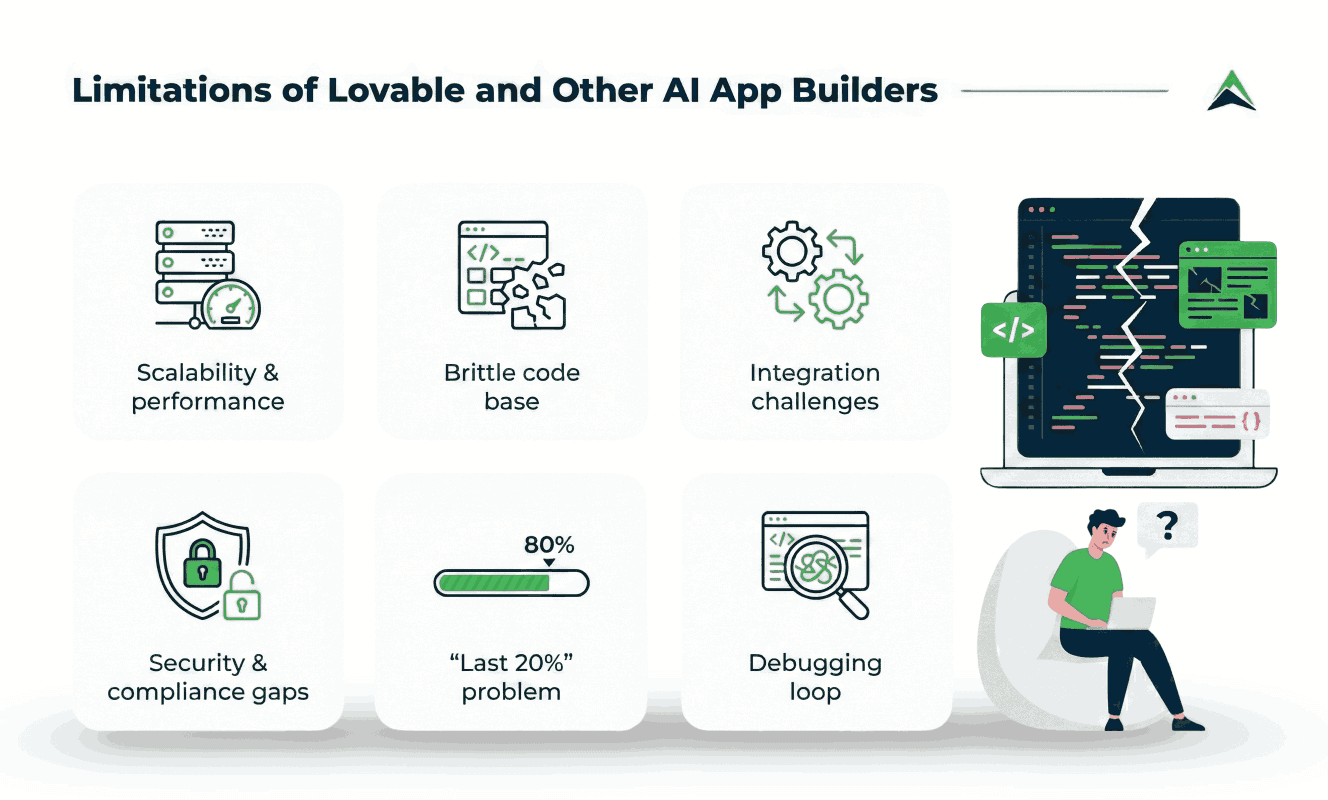
- Scalability & performance: AI-generated prototypes usually assume simple usage and infrastructure. They may use default schemas or basic cloud setups that can break under heavy traffic. If your app hits thousands of users, you may encounter bottlenecks (slow queries, UI lag) that the out-of-the-box code can’t handle gracefully. Custom architecture or optimized services are often needed once you scale.
- Brittle code base: Auto-generated code can be challenging to maintain. It may use unusual patterns or combine layers in ways a human developer wouldn’t. Refactoring or extending this code often feels fragile: one change can introduce bugs elsewhere. In a sense, you trade upfront speed for a codebase that requires expert care later.
- Integration challenges: Connecting to third-party services via API is a standard requirement. Lovable handles simple integrations well (e.g., standard Stripe checkout). However, dealing with legacy APIs, SOAP endpoints, or services with complex authentication flows (like OAuth 2.0 with refresh tokens) creates significant friction.
- Security & compliance gaps: You’ll likely need to audit the generated code for security holes, missing validation, or outdated libraries. A 2025 report found that 45% of code samples generated by AI contain security vulnerabilities. Moreover, compliance (like GDPR or HIPAA) is rarely handled automatically. Startups in regulated fields can’t rely on AI to enforce legal standards out of the box.
- “Last 20%” problem: AI can churn out the bulk of an MVP quickly, but the final stretch of polish is often slow. Uncommon features (complex business rules, customized dashboards, special payment logic, etc.) may stump the AI. As a rule of thumb, you might get 70–80% of a basic app done fast, but finishing the rest often requires more time than you expect.
- Debugging loop: AI fixes can be frustratingly recursive. You might prompt for a change, the AI botches it or introduces new bugs, and you end up in an “infinite debugging loop.” Each iteration consumes credits and time, undermining the speed advantage.
In short, AI builders give you a fast launch, but they can leave you facing scalability or technical debt down the road. By contrast, most custom-built startups plan their architecture for the future, avoiding these surprises.
When to move beyond Lovable
How do you know when it’s time to graduate from an AI-built MVP like Lovable to a custom-engineered solution? Look for these clear signs:
- You’re gaining real traction with users or revenue. If you have paying customers and a growing user base, you need an infrastructure that can reliably support them. If you’re growing fast, you can’t afford a fragile backend or frequent bugs.
- Running into performance limits. You might notice performance is becoming an issue (pages loading slower, occasional downtime) as more users onboard. If you’re at the point where outages or slow responses could cost you revenue or users, it’s a strong signal to invest in a more robust, custom backend.
- Facing complex architecture needs. If your product needs microservices, advanced data processing, or bespoke integrations (legacy systems, custom APIs), a generic AI prototype won’t suffice. Building a tailored architecture becomes critical.
- Meeting investor and stakeholder expectations. VCs and savvy stakeholders typically expect a maintainable codebase. In technical due diligence, they want tests, documentation, and a clean architecture. When you’re fundraising or eyeing Series A, custom engineering is often non-negotiable.
In essence, once testing turns into business, the returns on professional development skyrocket. AI-built prototypes can validate ideas cheaply, but a thriving startup needs a solid technical foundation.
Why custom software development beats AI for scale
When your startup is ready to scale, custom software development becomes far more attractive despite the higher initial effort. It’s best seen as an investment in the future of your product – an investment that brings benefits AI-built platforms simply can’t provide at scale.
Here’s why going custom usually wins in the long run:
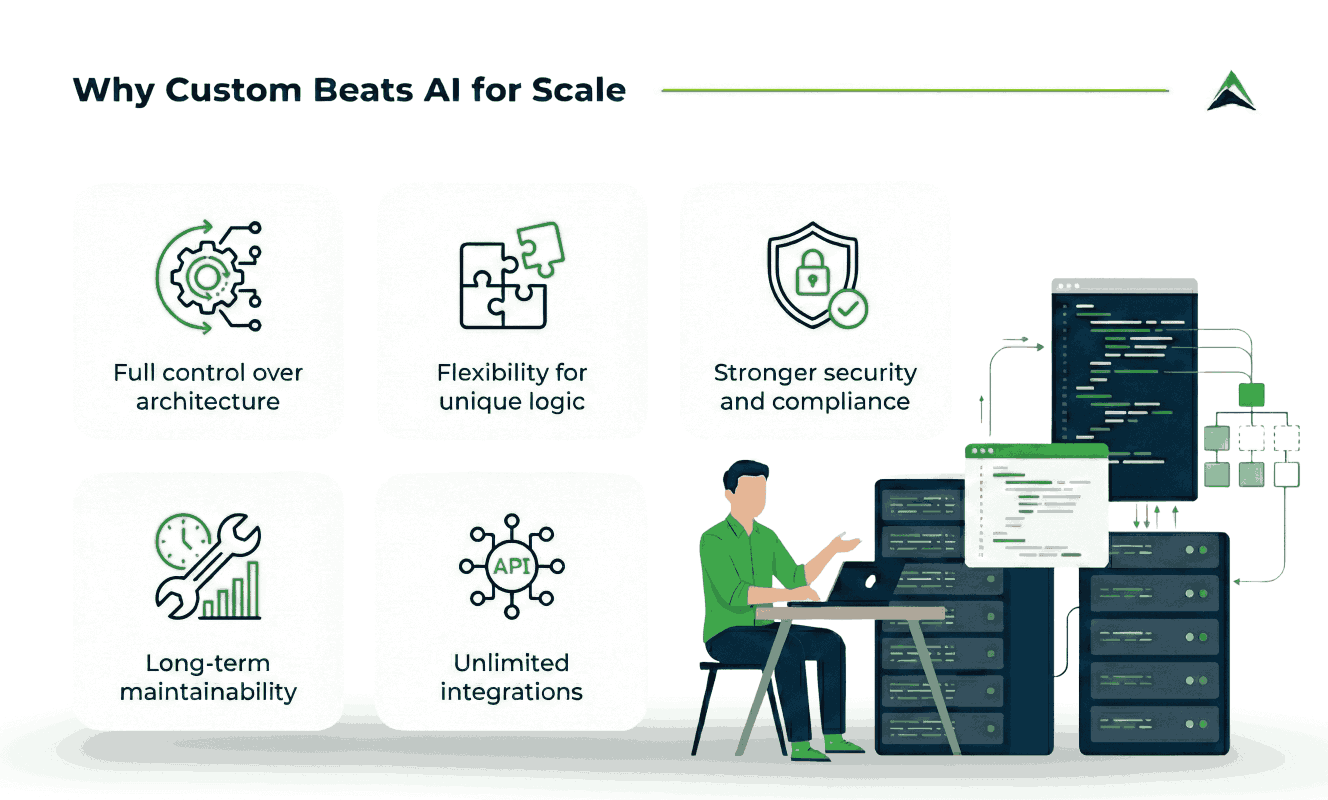
- Full control over architecture: With a custom-built application, your development team has complete control over how the system is designed. This means they can choose the optimal architecture, database, and services tailored to your specific use case.
- Flexibility for unique logic: Your product might require specialized algorithms, sophisticated business rules, or integrations that no AI can anticipate. Handcrafted code can implement whatever you need, however unusual.
- Stronger security and compliance: No-code platforms often have generic security that may not meet industry standards. Custom development allows you to meet strict compliance requirements because you can certify each component (database encryption, logging, audit trails) as needed. For enterprises or heavily regulated markets, this is non-negotiable.
- Maintainability and planning: A professional codebase with proper documentation, testing, and architecture makes future updates predictable. Engineers can build new features without worrying whether each change will break something unrelated. This confidence is crucial when the app must evolve.
- Freedom of integration: You can choose any third-party services or legacy systems to integrate, without being limited by the AI platform’s connectors. Whether it’s a specific CRM, IoT device, or on-premise system, you can make it work.
These benefits are also supported by industry analyses. For example, McKinsey notes that tech debt can account for 20–40% of a company’s entire technology value. Rushing development can bury you under technical debt that drags down agility and increases costs later.
From validation to scale: the challenge of moving off AI platforms
Let’s say you’ve built an MVP with Lovable, gotten positive validation, and now you’re convinced it’s time to rebuild for scale. Many founders in this position face a hidden cost of success: the process of moving off an AI platform can be challenging. It’s important to anticipate these challenges so you can mitigate them.
The cost of the ‘start over’ strategy
There is a common assumption that an AI-built prototype can be gradually refactored into a production-ready application. In reality, the architectural decisions made by the AI often make refactoring impossible.
- Client loss: Moving users from an AI-built system to a new platform is rarely seamless. Users might have to sign up again or reset passwords; some of their data might not migrate cleanly if the schema changes; there could be new bugs in the rebuilt version that didn’t exist before. These disruptions frustrate users, and you risk losing some of the very traction that prompted you to rebuild in the first place.
- The ‘feature freeze’: During the rebuild period, teams typically pause new feature development to keep the product stable, reliable, and secure, and not to lose users. While your team focuses on re-engineering the backend, your competitors might continue adding features or improving their products.
- Wasted budget: The initial savings from using an AI tool are offset by the full cost of custom development later. Teams effectively pay twice, once for fast validation and again for a production system capable of supporting growth.
How our AI-MVP experience bridges both worlds
At Eastern Peak, we’ve seen both the incredible upsides of AI-built MVPs and the headaches of scaling them. That’s why we’ve developed a hybrid approach that combines the best of both worlds – using AI to speed up development and employing solid engineering to ensure scalability. Many founders don’t want to choose between two extremes; they want both speed and a solid technical foundation.
In practice, our AI-MVP approach looks like this:
- Start fast: We use AI to accelerate the labor-intensive early steps, creating user flows, drafting UI prototypes, and establishing functional skeletons. This allows us to move through requirements and scoping and design at least three times the traditional speed.
- Build right: Senior engineers are essential to the process, overseeing it from the start to ensure the foundation is sound. With more than 15 years of experience delivering large, enterprise-grade software projects, we bring the practical knowledge needed to make the right architectural, data, and security decisions from the start. This ensures that the AI-generated MVP skeleton is transformed into a stable, production-ready system built to scale.
- Avoid debt: We provide full code ownership with no vendor lock-in and no “black box” mechanics. We deliver production-ready code that any developer can read and maintain.
- Scale smoothly: Because the system is built on standard engineering principles, the MVP doesn’t need to be rebuilt from scratch when you grow. We develop a post-MVP scaling plan and architecture roadmap together with you to ensure you are ready for Phase 2 feature evolution.
In short, we use AI as a tool in service of engineering. This way founders get exactly the fast delivery that Lovable promises, but it’s built on a foundation that Lovable alone struggles with. The result is an MVP that’s investable and scalable from the outset.
Conclusion
AI-built MVPs are changing how founders explore ideas, letting them put early versions in users’ hands almost immediately and gain clarity far faster than traditional development allows. Speed is valuable, but AI prototypes can be fragile, hard to extend, and limited when the product grows. Without a solid foundation, what starts as a promising experiment can quickly turn into technical debt.
Combining AI with thoughtful engineering offers a path that avoids these pitfalls, allowing teams to leverage the rapid iteration and experimentation that AI enables while building maintainable, readable code that can evolve alongside the product.
AI handles repetitive tasks and accelerates early development, while human oversight ensures the architecture, data models, and integrations are robust and scalable. This hybrid approach balances speed and stability, giving founders confidence that their first version is not just a prototype but a platform ready to grow.
Not sure how to turn your idea into a secure and scalable product? Our team knows how to combine AI speed with solid engineering to build products that are ready to grow. Reach out to us to get started.
Lovable is an AI-powered no-code app builder that turns natural language prompts into a functional web application. Yes, to an extent, but there are caveats. As traffic, data complexity, and security requirements increase, teams often encounter architectural and performance limitations that require a partial or full rebuild. Lovable performs well with standard workflows and common application patterns. Complex business logic, custom integrations, and edge-case-heavy processes usually require manual engineering, as AI-generated code becomes harder to extend and maintain in these scenarios. Alternatives include other AI and no-code platforms, as well as hybrid approaches that combine AI-assisted development with professional engineering. Hybrid AI MVP models offer faster delivery compared to traditional development while providing a scalable, maintainable foundation.Frequently Asked Questions
What is Lovable?
Can you scale a Lovable-generated app?
Can Lovable handle complex business logic?
What are alternatives to Lovable?
Read also:
About the author:

Alexey Shalimov, CEO at Eastern Peak
As CEO at Eastern Peak, a professional software consulting and development company, Alexey ensures top quality and cost-effective services to clients from all over the world. Alexey is also a founder and technology evangelist at several technology companies. Previously, as a CEO of the Gett (GetTaxi) technology company, Alexey was in charge of developing the revolutionary Gett service from ground up and deploying the operation across the globe from New York to London and Tel Aviv.