The logistics software market is steadily growing: valued at more than $17 billion in 2026, it is estimated to reach $31.74 billion by 2034. With a CAGR of 7.75%, it is set to expand further due to e-commerce adoption, higher customer expectations, and the globalization of commerce.
Regardless of size, businesses are considering custom logistics software as a competitive advantage because it addresses their unique challenges and modernizes logistics and supply chain infrastructure.
This article answers the “What is logistics management software?” question, explains the types of software available, and covers the steps and costs involved in building it.
What is logistics software development?
Logistics software development is the process of designing, building, and maintaining software that automates inventory control, optimizes fleet routes, and improves storage efficiency.
Managing logistics is a challenge in itself, so businesses choose custom logistics software to deliver solutions that support their operational goals. They often come with complete data ownership and seamless integration, too.
Types of logistics software
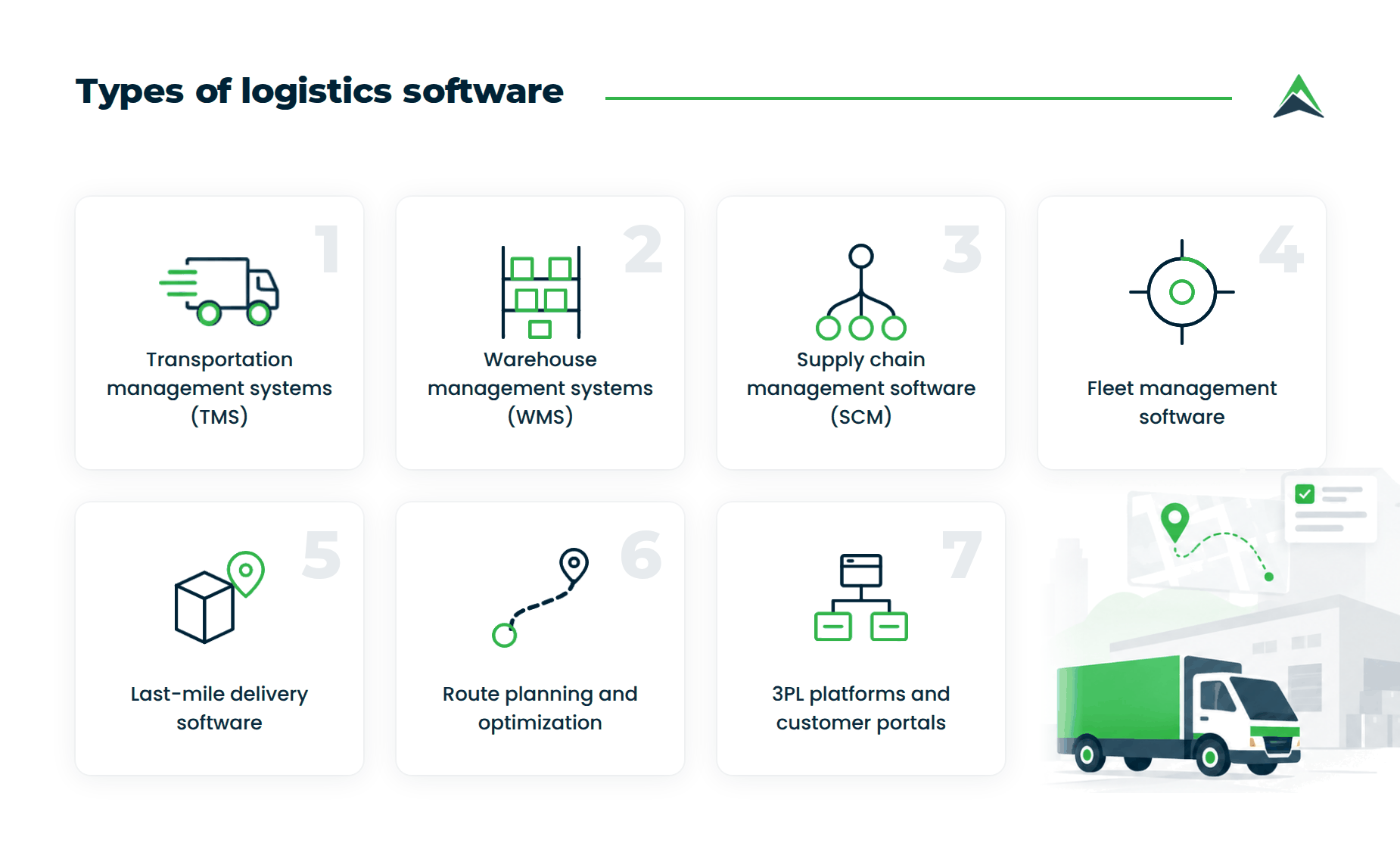
Businesses that specialize in logistics software development services create software that optimizes fuel efficiency, manages warehouses, coordinates supply chains, and powers customer portals.
Transportation management systems (TMS)
TMS is software that optimizes the physical movement of goods. With an impressive CAGR of 17.8%, the TMS market reached around $18.6 billion in 2025 and may well grow to $21.8 billion by the end of 2026. TMS automates critical logistics tasks (e.g., routing vehicles or consolidating shipments) to save time compared with manual coordination.
Their key capabilities include dynamic route optimization, carrier and freight management, real-time shipment tracking, multi-modal transportation support, and AI-powered demand forecasting, to name a few. This solution is most needed by manufacturers and freight shippers, e-commerce and retail distributors, and enterprises handling complex multi-carrier networks.
Warehouse management systems (WMS)
WMS offers effective inventory placement, streamlines order picking, and grants real-time visibility into stock movements. The WMS market is expected to reach almost $4.5 billion in 2026 — a considerable increase from $3.88 billion in 2025.
WMS tools can support inventory tracking, improved pick-and-pack strategies, labor and task management, and dynamic space and putaway management. Retailers and e-commerce brands, third-party logistics providers, and manufacturing facilities often use WMS to enhance their warehouse operations.
Supply chain management software (SCM)
SCM is a digital ecosystem that controls the movement of goods by centralizing data across suppliers, manufacturers, and warehouses. The SCM industry is on the rise: it hit close to $63 billion in 2025 and is projected to exceed $103 billion by the end of 2030.
Modern SCM can do AI-driven demand forecasting, supplier and order management, instantaneous inventory and warehouse updates, analytics, and integration with other platforms. It’s most in demand among global manufacturers, multi-channel retail and distribution companies, and consumer packaged goods (CPG) companies.
Fleet management software
Fleet management software offers GPS tracking, telematics, and predictive diagnostics to provide total control over fleet movement and driver compliance & safety. It automates maintenance schedules, monitors driver safety behaviors, tracks asset locations, and analyzes fuel use.
It is especially necessary amid 2.9 million unfilled truck driver positions across 18 markets, calling for better, smarter solutions. Developers providing logistics custom software development services build tools with telematics and real-time asset tracking, predictive maintenance scheduling, fuel consumption and driving analytics, and regulatory & ELD compliance.
Last-mile delivery software
Last-mile delivery software handles item delivery from a storage facility to a buyer. It manages moving goods from a local fulfillment center or retail hub directly to the end consumer’s doorstep. The last-mile delivery market is estimated to grow from $181.6 billion in 2026 to $348.8 billion in 2033.
The need for this solution is clear: it enables dynamic route planning, real-time tracking, customer self-service, and electronic proof of delivery. Shipping costs are now heavily weighted toward last-mile delivery, with the most common users of related software being e-commerce and retail merchants, on-demand grocery services, and various courier & express postal fleets.
Route planning and optimization software
Route planning and optimization software processes real-time information to determine the fastest, most fuel-efficient delivery path. It adjusts routes by analyzing order parameters, driver availability, vehicle specifications, and drop-off locations.
The route optimization software market is expected to exceed $12 billion by the end of 2026. Typically, tools in this field support dynamic multi-stop scheduling, detailed cost and demand analytics, and automatic task allocation. E-commerce and food delivery services, along with long-haul freight carriers, need these capabilities to improve route efficiency and save resources and driver effort.
3PL platforms and customer portals
3PL platforms and client web portals centralize warehousing, order execution, billing automation, and status tracking into a single digital hub for third-party logistics providers. They serve as the interface between the outsourced logistics operator and its B2B clients.
In 2025, the overall 3PL logistics market surged to $1.26 trillion. 3PL platforms and customer portals usually offer multi-tenant account management, a self-service client dashboard, and automated billing — all useful for 3PL companies, e-commerce brands and D2C retailers, and wholesale & B2B distributors.
Benefits of logistics software
Logistics software benefits companies by automating repetitive processes, giving broader oversight, and centralizing fragmented supply chain elements into a unified system.
What businesses gain from logistics software
Fewer errors and delays
Logistics platforms reduce and prevent errors typically associated with manual data entry or delayed updates. When companies digitize reporting, tracking, and paperwork, it’s easier to track and fix errors before they occur.
Speed optimization has influenced shipping, too: average parcel delivery time has decreased by 40% (from 6.6 days to 4.2 days). Once daily logistics tasks have a standard that can be checked, companies benefit from fewer misrouted shipments and delivery delays, protecting a company’s resources and reputation.
Real-time visibility across shipments, fleet, and inventory
Centralizing all the logistics elements brings the entire operation into a single point of control, giving access to separate supply chain elements and a broader pattern. With a custom digital solution, business owners have a detailed real-time view of asset locations, inventory levels, and driver statuses.
Real-time GPS keeps dispatchers informed of vehicle locations, allowing dynamic updates. This transparency lets logistics teams spot delays early and change schedules or routes before a minor issue becomes a major disruption.
Cost and resource optimization
Logistics software can pinpoint errors in a business’s daily operations and find better, more resource-efficient routes and storage options. Optimized routes cut fuel and time spent, while dynamic warehouse tasking reduces unnecessary walking time for staff.
This responds to a growing customer need to save on shipping costs: a McKinsey report has found that 90% of customers are willing to wait longer if it lets them spend less on shipping.
Data-driven decisions
Digital logistics solutions gather raw operational logs and turn them into detailed, accessible data that helps business owners observe their strategic and operational reality for smarter decisions. Built-in analytics track performance metrics and compare them with historical data, enabling trend forecasting and giving a company more agency over its next steps.
Why custom solutions override off-the-shelf platforms
Custom-made logistics software tools bring personalization and full ownership, strengthening businesses with an asset that grows alongside them. With logistics software built for you, you get:
- Workflows built around your processes. Custom platforms are designed around your specific warehouse layout, fleet rules, and customer commitments, so you don’t have to work around a system that was made for someone else.
- Full ownership of operational data. Owning your software code means total control over your business data — you don’t have to pay monthly fees or worry about the storage space not being enough. You can always upgrade or adjust based on your current needs.
- Unlimited integrations. Custom software allows seamless and endless connections with your existing accounting tools, legacy ERPs, or hardware.
Essentially, an already existing product can be imitated, but custom logistics software is an advantage your competitors cannot copy.
Key features of logistics software
While specific functionality varies by tool, high-performing logistics software often includes analytics, real-time tracking, connectivity, and more.
Tracking and visibility
Tracking tools combine live GPS updates and automated status alerts to provide visibility on shipments’ locations. This system lets dispatchers and support teams monitor deliveries and help when issues arise, while notifications keep customers updated.
Route optimization
Such a feature processes live traffic data, weather patterns, and vehicle capacity limits. Drivers get smarter suggestions on when and where to pick up and drop off their deliveries. This significantly cuts driving time and allows the team to handle more deliveries over time.
Warehouse control
Logistics software regularly provides control over the movement and storage of stock inside fulfillment facilities. Digitizing warehouses helps dispatchers assign putaway locations based on turnover speed and calculate optimized picking paths for workers based on the incoming information. This feature also makes it far easier to prevent warehouses from overcrowding or sitting empty due to ineffective management.
Fleet and dispatch management
The fleet management feature means monitoring driver schedules and maintaining vehicle health. Drivers get assignments based on fuel, availability, and proximity, while online tracking keeps the dispatchers informed about vehicle health and road issues.
Paperwork automation
Paperwork automation digitizes documentation, including bills of lading, customs paperwork, and shipping invoices. Cargoclix’s 2026 survey of 55 customers found that 45% of their processes are still paper-based — which, while not broadly generalizable, still provides a useful illustration. However, the situation is shifting toward greater digitization daily.
At all levels of the supply chain, quick mobile scanning and digital signatures save time and let drivers spend far less effort on paperwork. Moreover, digitized paperwork is easier to track, so updates on delivery, signature, or warehouse status reach all users faster.
Analytics and demand forecasting
Analytics gather historical data on operational metrics to evaluate carrier performance and forecast future trends to account for. By applying machine learning models to past order patterns, the platform predicts upcoming volume surges and identifies inefficient delivery corridors.
This lets business owners allocate labor accurately, which is especially useful since about 54% of supply chain and logistics leaders report using automation to mitigate workforce shortages.
Connectivity layer
Logistics software is frequently expected to connect to carrier networks, internal accounting systems, and various vehicle hardware. API integrations connect businesses’ tools to external partners’ features, ERP engines, or telematics, granting them the flexibility and customization to improve functionality and convenience.
Technologies powering modern logistics software
Today, logistics software uses a broad range of technologies (AI & ML, IoT & telematics, cloud architecture, and APIs & integrations) to automate repetitive tasks, give businesses a competitive analytical edge, and scale operations. This comes as no surprise: 56% of supply chain leaders are increasing their supply chain technology and innovation investments to boost supply chain resiliency, transparency, and sustainability.
- AI/ML. Artificial intelligence turns logistics software from merely reacting to operational issues to predicting and capitalizing on existing data points and trends. According to both Gartner and DHL, AI and ML are among the most newly integrated technologies in the supply chain. They use the existing data to provide predictive demand forecasting, dynamic route optimization, and fleet maintenance. Moreover, as AI agents have become more common, they have also been introduced in logistics software to handle routine administrative workflows.
- IoT and telematics connect vehicles or other physical assets to a larger digital system. Smart devices like RFID tags, automated barcode scanners, and warehouse sensors help companies know where their vehicles and deliveries are located 24/7.
- Cloud architecture. Cloud infrastructure gives businesses a scalable computing foundation to run high-volume supply chain solutions that grow with the company. This technology is especially necessary for a logistics company because it ensures flexible scalability and centralized data access, offering an efficient interface and access to dynamic data.
- APIs & integrations. APIs allow logistics software to connect seamlessly with external tools, hardware, and legacy business platforms. For instance, they might be connected to shipping networks, core enterprise platforms, or digital storefronts. Integrations are also commonly used to feed location and vehicle diagnostic data from hardware providers into a dispatch dashboard.
How to build logistics software: step-by-step
Building logistics software follows a structured, well-defined progression from product concept through design and development to testing, launch, and post-launch management.
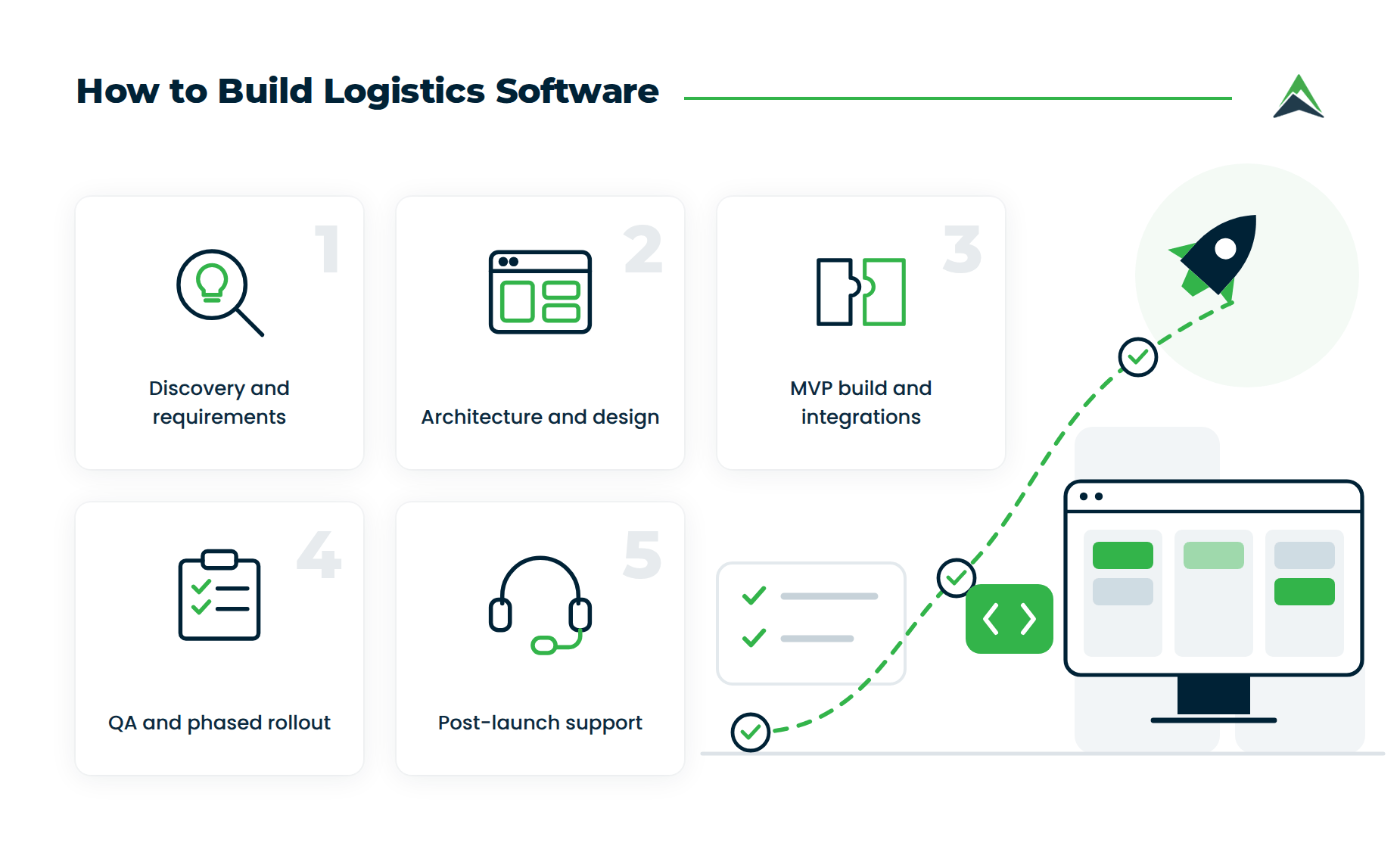
Discovery and requirements
When it comes to how to develop logistics software, the discovery stage sets expectations by evaluating existing supply chain issues and aligning solutions with business goals. During this stage, software developers, along with your team, map out logistics problems in your business and review internal processes — this creates a clear understanding of how to integrate future software to address the issue at hand.
Architecture and design
During architecture and design, a logistics software development company uses your operational requirements to create a technical design and intuitive user interfaces. This is when the developers select a tech stack and design microservices and cloud infrastructure, while UX/UI designers construct visual prototypes and propose a vision for the software.
MVP-first development & system integrations
Building an MVP and system integrations is a smart move that prioritizes core features first to validate the software in a real environment. Custom logistics app development targets the main workflows (such as basic dispatch, real-time GPS tracking, or barcode scanning) and establishes connectivity by building custom APIs. Even for an MVP, the development team still focuses on connecting it to the crucial external elements.
QA and phased rollout
A custom logistics software development company goes through QA and phased rollout to continuously test the logistics software and make sure it’s ready for traffic and volume spikes. QA engineers run end-to-end functional tests, check how the product performs under traffic spikes, evaluate cross-device compatibility, and examine security compliance. The system is often rolled out in phases, testing how the product works in a single warehouse or operation before expanding it further.
Post-launch support
Custom logistics software development services often include ongoing monitoring and support to maintain platform performance and keep it aligned with business goals. Usually, the engineering team provides post-launch performance monitoring and fixes bugs or security gaps. Beyond fixing issues as they arise, this support includes further upgrades as the business grows.
How much does logistics software development cost
The price of custom software development for logistics varies based on complexity, required capabilities, and organizational scale.
Cost factors
The price of developing logistics software depends on the solution type, scope, integrations, platforms covered, and team location.
- Type and scope. Apps with only one or two functions cost far less than those hosted on different platforms and with many features. For instance, it’s far cheaper to make a driver tracking app than a solution that combines multiple purposes.
- Number of integrations. Connecting your software to external ecosystems increases technical complexity and raises costs. Each addition, such as carrier APIs, telematics hardware, mapping services, or legacy ERPs, will bump the costs up.
- Platforms and interfaces. A team that builds a web-only admin panel keeps initial costs relatively modest. At the same time, it’ll be more expensive to add native mobile applications for iOS and Android.
- Team location. Companies that are located outside of North America or Western Europe typically charge less. For lower costs, many companies look for developers in Eastern Europe or Asia to combine cost efficiency and deep technical expertise.
Cost ranges
Logistics software development cost ranges based on whether developers build an MVP, a mid-level platform, or an entire enterprise system.
- MVP. An MVP that focuses strictly on core operational essentials demands much lower development costs. It gives business owners a chance to learn whether their product is worth further investment without a significant financial loss.
- Mid-level platform. Such a system usually combines more features and diverse integrations into a fully functional tool while keeping costs relatively low. It is a regular balance between advanced functionality and manageable expenses.
- Enterprise system. Far more complicated than an MVP or a mid-level platform, an enterprise system contains complex functionality and demands a greater financial commitment. The higher upfront cost delivers more functions, whether it includes global operational scale, AI predictive analytics, or custom ERP integrations.
Logistics solutions in Eastern Peak’s portfolio
Eastern Peak has delivered logistics software across fleet management, corporate mobility, parcel delivery, and supply chain export operations. Four examples:
- Cloud-based fleet management suite. A GPS fleet management platform in two editions. The individual edition gives vehicle owners engine status, trip reports, live location, and remote vehicle control from a mobile app and doubles as a white-label product for partners. The enterprise edition adds fleet-wide monitoring of routes and stops, dispatch, and reporting for operators running many vehicles at once.
- Corporate mobility platform. A platform for a corporate mobility provider serving 150+ organizations. It handles employee commuting, airport travel, and shared vehicle pools through a rider app for booking and a back-office system for coordinating shuttles, routes, and suppliers. Each organization gets its own configuration.
- Customer platform for a European parcel delivery network. A cloud-based shipping platform for a delivery provider with 500+ depots across 30 countries, replacing a desktop-era system that could not keep up with shipment growth. Customers create shipments, print labels, and track or reschedule deliveries themselves. Customs documentation is generated automatically, and AI-driven route optimization accounts for traffic, weather, and vehicle availability.
- Production and export system for a green coffee sourcing company. A bilingual, multi-country production and export management system for a vertically integrated coffee sourcer supplying roasters worldwide. It replaced manual processes with warehouse lot tracking, shipment orders, export plans, waybills, and production reporting, plus a mobile app for logging quality data in the field.
Moving toward enhanced logistics
As the logistics market is getting more complex, custom logistics software development also becomes a strategic necessity. Logistics is an industry where mistakes or delays can bring costly outcomes, and so investing in a product that keeps your vehicles healthy or manages your warehouse storage effectively is a decision that brings long-term advantage.
A well-thought-out choice made on time puts your business ahead of competitors and opens new operational opportunities.
Still considering how to close the gap between your operational capacity and market potential? Contact us — we’ll help you build a product that grows with you.
Frequently Asked Questions
What is logistics software development?
Logistics software development is the process of building a digital logistics product designed to manage supply chain and transportation operations. The product itself differs, but the problem it solves lies within the sphere of logistics.
How much does it cost to develop logistics software?
Developing custom logistics software varies based on feature scope, technical complexity, target platforms, and integration requirements.
How long does it take to build custom logistics software?
Project timelines depend heavily on system complexity and the number of external integrations. An MVP can take as little as four months, while a full-scale enterprise product can require more than a year to finalize.
What is the difference between TMS, WMS, and SCM software?
A transportation management system (TMS) handles freight outside the warehouse, a warehouse management system (WMS) manages stock inside it, and a supply chain management (SCM) system often works as an umbrella software.
What software do logistics companies use?
Logistics companies use a combination of TMS, WMS, Enterprise Resource Planning (ERP) platforms, and custom software portals to perform different tasks for them.
Read also:
About the author:

Oleg Roberman, Chief of Delivery at Eastern Peak
With strong technical background and outstanding project leadership skills, Oleg helps Eastern Peak customers introduce competitive advantages and instill productive changes in every process by resolving complex business issues and managing multicultural teams through innovation and creative thinking.