As of 2026, the global mobile app market is projected to reach nearly $378 billion, with a CAGR of over 14% (2026-2035). As humanity increasingly moves toward a mobile lifestyle (communication, travel, purchases, even professional operations are all mobile now), businesses must rapidly advance their presence and performance in this domain.
Over 8.8 billion mobile subscriptions are active worldwide, with users spending hours on their phones every day. This has made the mobile screen the primary battlefield for customer attention, meaning that companies playing the long game need to view mobile app development services as the priority in 2026.
This article examines the mobile app development process, key industries it’s used in, core features a successful mobile app needs, the mobile app development lifecycle, its costs, and what to expect in 2026.
What is mobile app development?
Mobile app development is a mechanism of outlining, building, testing, and rolling out software applications that run on smartphones and tablets. It involves product strategy, UX/UI design, frontend and backend engineering, integration, and ongoing maintenance to deliver a fully functional mobile solution for iOS, Android, or both.
And now, before we ask “how to develop a mobile app,” we need to make one quick stop.
Types of mobile app development
- Native app development. Native app development is the creation of mobile software for a specific operating system using its official programming languages and tools (e.g., Swift for iOS or Kotlin for Android). Business owners choose native development when they need deep integration with device features and prioritize user experience with the app.
- Cross-platform app development. Cross-platform development uses a single codebase to build apps that run on multiple operating systems, typically via frameworks such as Flutter or React Native. If a company needs a faster-to-market pipeline and lower development costs, it often goes for this path.
Industries that benefit from mobile app development
Fintech & banking
Fintech and banking use mobile application development services to build online banking, investment, and trading platforms, digital wallets, and various payment gateways. In Q3 2025, the number of downloads and installations of finance apps grew by 11% YoY globally.
With how many financial and banking companies are moving to mobile, it’s no surprise that the industry typically requires strict regulatory compliance (KYC, AML), strong encryption, and multi-factor authentication as the gold standard.
E-commerce and marketplaces
E-commerce and marketplace app developers create online stores, multi-seller marketplaces, and auction platforms. The mobile e-commerce numbers demonstrate rapid progress: in 2025’s H1, the installation rate exceeded the annual average by 16 percentage points.
Aside from secure payment procedures similar to those in banking, this industry demands that development teams deliver seamless UX, real-time inventory synchronization, and scalable infrastructure.
Logistics & on-demand services
Most companies in logistics and on-demand services use development teams to build instruments such as courier tracking apps, ride-hailing platforms, food delivery apps, and warehouse management tools. This usually requires real-time GPS tracking, route optimization, and Enterprise Resource Planning (ERP) management. More than 7.6 billion users globally are actively engaging with apps that offer on-demand services.
Healthcare
The healthcare industry uses mobile software development to build and maintain telehealth platforms, remote patient monitoring instruments, appointment booking systems, and fitness and wellness apps. The market is particularly strict on data privacy compliance, secure data storage, and interoperability with various medical systems.
These priorities aren’t just due to the nature of the app itself, but also to how quickly this sphere is becoming more in demand — in 2025, healthcare app growth reached nearly 19%.
Education & e-Learning
Mobile app development agencies build online educational and tutoring platforms, learning management systems, and exam-preparation tools for the education and e-learning markets. Education apps were among the most commonly downloaded programs in 2025, with more than 1 billion downloads.
As a rule, these apps are expected to include reliable progress-tracking analytics, video or audio streaming, the ability to host extensive amounts of content (e.g., books), and secure user management features.
Automotive
The automotive industry uses app development companies to create specific brand car apps (including vehicle maintenance software), fleet tracking systems, and ride-sharing tools. In 2024 alone, the automotive mobile app market was more than $4.2 billion. Today, development teams are expected to deliver impeccable IoT integration, real-time data updates, and compatibility with embedded vehicle systems.
Entertainment
In the entertainment industry, businesses pay for the development of a range of apps, from video or music streaming platforms to mobile games or social media apps. It’s the second-largest mobile app industry after games, and the downloads of entertainment mobile apps exceeded 8 billion. With so many users adding volume and data, these apps demand high-performance streaming, content personalization algorithms, and scalability.
Essential features of a successful mobile app
User experience & engagement
- Intuitive UX/UI and navigation. Intuitive UX/UI and navigation ensure users can interact with an app’s features naturally and without a steep learning curve. Users need a clean layout with logical flows that don’t require additional understanding or training. This minimizes frustration and reduces friction, leading to longer app use.
- Simple onboarding. Simple onboarding reduces user abandonment by streamlining the initial setup and demonstrating value from the first use. This way, a newbie understands the value of an app they decided to download.
- Personalization. Efficient mobile platforms must focus on curated content tailored to users’ preferences and settings. When individuals feel understood, they engage more often with a program. In a B2B context, this means tailoring the dashboard to the user’s specific role within the client’s organization.
- Smart notifications. Timely, behavior-based push notifications re-engage users without becoming intrusive or spammy.
Business features
- Analytics and reporting dashboards. Integrated analytics and reporting dashboards provide real-time data visualization to track the main performance indicators (KPIs) and user behavior. Advanced analytics go beyond metrics like total downloads. For a service provider, the focus is directed at cohort analysis, conversion funnels, and churn prediction.
- Admin panel. A centralized admin panel is designed to allow non-technical staff to manage app content, user accounts, and system configurations through a simple, practical interface. Its goal is to reduce the developer bottleneck by empowering the client’s business team to make real-time updates without code deployments.
Technical infrastructure
- Security and encryption. Mobile app security and encryption protocols protect sensitive user data and ensure that they remain compliant with privacy regulations across the world (most often, GDPR and HIPAA). Security and encryption vary significantly, and they often use a multi-layered approach.
- Performance optimization. Performance optimization helps an app maintain fast load times, smooth transitions, and efficient resource management. This prevents battery drain and keeps the app responsive even in low-bandwidth environments.
- API integrations. API integrations connect the mobile app to external services, legacy systems, and third-party platforms, extending functionality and enabling data synchronization.
- Scalability considerations. Scalability is the app’s architecture’s ability to handle user load and data volume, especially as its audience grows. It is often one of the features that apps struggle with and don’t account for, since they can’t always predict the pace of change.
The mobile app development process
Regardless of how complex or simple your vision is, the app development stages are always similar. Just like building a good car, making a reliable app has a rather specific, elegant process that ensures no concern is left unaddressed.
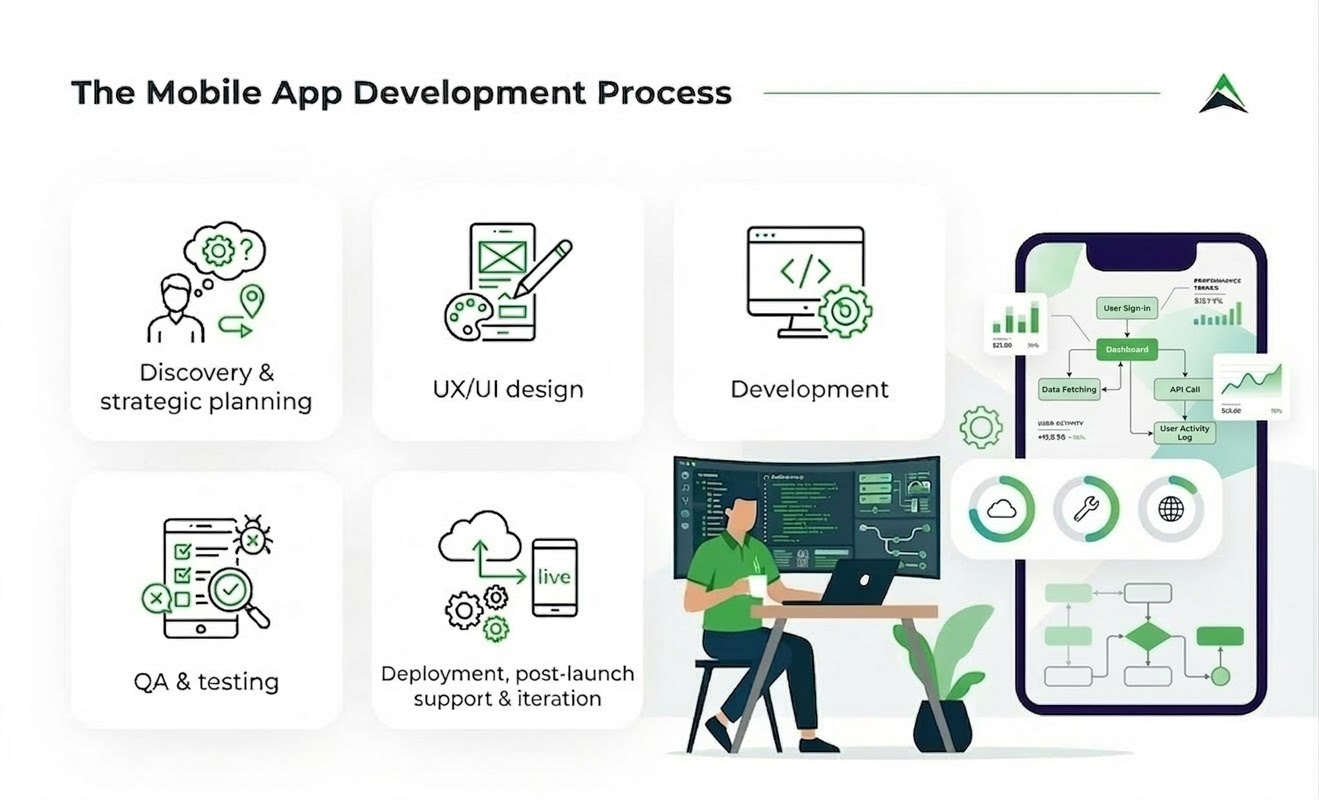

Discovery & strategic planning
Discovery and strategic planning involve defining the project scope, identifying the target audience, and aligning functional specifications with business goals. At this stage of an app development lifecycle, the big idea starts to get some “meat” and moves from vague ideas to reality.
Here, business owners need a detailed breakdown of competitors and user personas to refine the concept into a more fleshed-out version and provide a blueprint for subsequent mobile app development steps.
UX/UI design
UX/UI design focuses on creating the visual interface and user journey maps to ensure the app is both aesthetically pleasing and easy to navigate. In the previous stage, a development team worked with a skeleton, but now, they are moving to high-fidelity interactive prototypes. It’s also the exact moment shareholders get to actually “feel” the app’s flow before its development.
Development
The development phase involves writing front-end and back-end code, integrating APIs, and building the functionality of your mobile app, depending on the size and budget. That’s the step we probably envision when searching “what is the process of app development?”
Today, developers typically break this creation into specific stages or “sprints,” which gives a business owner more transparency and control over the process. It’s also a smart move if the market or company’s priorities change mid-build.
QA & testing
QA and testing verify that the application is bug-free, secure, and performs consistently across devices and conditions. Often, what works on one device or operating system won’t work the same on the other, and that’s why this step is so essential. The team runs an app through unit, regression, and user acceptance testing to identify potential pitfalls in real-world scenarios.
Deployment, post-launch support & iteration
Deployment and post-launch support are about releasing the app to stores and providing ongoing maintenance to fix bugs and implement feature updates. Getting into the App Store and Google Play is a bureaucratic hurdle, but it often doesn’t mean the actual work is done — now, when the app gets its first real users, many things can feel (and behave) differently.
That’s why the development services often include monitoring crash logs and user feedback for Day 1. As the developer team gets more information, it prepares improvements for the software’s next iteration.
Mobile app development costs & timelines
The range of mobile app development costs is vast and varies significantly based on app complexity, platform choice, team location and composition, and hundreds of other specific factors. It’s among the reasons you typically don’t see the specific price when you browse online. This information isn’t a secret — the differences in custom mobile app development are too broad to cover them all.
- App complexity. When you hire mobile app developers, the depth of features, the number of screens, and the sophistication of the backend logic affect how many hours it will take to create the app, which directly influences price differences.
- Simple. A simple app, often an MVP, offers core utility with standard UI components.
- Medium complexity. A medium-complexity software will include a custom UI/UX, API integrations, and a dedicated admin panel.
- High complexity. Although there’s no “ceiling” on how complex an app can be, you can expect advanced tech like AI-driven personalization, real-time data sync, and blockchain security.
- Platform choice. Platform choice refers to picking between native and cross-platform development. Native app development usually costs more than cross-platform development, since it effectively means building two apps, even if they are similar in many ways.
- Team location and composition. The mobile app development company’s geographic location and level of expertise are primary drivers of the hourly rate, significantly impacting the overall project budget. A team in North America or Western Europe will typically cost more than offshore developers.
Mobile app development trends to watch in 2026
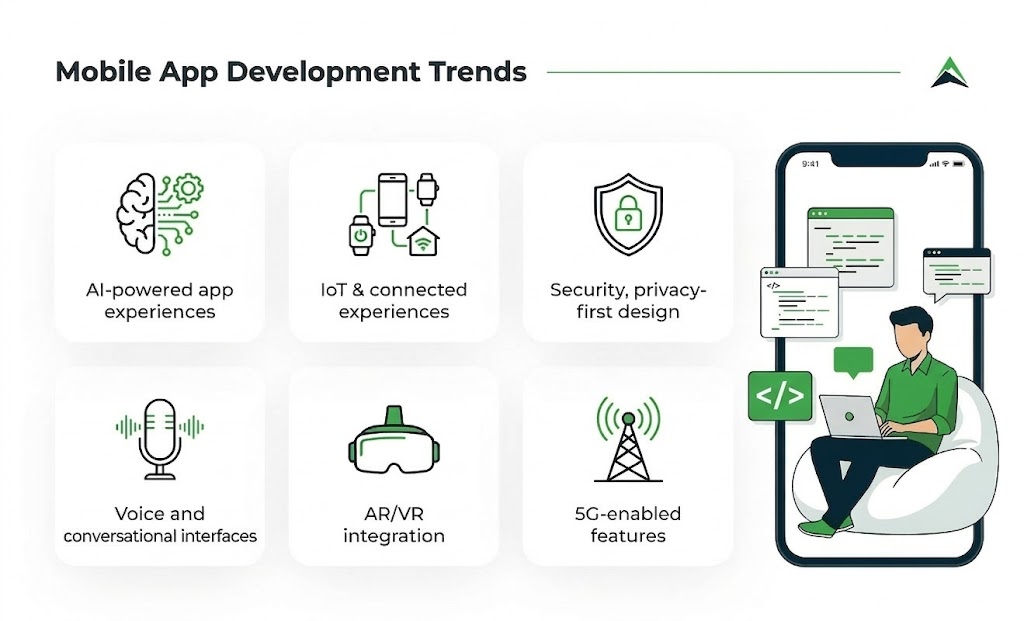

- AI-powered app experiences. In 2026, we’ll witness AI-powered apps using on-device machine learning and generative models to provide predictive assistance, automated content creation, and hyper-personalized interfaces. Apps are no longer just tools; they are proactive assistants that perform tasks on the user’s behalf. This trend is rapidly transforming the app experience as we know it: fashion apps help users decide their color or style, mental health programs adjust the user journey to personal needs, sleep trackers analyze user sleeping patterns, and more.
- IoT & connected experiences. Apps must now seamlessly manage complex hand-offs among wearables, vehicles, and home systems. The Internet of Things (IoT) is expanding daily. Companies deploy these tools for easier urban navigation, better decision-making, safer healthcare services, and performance optimization.
- Voice and conversational interfaces. Voice user interfaces (VUIs) utilize natural language processing (NLP) to allow hands-free navigation and complex command execution through fluid, human-like dialogue. Using voice AI tools gives users the experience of the speed of human interaction and frees up their hands for on-the-go software use (exactly as the IoT trend demonstrated).
- Security, privacy-first design. Privacy-first design integrates security into the product’s architecture, meaning it uses zero-trust frameworks and on-device data processing to protect user sovereignty. Given the volume of information users generate and share daily, integrating security is a smart choice.
- AR/VR integration. AR/VR integration transforms mobile apps into immersive gateways for virtual try-ons, remote training, and interactive 3D visualizations. This technology is particularly useful for furniture retailers (such as IKEA) and the entertainment and clothing industries.
- 5G-enabled features. 5G technology provides the high-speed, low-latency infrastructure that is essential for data-heavy features. Streaming platforms and sports apps are among the main beneficiaries of these improvements, offering techniques such as network slicing, in which an app can request a dedicated “slice” of the 5G pipe for critical tasks to minimize lag, regardless of the network.
Our mobile app development case studies
The industries and features described above are part of our daily work at Eastern Peak. Here are a few mobile projects that show how these principles come together in practice.
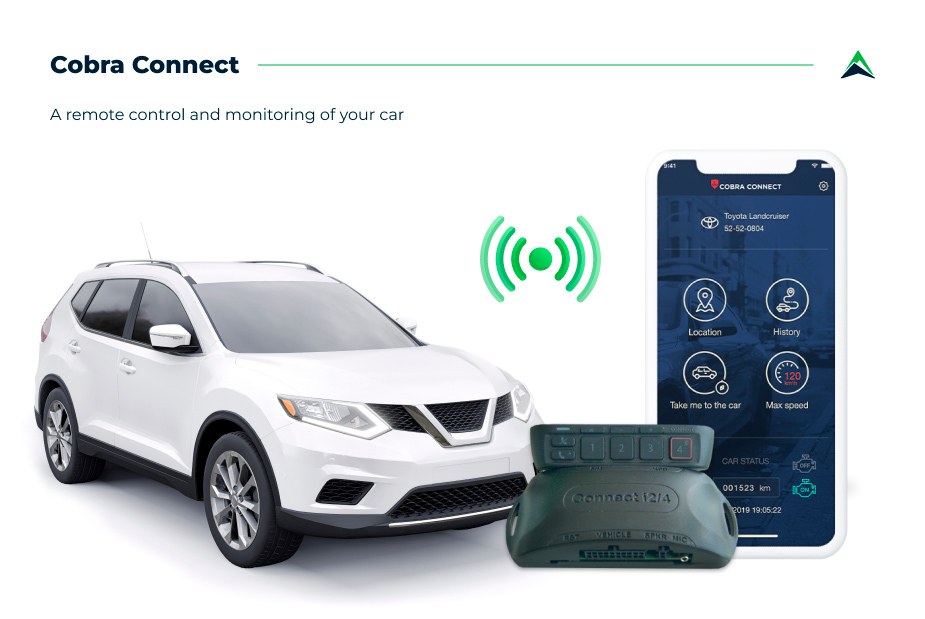
Cobra Connect: automotive IoT app
Cobra Connect is a mobile application that gives car owners remote control over their vehicles. The app communicates with a hardware box installed in the car, which contains an alarm system with internet connectivity. Users can lock and unlock doors, check engine status, pull trip reports, and locate their car in real time, all from their phone. Data flows continuously between the device, the cloud, and the mobile interface.

FixitJoe: on-demand home repair marketplace
FixitJoe is an app that connects homeowners and businesses with professional repair technicians. The app includes real-time GPS tracking (users follow the repairman’s route), in-app payments, and a proprietary rating algorithm developed by Eastern Peak to filter for service quality. The core infrastructure mirrors what you’d find in apps like Uber, adapted for the home services vertical.
Motshelo Mobile: fintech savings and lending app
Motshelo Mobile is a mobile platform for personal short-term savings and peer-to-peer lending. Users can save money, lend and borrow from other app users, create groups, and manage their accounts with full deposit, withdrawal, and transfer capabilities. The app also provides access to cash through VISA cards and major retail shops, along with summary reports on all transactions.
Bonshine: on-demand car cleaning service
Bonshine is an on-demand waterless car cleaning service with dedicated mobile apps for both customers and cleaning professionals. The system includes iOS and Android apps, a web consumer interface, and an extensive back-office dashboard for corporate customers.
A full business cycle was implemented, from single-click ordering with in-app payments to business-side analytics and reporting. The project required real-time scheduling, GPS-based service coordination, and the kind of scalable infrastructure needed to support a growing on-demand user base.
From sharp vision into business value
Professional mobile app development services alleviate much of the operational burden for company owners by providing a ready-made solution built for their business value and market proposition. Navigating the ever-changing landscape might be overwhelming, considering the trends.
By outsourcing to a specialized team, you bypass the friction of recruitment, the overhead of infrastructure, and the steep learning curve of the constantly changing legal and business standards.
If you want to turn your idea into reality while using the best of what 2026 offers in terms of technology and user-centricity, contact us to discuss your technical requirements and define the path from concept to launch.
Final pricing for mobile app development is dictated by the depth of the feature set, the number of third-party API integrations, your team’s location, and whether you choose a native or cross-platform approach. A Minimum Viable Product (MVP) focuses on a single core value proposition, with the main features built to test the market, while a full app includes a comprehensive suite of secondary features and advanced UI/UX. A standard professional team consists of a project manager, a UI/UX designer, frontend/backend developers, and a QA engineer. Yes, continuous maintenance is essential — your team will need to track security, OS updates, and feature iterations in response to user feedback.Frequently Asked Questions
How much does it cost to build a mobile app?
What is the difference between an MVP and a full app?
What does a mobile app development team look like?
Do I need to maintain my app after launch?
Read also: