The article was updated on December 10, 2025.
It’s pretty obvious why large hotel chains need hotel management software for handling their immense workloads. Yet small properties like boutique hotels and guesthouses experience a similar need for streamlining and automating a plethora of tasks.
The problem lies in the fact that out-of-the-box hotel management systems, which may perfectly suit hotel giants, are only partially applicable to smaller hospitality market players. Small hotels and guesthouses need custom solutions to help them manage bookings, accounting, front desk, and back-office processes, often handled by only several team members.
Despite economic shifts, the boutique hotel sector remains robust. In 2024, the market size of boutique hotels in the US reached $35.8 billion.
Obviously, this growing market needs property management systems to help hotel owners reach their business goals while maintaining the highest standards of service and creating memorable guest experiences.
In this guide, we’ll explore the advantages of hotel management systems for small hotel industry players and examine the must-have features and considerations for custom hotel PMS development.
Whether you are a boutique hotel owner looking to automate daily workflows or modernize legacy operations, or an entrepreneur planning a unique hospitality concept that off-the-shelf software just can’t handle, this guide is for you. Read on to learn more!
What is a hotel management system (HMS)?
A hotel management system (HMS), also known as a property management system (PMS), is a comprehensive suite of software tools designed to streamline routine hotel workflows. It manages the entire guest cycle – from reservation and check-in to housekeeping, billing, and checkout – automating tasks to reduce manual effort for staff.
Key drivers for digital adoption
The hospitality sector is embracing digitization. As the number of smartphone and Internet users grows, more and more guests are starting to enjoy and prefer digital experiences.
In 2026, guests expect seamless mobile check-ins, contactless payments, and instant answers via AI chatbots. Data supports this shift: 71% of guests are now more likely to choose a hotel that offers self-service technologies like digital keys and contactless check-in.
Evolving user expectations:
- Modern travelers: use hotel reservation software not just to book but to curate their entire stay. They also value digital communication channels that allow them to request services instantly without visiting the front desk.
- Hoteliers: increasingly use automated solutions for staffing, accounting, managing assets, and more.
Many hospitality providers use ready-made systems for property management. Others choose hotel management software development to create custom solutions tailored to their unique needs. Such systems offer distinct advantages for hotel owners, management, and personnel.
Let’s now take a closer look at the benefits of hotel management software for small hotels.
Advantages of hotel management software for small hotels
Understanding the benefits of a hotel management system is easier if we look at some of the small hotels’ specifics.
Small hotels and guesthouses are run by a limited number of staff members who are torn between tasks they have to attend to and juggling different roles. The management needs mobile solutions to help them get a holistic view of the hotel processes while they are off the premises.
These hotels are often operating at limited budgets and are looking at an optimal set of hotel management system features for a reasonable price.
In this regard, here’s what a good hotel property management system (PMS) brings to the table.
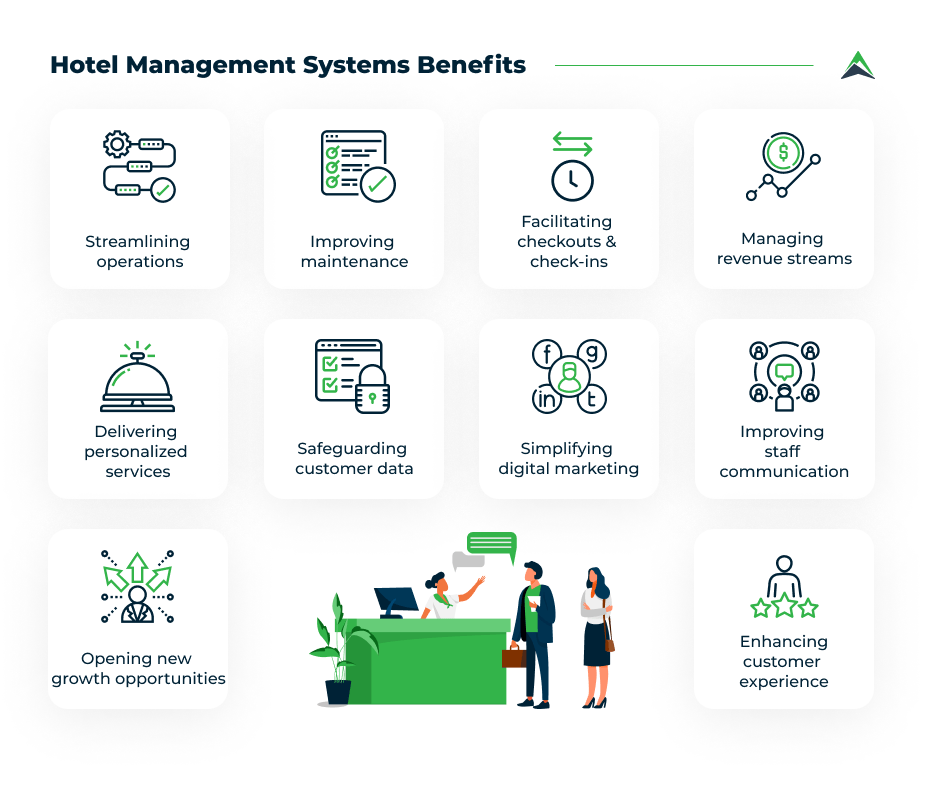
Streamlining operations
Traditionally, everyday processes of a guesthouse, rental property, or hotel require juggling multiple disconnected apps, leading to double bookings and lost data. A hotel property management system aggregates these features into one platform, automates rule-based tasks (like assigning room cleaning), and eliminates human error.
According to recent industry data, 89% of hotel operators save 2–10+ hours per week with their hotel management systems.
Such systems also integrate with third-party services to meet specific requirements and needs.
Improving maintenance
With hotel PMS software, smaller properties are better equipped for effectively handling maintenance, cleaning, and catering tasks. The system sends quick notifications about room service needs so that the staff arrives on time for cleaning and preparing the rooms for other visitors.
The asset management is handled in a similar manner – the system reminds property managers to purchase the inventory and the necessary supplies.
Facilitating checkouts and check-ins
The PMS systems account for quick and easy check-ins. Similarly, guests may easily check out, and the personnel can quickly assign rooms or order all kinds of guest services.
Managing revenue streams
Effective hotel management system software integrates with payment gateways, accounting modules, and payment processing systems. This helps manage property finances, monitor expenses and revenues, and derive analytic insights from financial data to improve profitability.
Delivering personalized services
PMS systems also use big data to track customer preferences and behavior patterns. Property owners can monitor how the behavior of a particular guest changes depending on a season or other circumstances and come up with tailored offerings and personalized services.
Safeguarding customer data
Most modern systems are cloud-based hotel management software. This means all personalized guest data, including credit card details, is encrypted and stored in a secure cloud environment and guarded by advanced systems for data protection.
Simplifying digital marketing
A great property management system integrates tools for digital marketing, such as marketing channel management. Hoteliers can perform marketing tasks easily, using customer insights obtained through data analytics and directly inside a PMS environment, without having to switch between apps.
Improving staff communication
Hotel PMS software enables personnel to communicate faster and schedule and delegate tasks. Equipped with smartphones and tablets, the staff is no longer required to stay in one place. They can quickly attend to the most urgent tasks as soon as they get notifications.
Opening new growth opportunities
Relieved of the routine and tiresome tasks, the hotel staff can concentrate on what’s really important. Added time and resources allow hoteliers to focus on strategic planning, looking for new revenue streams, and fostering customer relationships.
Enhancing customer experience
By optimizing management processes, PMS systems consistently improve service quality.
Visitors get to enjoy a memorable stay and top-notch personalized service, which is hassle-free, seamless, and delivered in a timely manner. This helps property owners build stronger and lasting customer relationships.
Examples of top hospitality software for small hotels
Picking the best hotel management software for a small hotel can be a tricky task. Vendors tend to target large hotel chains and often overlook SMB companies in the hospitality sector. However, there are some good exceptions.
Below is a list of hotel management software for small properties that you may find attention-worthy:
- Hotelologix is a multipurpose tool targeting both large hotels and small properties. Available on a SaaS basis, it syncs with several third-party services. The solution boasts a robust reception module and integrates with booking and accounting modules to simplify hotel operations. The app automates room service and inventory tracking and can be expanded to include modules for managing revenue streams and marketing channels.
- Little Hotelier is an all-in-one reservation and property management system designed specifically for small accommodation providers. It enables small hotel owners to manage their front desk, online bookings, and guest communications from a single mobile-friendly interface.
- Hotelfriend is intended specifically for SMB hospitality companies. It helps small hotel owners manage and automate every facet of small property management – from booking and reservations to accounting and staff management. The platform also covers channel management and helps connect with marketplaces and online travel agencies.
- Easy Innkeeping has a modular structure. Each module is intended for managing a particular area of operations. You may purchase these modules separately if all you need, for example, is small hotel booking software, or buy an entire suite covering every area of hotel operations – from front desk to digital marketing.
- RoomRacoon is an award-winning app that has the core features small hotel management needs, plus integrations for added functionality. The suite features marketing and CRM tools, a POS system, and pricing intelligence. The app supports multiple languages and currencies.
Why build custom? Surely, each of these tools has pros and cons. Just like any out-of-the-box software, the tools listed above are universal and may not be able to cover all of your specific needs. If you need a tailored solution, developing custom hotel management software is often the best decision for long-term scalability and ownership.
At Eastern Peak, we have delivered such tailored solutions for major hospitality industry players:
- Automating property access: For a major rental management firm, we developed a mobile-first platform that replaced physical keys with smart lock integration and geofencing. This allowed for automated, keyless check-ins and real-time security monitoring, significantly reducing front-desk workload.
- Scaling global operations: We re-engineered the core infrastructure for an exclusive international hotel network. The new system was built to handle high-load booking traffic and complex member data across multiple continents, ensuring stability during peak demand that legacy systems couldn’t match.
- Streamlining service delivery: To optimize dining and room service, we built an all-in-one management suite that unifies omnichannel ordering into a single dashboard. This reduced staff errors and improved table turnover times through digitized waiter tools.
Hotel management software development: key considerations
How to create a hotel management system? For hoteliers, the answer to this question lies in defining their business needs, choosing the development company, and, most importantly, deciding on an optimal feature set.
Below is a checklist for 2026 development standards.

1. Define the HMS modules you need
Running a small hotel presupposes controlling workflows across several business domains. Your hotel management software should help you manage the most essential areas of your business, such as bookings and reservations, accounting, task scheduling, finances, promotion, analytics, and customer relationships.
Define your priorities and make sure you include the corresponding hotel PMS modules in your system. To ensure project success, Eastern Peak advises consolidating your planning into a comprehensive functional specification that outlines requirements, workflows, and integration needs. Note that some of the key functions may be added through integrations with third-party services.
2. Pick the most important features for each module
The next step involves determining the must-have features for each of the modules that you choose to include.
A Booking & Reservation module, for example, could include features like:
- Online bookings: Most people prefer online bookings over emails or phone calls. The online booking feature of a small hotel management software system helps hoteliers accept booking requests directly from the hotel website.
- Managing reservations: Once a room is booked, the hotel staff gets all the reservation details and starts processing the request: changing the room status, making sure the rooms are available for a scheduled date, ordering additional transportation or room service, etc.
- Distribution channel management: This feature is responsible for maximizing marketing outreach through collaborating with Online Travel Agencies.
A Staff & Tasks management module could include features like:
- Tasks delivery: This feature is responsible for assigning tasks to hotel personnel and monitoring how they progress. Hotel managers can set the tasks remotely through a PMS system, which enables staff to work more efficiently and get new task updates in real time.
- Back office management: This feature helps managers keep their hands on the pulse of staff management processes, assign shifts, get updates on sick leaves, vacations, days off, and salaries.
A Monitoring & Analytics module:
- Revenue management: This feature monitors income and spending.
- Reporting: Quick report generation for taxes, statistics, and other purposes is one of the key hotel management software features.
A Customer Communication module:
- Tools for managing customers’ data: A feature for handling, storing, and managing customer data would surely enhance every property management software.
- Invoicing: Automated invoicing feature will ensure that the invoices are issued fast and are free from inaccuracies and errors.
- Surveys and notifications: add these tools if you intend to run customer surveys and notify them about the available opportunities and discounts.
We at Eastern Peak have hands-on experience in building property management software for hotels and can help you create technology solutions that meet your hotel business needs. Want to develop custom hotel PMS?
3. Create an attractive user interface
Even if you’re building a small hotel property management software for internal use only, make sure its interface is convenient, easy to use, and visually attractive. You and your staff will be spending a lot of time in an application environment, so do your best to make the user experience smooth and pleasant.
Investing in a thorough UX/UI design process ensures your hotel management software features are intuitive and aligned with your team’s daily workflows.
4. Choose an optimal tech stack
After you’ve listed all the core requirements for your small hotel software, you need to decide on a best-suited tech stack for bringing it to life. For 2026, we recommend using React or Angular for the front-end part of your hotel management system software to ensure responsiveness across devices.
For the backend part, use Python and Node.js frameworks, MySQL database, and Swagger API documentation. AWS provides scalable and reliable infrastructure services for building a hotel property management system.
5. Provide support to all integrations
Eastern Peak advises that modern hospitality relies on a connected ecosystem, not isolated tools. You may need to integrate your system with third-party tools for accounting, POS system management, and channel distribution tools. Each hotel has its very specific needs, so you may need your own unique set of integrations.
For example, you may choose not to build your own booking module from scratch and instead integrate your system with small hotel booking software.
6. Ensure scalability
Even if you don’t intend to expand your hotel business in the near future, plan for scaling your system in advance. Even for boutique operations, the architecture should be cloud-native, allowing for auto-scaling during peak seasonal traffic or marketing campaigns. Scalability will also ensure the non-disruptive performance of your platform during peak seasonal workloads.
7. Think about 24/7 tech support
Even if the system you build is 100% reliable, at some point you are bound to experience some tech difficulties. Initially, your personnel may be in need of a helping hand as they learn how to use the newly built system.
Choose a trustworthy tech partner that is ready to offer you 24/7 tech support and is committed to helping you resolve any of the potential problems.
AI & automation: the new standard for hotel management software
As we move into 2026, custom hotel management software is shifting from basic digital tools to systems that quietly automate the operational load small hotels struggle with most. Small hotels are increasingly adopting AI-driven features to compete with larger establishments without increasing headcount.
- AI chatbots & concierge: Automated assistants can handle common guest queries (“What is the WiFi password?” and “Late check-out request”) instantly, freeing up staff for high-touch interactions. This reduces front-desk workload, accelerates response times, and ensures consistent guest communication even during off-hours.
- Dynamic pricing algorithms: Smart software can analyze local demand and competitor rates in real-time, automatically adjusting room prices to maximize revenue per available room (RevPAR).
- Personalized guest experience & marketing automation: AI analyzes guests’ past stays, preferences, booking history, or behavior to personalize offers, communications, and upsells (e.g., spa, upgrades, dining).
- Predictive maintenance: IoT integrations within a hotel property management system can alert staff to HVAC or plumbing issues before a guest even notices, preventing negative reviews.
Integrating these capabilities during hotel management software development ensures your platform remains competitive for years to come.
Key takeaways
- Shift to cloud: Small hotels are moving to cloud-based hotel management software to enable remote management and reduce IT costs.
- Custom vs. off-the-shelf: While tools like Little Hotelier exist, custom hotel management software offers better long-term value, data ownership, and workflow fit.
- Mobile first: In 2026, both staff and guests demand mobile-first experiences, from check-in to housekeeping task management.
- Core modules: Essential hotel PMS modules include booking and reservations, staff and task management, revenue management, customer communication, and analytics.
- Embrace AI and integrations: Leading systems now include AI (for chatbots, analytics, and dynamic pricing) and seamless OTA/channel management.
- Plan thoroughly. Define your system’s scope in a functional specification, design intuitive UX, choose a scalable tech stack, and incorporate continuous testing. These steps align development with your business needs.
- Work with experienced developers. Partnering with a team that follows a proven software development process ensures your PMS is built to spec.
Conclusion
Managing a small property can be as challenging as running a large hotel chain: the staff and resources are often limited, so owners need comprehensive toolsets to help them handle and distribute numerous processes and tasks.
Instead of using disparate tools and software, automated hotel property management systems combine all the features needed to manage small hotels, guesthouses, condos, or rental properties easily and effectively.
PMS software is capable of accelerating time-consuming processes, eliminating human errors, streamlining routine processes, and helping deliver unforgettable guest experiences.
Looking for a tech partner experienced in hotel management software development to build hospitality software for small properties? Contact us now for a free consultation!
Hotel management software (HMS) is a digital solution designed to streamline and automate hospitality operations, ranging from front-desk reservations to back-office accounting and personnel management. Hotel management software is an umbrella term that may include both basic solutions and end-to-end Property Management Systems (PMS) combining a wide range of features for hospitality management. Modern hotel management software functions as a centralized digital ecosystem that synchronizes data across all departments in real-time. These solutions leverage technologies like robotic process automation (RPA), big data analytics, natural language processing (NLP), and machine learning (ML) to streamline the processes across every facet of hotel management operations. This ensures that front-desk, housekeeping, and sales teams operate on a single, automated source of truth. While platforms like RoomRacoon or Little Hotelier are popular standards, the “best” solution is often one built specifically for your business. Off-the-shelf tools can be rigid and carry high recurring costs. Custom hotel software is frequently the superior choice for innovative companies because it eliminates vendor lock-in, fits your workflows perfectly, and becomes a proprietary asset rather than a monthly expense.Frequently Asked Questions
What is hotel management software (HMS)?
How does hotel management software work?
What is the best hotel management software?
Read also:
About the author:

Alexey Shalimov, CEO at Eastern Peak
As CEO at Eastern Peak, a professional software consulting and development company, Alexey ensures top quality and cost-effective services to clients from all over the world. Alexey is also a founder and technology evangelist at several technology companies. Previously, as a CEO of the Gett (GetTaxi) technology company, Alexey was in charge of developing the revolutionary Gett service from ground up and deploying the operation across the globe from New York to London and Tel Aviv.