Digital progress is rapidly shaping one of the newest chapters in the healthcare industry: healthcare software development. The healthcare IT market was valued at $998.8 billion in 2026 and is projected to exceed $1.830 billion by 2030, with a CAGR of 15.8%. Since standards began shifting in 2019, software development has become a way for healthcare organizations to stay relevant.
With AI integration, cloud computing, and a more on-the-go approach, healthcare software solutions have diversified to meet organizations’ needs. It’s effective on several levels: at the individual level, it improves service delivery for providers; at the organizational level, it helps cut costs and reduce administrative burden.
This article explores healthcare software development, its primary directions and development stages, key considerations and factors that impact final development costs, and the changes the market expects.
What is healthcare software development?
Healthcare software development is the process of designing, building, and maintaining digital systems that support clinical, administrative, and operational functions.
At their core, healthcare software development services exist to improve care delivery, eliminate redundant processes, and support healthcare progress where it’s most needed — in practice, to help patients, employees, and leaders.
Key healthcare software development services
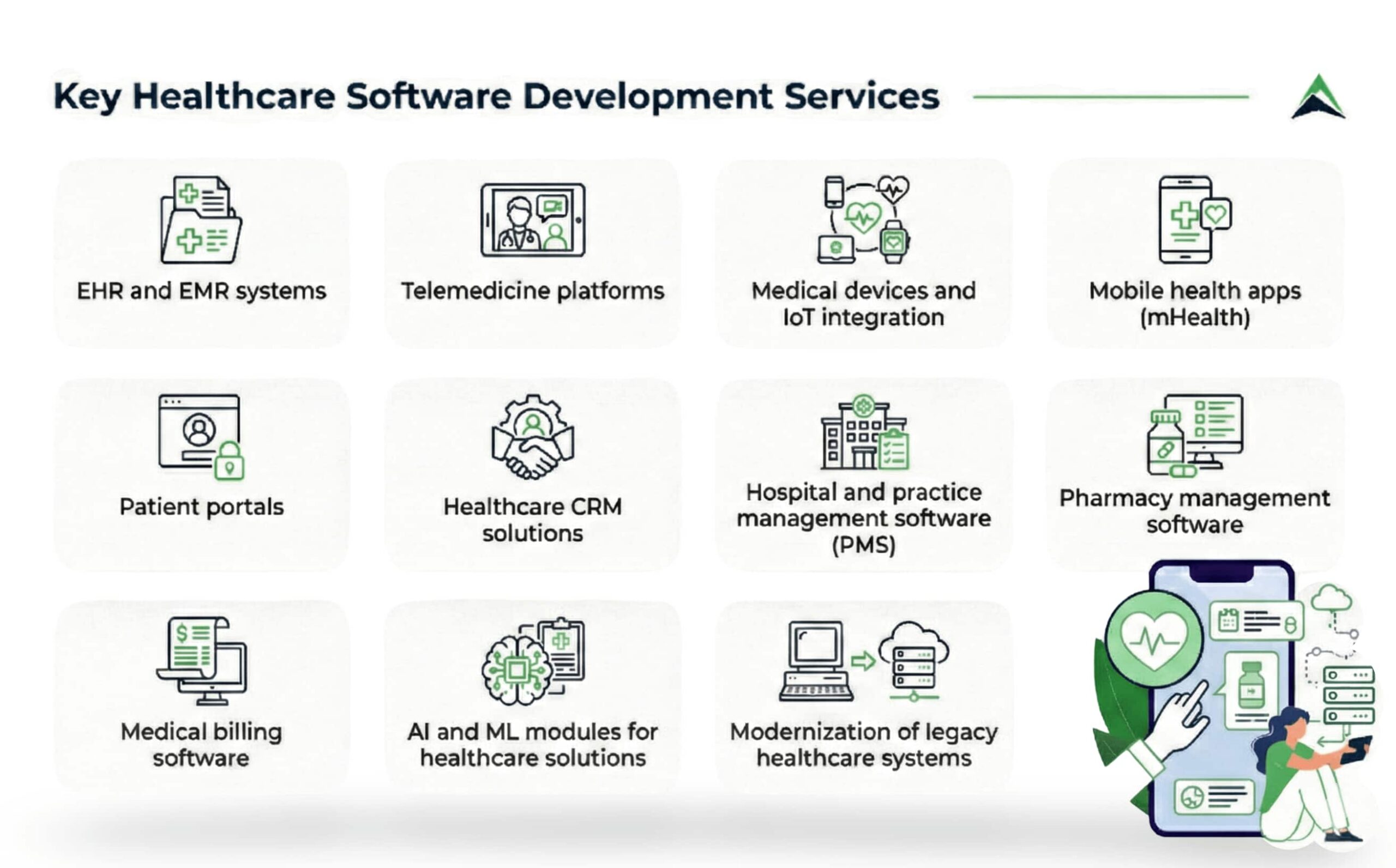
Healthcare software development services encompass a wide range of digital solutions tailored to organizations’ business profiles and existing challenges they intend to address. Here’s a brief look at the main areas where custom healthcare software development services are needed.
EHR and EMR systems
At the heart of most development services for healthcare organizations, EHR and EMR systems store and manage patient records. Since these systems are vital to centralized care coordination, custom software development for healthcare primarily focuses on interoperability, regulatory compliance, data security, and ease of use.
For healthcare organizations, EHR and EMR improvements are critical to operational efficiency and regulatory reporting, so they expect continuous improvement in these areas.
Read also: EHR Systems: Key Features, Capabilities, and Adoption Tips
Telemedicine platforms
Telemedicine platforms have been rapidly growing in number and patient volume since the coronavirus pandemic. This change has put pressure on organizations to rapidly adapt and ensure their platforms can handle increased operational scale or, in many cases, simply to introduce these options in the first place.
Companies develop healthcare software that is easy for patients to use and remains lightweight enough to be accessed with limited internet coverage and on various devices.
Read also: Doctor-on-Demand: A Practical Guide to Creating a Telemedicine App
Medical devices and IoT integration
By connecting healthcare software to smart devices, software development companies enable ongoing patient health data tracking. This reduces errors and delays in care, improves patient satisfaction, and maintains high organizational performance. Practitioners gain better clinical insights without spending all their time at the patients’ bedside.
Read also: Internet of Medical Things: Best IoT Applications in Healthcare
Mobile health apps (mHealth)
Mobile health apps help users track their health data (e.g., steps, heart rate, blood sugar levels) and follow better routines. People are growing increasingly health-conscious and are taking more autonomy of their wellness, so it’s not surprising that they are also using healthcare apps for better care.
Read also: Designing User-Centric Healthcare Apps: Best Practices
Patient portals
Patient portals are platforms that store patients’ EHR and allow them to manage access to this information at any time, as well as provide self-service options (appointments, results, forms, and messaging). In line with our previous statement, users want to know their health status and have access to this information without extra hassle. In turn, organizations get reduced administrative burden and higher patient satisfaction.
Healthcare CRM solutions
Healthcare organizations use CRM software to manage and improve patient relationships. CRM solutions built by software development companies typically integrate with EHRs, marketing tools, and analytics platforms.
Hospital and practice management software (PMS)
Hospital and practice management systems help organizations organize and streamline all the processes necessary for their performance, such as scheduling, staffing, resource planning, and day-to-day operations. Software development work often targets real-time scheduling and capacity management, billing-adjacent workflows, and operational dashboards.
Pharmacy management software
Pharmacies must keep track of thousands of products that must be properly dispensed and accounted for. Developers create complex hospital pharmacy systems or retail pharmacy inventory platforms that make it easier for employees to avoid costly mistakes and regulatory issues.
Typical capabilities include inventory accuracy and expiry/lot tracking, dispensing checks, and integration with prescribing and payer systems (where applicable).
Read also: Pharmacy App Development: Benefits and Opportunities to Explore
Medical billing software
Medical billing solutions help modernize claims workflows and reduce manual rework. Most bills are processed online today, yet many organizations haven’t kept up with this trend and either create or maintain redundant documentation trails that can be fully digitized.
That’s why developer teams are building healthcare software that tackles claims processing, payer integrations, and automated error checking.
AI & ML modules for healthcare solutions
AI and ML modules apply advanced algorithms to analyze healthcare data and support clinical and operational decision-making, which can notably benefit the healthcare outcomes. Organizations hire specialists to incorporate AI and ML advances into diagnostics, predictive analytics, automation, and service personalization.
Models can analyze patient histories, lab results, and real-time monitoring data to flag anomalies, support diagnosis, or prioritize high-risk cases On the operational side, AI-driven automation improves efficiency by optimizing scheduling, resource allocation, and billing workflows.
Read also: AI in Healthcare: How AI Changes the Way Healthcare Is Delivered
Modernization of legacy healthcare systems
Many organizations rely on aging systems that fail to meet emerging client and technical expectations, so software development companies support businesses to make the transition as smooth as possible. They minimize disruptions by maintaining data integrity and carefully refactoring the outdated software.
The healthcare software development process
Despite variability in software development goals, key stages of healthcare software development include:
- discovery & functional specification
- UI/UX design
- development (backend, frontend, and integrations)
- QA and security, compliance testing
- launch and maintenance
Discovery & functional specification
Discovery and functional specification are all about turning a vision into a practical blueprint of the future project. A custom healthcare software development company collaborates with a healthcare organization to determine the business goals the product will address, the gaps it will close, user requirements, regulatory considerations, and the overall technical scope.
A development team begins by interviewing the main stakeholders and analyzing the potential workflow. After the starting points are defined, they conduct risk evaluation and analyze compliance requirements.
UI/UX design
During the UI/UX design stage, specialists create healthcare software with intuitive role-based interfaces for clinicians, administrators, and patients. That is why the details from the previous stage can be introduced later in the UI/UX design step, serving as a reliable map.
If the software supports multiple roles with access to the product, designers also account for this by designing different workflows. Moreover, they focus on wireframes and design systems to ensure an excellent user experience that supports complex workflows while remaining accessible.
Development
The stage of actual development covers backend and frontend implementation, integrations, and system architecture. Due to the dynamic nature of EHR and EMR systems, a great deal of healthcare software development focuses on interoperability — secure, rapid sharing and access to patient records across the organization. Developers must consider how to achieve this goal without imposing additional burden on the product.
At the moment, companies offering software development services in healthcare rely on HL7 (Health Level 7) or FHIR (Fast Healthcare Interoperability Resources) to secure data movement across healthcare ecosystems. This also covers priorities such as HIPAA-compliant software development for U.S. markets and GDPR-compliant software development for EU-focused products.
QA, security & compliance testing
This step validates system functionality, performance, and regulatory compliance before release to make sure the “rough draft” is ready for polishing. While we tend to view development as the end goal, it’s only the beginning.
Now’s the time to evaluate how well the software performs under different real-time conditions. It includes functional testing, security audits, penetration testing, and validation against healthcare standards. All of this is particularly vital for healthcare organizations due to their access to sensitive patient data.
Launch & maintenance
The launch & maintenance stage is never really over — it’s the process of deploying the software and updating and fixing it when needed. Even the most diligent testing can only minimize, not predict, all potential issues.
Ongoing maintenance enables companies to address emerging concerns and keep their software efficient as healthcare and business requirements evolve.
Main factors to consider in custom healthcare software development
Building healthcare software requires development teams to consider regulatory, technical, and user-centric requirements that can determine how the product is received.
Regulatory compliance and data privacy
Although every software company must be careful about regulatory compliance and data privacy, it’s especially important for healthcare institutions.
Based on limited data from the previous year, which HIPAA will soon expand, the U.S. alone recorded 628 data breaches in 2025. Some of the most expensive cases in U.S. history occurred in 2024 (the top 1, affecting nearly 193 million people) and 2025 (the third-largest, impacting nearly 15 million individuals).
The numbers aren’t encouraging globally, either: it takes around 241 days to identify a data breach. That is why developers must comply with strict regulations and build HIPAA-compliant software that also checks in with local healthcare laws, depending on the market. It saves organizational resources and helps prevent severe legal repercussions.
Security by design
While security is essential in all software development projects, healthcare teams need to embed it into the system architecture from the start rather than add it after development. This includes encryption, secure authentication, role-based access, and regular security testing.
We have already discussed the costs of data breaches above, but security threats aren’t limited to this issue alone. They can harm a business’s reputation or even disrupt its operations.
Interoperability and integration with existing healthcare systems
According to the U.S. Assistant Secretary for Technology Policy, around 70% of hospitals engaged in an interoperable exchange at least once in 2023. A developed product may need to connect with EHRs, laboratory systems, billing platforms, or medical devices, depending on its area of focus.
It’s particularly vital because businesses that do so early can avoid data silos and support coordinated care delivery.
Prioritizing user experience for clinicians and patients
Patients are among the most vulnerable client groups across all business sectors due to the nature of the medical industry. The development team and the product owner aim to ensure that each patient can focus on receiving care without being overwhelmed by a complex product, making a good UX a priority.
In many ways, clinicians’ experience directly contributes to their work, as they are the driving force behind most healthcare decisions. Essentially, clinicians do the job, and the software’s goal is to make it happen.
Scalability & architecture
As the healthcare industry grows, businesses will need to manage a larger volume of patients and data; as a result, software development often incorporates this aspect into practice. This is when business owners typically begin considering cloud infrastructure and modular architecture to prepare for future growth.
A reliable software development team knows how to handle it, as it will affect platform stability.
What determines the cost of healthcare software development?
There is no one-size-fits-all price for healthcare software development, and companies need to consider technical scope, regulatory requirements, and long-term operational considerations when estimating the potential costs.
- Scope and functional complexity. Unsurprisingly, the more complex your project is, the pricier it will be. But what does “complex” entail, aside from the number of features? Factors that can drive higher costs include user roles (it’s one thing to make a product only for patients and another — for clinicians, too) and workflows. While some features can come as a “standard” addition, some others, such as real-time data processing or AI modules, will require more work from your development team.
- System integration. Healthcare software often needs to integrate with existing systems, including EHRs, laboratory platforms, billing software, and medical devices. Each integration adds efforts for development, testing, and maintenance. Therefore, the more integrations your tool has, the more costs will accumulate.
- Regulatory compliance. Complying with regulations doesn’t cost money per se, but making sure that your product follows the existing guidelines does. Moreover, companies planning to expand into other markets may want to include tracking this factor (and software maintenance) in their budget planning.
- Team composition & location. Development costs vary depending on the size and location of your healthcare software development company. Although it’s valid that hiring specialists locally can help them be more in tune with some job specifications, you can significantly cut costs by looking for specialists abroad without sacrificing the quality.
- Hidden costs to anticipate. Some additional expenses don’t show up on the surface immediately, but they can bite off a significant chunk of your budget. Healthcare software frequently incurs additional costs for cloud infrastructure, third-party APIs, or monitoring tools. That’s why a person with a product vision has to explain their expectations in much detail during the discovery stage in order to have a more transparent vision.
Industry trends shaping healthcare software development in 2026
In 2026, healthcare software development is shaped by multiple technological advances, a move toward even greater digitalization, and expectations for more secure, interoperable digital infrastructures.
Intelligent care & automation
Healthcare is placing greater value on intelligence (both technological and human), which means automation is moving in fast.
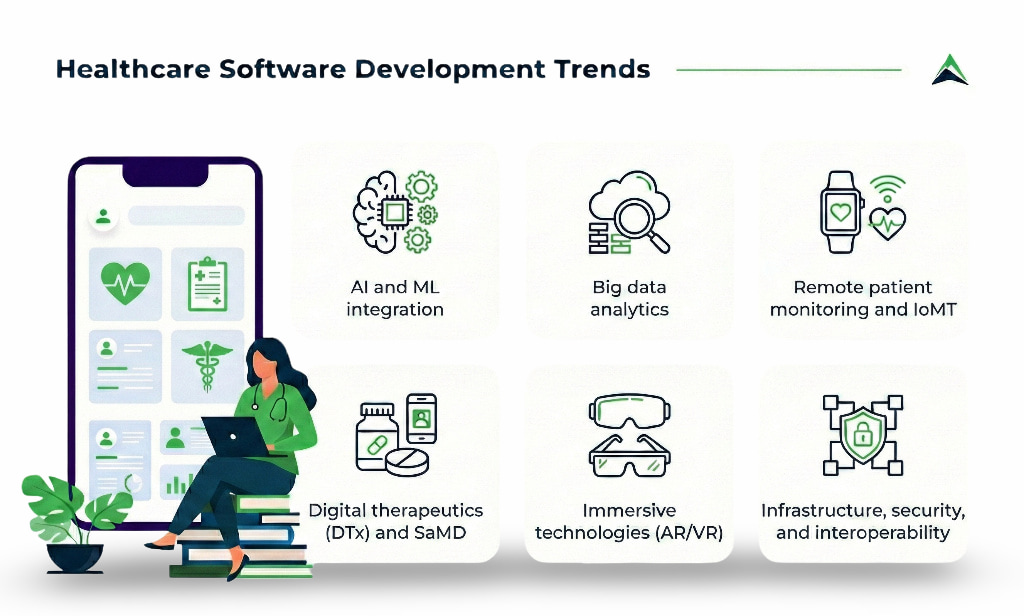
- AI & ML. Technologies such as AI and ML can revolutionize the medical sphere. Many companies are integrating AI and ML into their operations to personalize the user experience, automate routine health checks, and monitor users’ health-related behaviors. Moreover, software that provides predictive diagnostics and clinical decision support can reduce human error and improve treatment outcomes for clinicians.
- Big data analytics. In line with interoperability and the gradual reduction or elimination of paper documentation, healthcare organizations are generating more data. Although a great amount of it remains (yet) unstructured, this is changing. Software development increasingly incorporates analytics platforms capable of processing large datasets fast.
Patient-centric & connected health
Patients are the center of healthcare, and the old-school and generic treatment of every individual identically is no longer a viable option. In 2025, the patient-centric healthcare app market was valued at more than $26 billion.
Hospitals and private businesses diversify their services to meet the different cultural and socioeconomic needs of their patients. This change is evident in several trends: the rise of omnichannel communication, increasing personalization (which also connects to big data and AI/ML), and data synchronization, all of which aim to ensure high customer satisfaction.
- Remote patient monitoring & IoMT. Many people monitor their health outside hospitals: some do so because of chronic health conditions, limited hospital capacity, or simply to be more health-conscious. This pushes them to wearable devices and IoMT technologies for greater clarity. For that reason, real-time tracking and multi-device integration will demonstrate striking progress in 2026. Business leaders agree with this statement: in 2025, Global Life Sciences CEO Outlook by KPMG found that more than 80% of life sciences CEOs view IoMT as a critical capability driving progress.
- Digital therapeutics (DTx). The rise of DTx and Software as a Medical Device (SaMD) is driven by the growing need for medical care. With a shortage of medical providers to meet this demand, organizations are building healthcare solutions that deliver evidence-based interventions through regulated software. Although we have already seen many such products in the self-care and mental health app sector, more are being developed and undergoing stronger clinical validation.
- Immersive technologies (AR/VR). AR and VR technologies have lost the awkwardness of the early integration days. They are used globally across industries, from entertainment to eCommerce, and the AR and VR healthcare market is expected to reach $3.81 billion by the end of 2026. Medical training and surgical planning have already benefitted from it, but we may likely see new care delivery models.
Infrastructure, security & interoperability
Organizations want a flexible, reliable infrastructure that can scale and remain secure as volumes grow. As more medical services become part of the broader data-sharing space across organizations, healthcare software solutions development matches the pace in stride.
Patients can expect better clinician awareness and improved communication even if they switch hospitals or apps.
Our expertise in healthcare software development
At Eastern Peak, we’ve delivered a wide range of healthcare solutions spanning clinical care, healthtech, and patient-facing platforms, each tailored to complex regulatory and operational environments.
- Genetic risk assessment and preventive care platform. Our team worked on a healthcare solution that enables providers to use genetic and clinical data to identify patients at elevated disease risk, particularly in oncology. By facilitating genetic evaluations at the point of care, the software allows healthcare systems to design tailored cancer prevention plans.
- Clinical operations and research coordination system. A centralized platform for managing clinical workflows, staff scheduling, and research coordination, helping healthcare and life sciences organizations stay compliant, productive, and aligned across sites while ensuring safe and efficient trial execution.
- Personalized medicine and rare disease analytics platform. A data-intensive healthcare platform focused on rare diseases and personalized treatment discovery. The solution integrates patient genetic data, medical records, published research, computational drug screening results, and treatment feedback to generate novel insights and potential therapy options.
- Connected medical device. Eastern Peak developed both the hardware and software for a connected medical device that monitors the female fertility cycle. The solution uses embedded microprocessors to collect, filter, and process sensor data, which is transmitted via BLE to a mobile application. The companion app presents real-time insights and results to users, enabling accurate fertility tracking.
- Virtual health assistant. A patient-centered mobile platform that helps users manage medications, appointments, prescriptions, lab work, and follow-up care. The solution supports reminders, prescription refills, telemedicine access, and coordination with pharmacies and healthcare providers.
- Mobile healthcare platform. The solution enables on-demand telemedicine consultations with licensed healthcare providers, allowing users to receive medical advice, prescriptions, and care guidance regardless of location. In addition to virtual care, the platform helps users locate nearby medical facilities and pharmacies and securely share essential medical information with clinicians when in-person care is required.
- AI-powered healthtech solution. We delivered a healthtech platform designed to protect workers in high-risk healthcare and field environments. The solution combines wearable devices, mobile applications, backend systems, and cloud infrastructure to enable real-time GPS tracking, automated SOS alerts, two-way voice communication, and geofencing. A key innovation was AI-powered fall detection based on a self-learning neural network, capable of triggering emergency responses even if the user is incapacitated.
Conclusion
We’re witnessing healthcare software modernization accelerate even as you read this. Healthcare software is a niche where each smart investment doubles the input and, more importantly, builds customer trust. Although the industry is moving fast, business owners who seize the moment can create an irreplaceable product that serves as an example of success for those lagging behind.
Want to develop a custom healthcare software solution that will have a lasting impact? Our team specializes in building user-centric software that matches elegant solutions with your vision. Contact us to make it real.
Healthcare software is any digital solution that supports healthcare organizations or companies by improving their workflows, integrating new technologies for better care outcomes, or simplifying outdated practices. Its primary objective is to make a healthcare organization smarter and more responsive. Compliance starts in the discovery phase and continues through design, development, and testing with access controls, audit trails, documentation, and regular reviews. The cost of developing custom healthcare software varies based on several factors, including project complexity, integrations, and team location. It can — and often should. Modern healthcare software is typically built to integrate with existing systems via APIs and interoperability standards such as HL7 or FHIR.Frequently Asked Questions
What is healthcare software?
How do you ensure regulatory compliance?
How much does custom healthcare software cost?
Can the healthcare software integrate with existing systems?
Read also:
About the author:

Alexey Shalimov, CEO at Eastern Peak
As CEO at Eastern Peak, a professional software consulting and development company, Alexey ensures top quality and cost-effective services to clients from all over the world. Alexey is also a founder and technology evangelist at several technology companies. Previously, as a CEO of the Gett (GetTaxi) technology company, Alexey was in charge of developing the revolutionary Gett service from ground up and deploying the operation across the globe from New York to London and Tel Aviv.