We’re witnessing one of the most rapid digital transformations in the financial sector, and the wave will reach not just FinTech or banking companies. Internationally, the financial services software industry reached $151.48 billion in 2024 and is projected to grow at a CAGR of more than 11%.
From neobanks and payment gateways to automated wealth management and decentralized finance, financial software solutions are entering almost every company, and they are here to stay. All businesses that operate with money in mind benefit from this breaking shift.
However, this race also means that companies dealing with finances need to stay on top of the game to avoid falling behind. Developing well-performing financial software, then, becomes both a competitive and a success factor.
In this article, we take an in-depth dive into financial software development services, explore how to develop financial software along with the critical factors involved, and look at the leading trends in financial software development.
It’s useful for founders, product leaders, and decision-makers in banking, FinTech, insurance, or other businesses handling financial data who are planning a new product, updating systems, or looking at development options.
What is financial software development?
Financial software development is the process of designing, building, and using digital solutions for any finance-related purposes. This is more than just coding and creating a tool. It’s building ecosystems that combine software engineering, cybersecurity, regulatory expertise, and data intelligence.
It’s not just financial institutions that use custom financial software development services. Every company that works with financial data uses some form of financial software. The nature of the development process requires professionals to build a technological implementation that embeds itself in the business architecture and its operations.
Whether it is a traditional bank modernizing its legacy stacks or insurers digitizing customer interactions, the principle behind development remains the same — precision.
Key financial software development services
Today’s scope of financial software development services is endless. Here’s a diverse range of specialized services designed to support different segments of the industry.
Financial software development: services at a glance (2026)
| Category | 2026 Market Size | MVP Cost* | Source |
|---|---|---|---|
| Banking software | $23.16B → $83.78B by 2034 | $250K–$500K+ | Fortune Business Insights |
| Mobile / digital banking | Subset of $23.16B core banking | $150K–$400K | Fortune Business Insights |
| Lending & credit platforms | $19.88B by 2026 | $120K–$300K | Allied Market Research |
| Payments & digital wallets | $200.03B → $235.03B (2027) | $80K–$250K | Precedence Research |
| Wealth & investment platforms | $4.23B → $9.99B by 2034 | $150K–$350K | Fortune Business Insights |
| Insurtech platforms | $23.54B → $132.71B by 2034 | $100K–$300K | Fortune Business Insights |
| Regtech software | $22.30B → $112.10B by 2033 | $100K–$250K | Grand View Research |
| Personal finance | $1.71B → $2.21B by 2031 | $60K–$150K | Mordor Intelligence |
*MVP cost ranges are Eastern Peak delivery estimates for 2026 builds. Final figures depend on integration scope, compliance burden, and team composition.
Custom fintech app development
The global fintech market size is constantly growing. It’s not surprising that this sector is one of the primary beneficiaries of custom financial software development.
- Banking solutions. Banking software is rising just as much as the broader industry. With a 2024 market value of $16.79 billion, financial software developers have plenty of opportunities for involvement. Developers build the core pieces of a digital bank, such as accounts, transactions, balances, and transfers. They analyze existing security and authorization measures and create digital onboarding flows that include ID verification and KYC/AML checks. Plus, banking software development teams build clean and secure mobile and web banking apps and modernize traditional systems.
- Investment & trading apps. Investment and trading apps are digital platforms that allow users to sell, buy, and manage assets such as stocks, crypto, and FX. A recent publication from Business Insider suggests that AI bots integrated into new investment systems will often replace bankers for many tasks — this already signals a technological shift that requires new software. Building financial software platforms for trading stocks, crypto, FX, or other assets, teams still prioritize quick data processing. They maintain the style of traditional investment and trading but make it more effective and user-friendly.
- Lending & credit solutions. Lending and credit platforms handle loan applications, document uploads, and approvals through AI- and ML-powered analysis. Recent technological opportunities enable practical improvements such as automating underwriting and identity verification and building interactive, easy-to-grasp dashboards.
- Payment & digital wallet solutions. Financial software development makes payment and digital wallets much more widespread. Customers no longer use traditional payment methods that require them to be physically present for the payments or wallet management. Today, engineers build systems that can move user money quickly. Their products now store cards, IDs, loyalty points, and more, plus they integrate with Visa/Mastercard and open banking.
- Personal finance management apps. Personal finance management apps are tools that help users track their spending, plan a budget, and organize their savings. Today, personal finance management, whether it’s a money-saving instrument or a long-term spending-tracking tool, is available for free or at a low cost. Software development improvements that provide users with AI-based insights and quick account sync played a crucial role in this.
InsurTech solutions
Insurtech, or insurance technology, focuses on reducing delays, paperwork, and manual decision-making that are typically associated with outdated insurance operations. Today, developers build systems that handle everything from generating quotes to managing claims without the constant need for checking each input.
Companies that create insurtech solutions typically focus on developing digital platforms, SaaS, and mobile apps that simplify insurance processes. This market is already over $15.6 billion as of 2024, with North America dominating the industry. Developers create software that can quickly assess risks and detect fraud by identifying claim inconsistencies.
Much of the work now automated by insurtech enables fast, transparent digital interactions that benefit both insurers and customers.
Read also: Software Solutions for Insurance Companies: Best Practices
RegTech and compliance software
RegTech projects revolve around one core mission: helping financial organizations stay compliant without exhausting their teams. That’s one of the findings highlighted in the newest Forbes article on the main fintech trends: “the merger of compliance and code,” as the author states.
Today, financial software developers create technologies that monitor transactions, screen users against sanctions lists, and even generate reports required by regulators. A small number of professionals in a team might find it difficult to track the rules 24/7. That’s why the risk reduces, as RegTech solutions can monitor regulations across multiple regions even as they change in real time.
Data analytics and AI solutions
Data is everything. For the finance industry, it’s critical because it generates and stores vast amounts of data. An analytics team turns it into practical insights that support a business’s subsequent strategy.
Financial software development enables financial institutions to securely integrate this data by using AI and new analytical tools. We see it daily in complex models for fraud prevention or financial forecasting. This doesn’t mean that the human input becomes obsolete — instead, experts can focus on what matters after the raw data is properly processed.
Read also: Examining AI Uses in Banking & Financial Services
Cloud migration and API integration
Users expect their digital instruments to work swiftly, especially in their financial services; money moves quickly, and financial software needs to keep pace. Today, businesses turn to the cloud and APIs for scalability: as they grow, their financial ecosystem has to keep up without breaking.
So developers migrate old systems from on-premise servers to platforms like AWS, Azure, or Google Cloud. The previously monolithic applications become modular microservices.
Moreover, API integration enhances business capabilities in the financial sector by enabling them to integrate third-party services. While this complicates the existing architecture, well-designed custom financial software solutions ensure performance, scalability, and flexibility.
Financial software development process
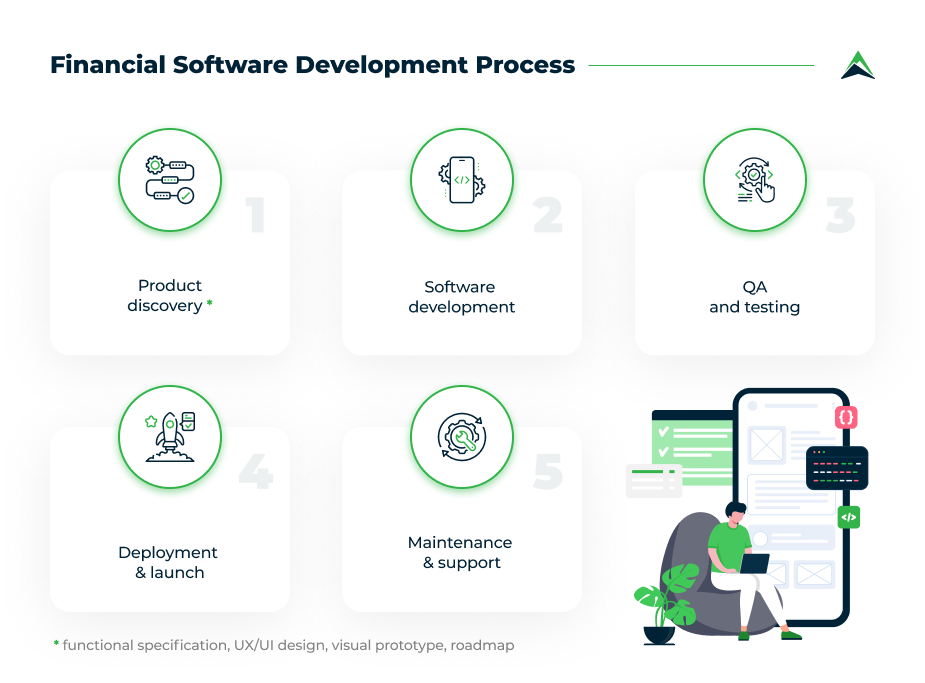
If you’re looking for a reliable financial software development company, here are the processes it will go through with you, from the idea through long-term maintenance. Let’s take a look at a typical software development cycle.
1. Product discovery & strategic planning
Businesses can’t start banking & financial software development without this stage, and they need more than just a business idea. Product discovery is the most important step, since it calls for a combination of a broader vision (who this product is for) and a narrow focus (details to consider). Here’s what happens during this stage:
- Functional specification process. This stage involves gathering strategic information about a business and determining its strengths relative to other competitors, mapping out user journeys, and outlining the technical foundations the product will need.
- UX/UI design process and the creation of a visual prototype. Here, a team creates a visual representation of a product that shows the “live” version of the future solution. Often, it helps to identify the changes needed since the visual step often puts certain functionalities into perspective.
- Outlining the development roadmap. This step involves defining the development roadmap, which includes a step-by-step plan for features, integrations, compliance considerations, infrastructure in general, and how they will interact.
2. Software development & iteration
Once all adjustments are made and the plan is finished, the software development process begins. As a rule, teams develop financial software in agile sprints: the end result is broken down into manageable pieces, allowing them to deliver functional components in rapid cycles.
Why this approach, though? Just as in the planning stage, much can change during development. And so this strategy allows teams to validate features as they’re built, and if feedback suggests something to fix, they can do so without disturbing the previous “layers” of development.
3. Quality assurance & testing
Financial software only works if it’s safe and secure, so QA and bug fixing need to be thorough. Just before the release, a team checks for any bugs or errors because once the product is launched, it’ll be much more challenging to fix them. This can take several rounds of functional, regression, integration, and security tests.
Often, testers simulate real-life environments to test how the product will perform under various complex conditions, such as high traffic or attempts to break authentication flows.
4. Deployment & launch
Contrary to what some business owners might think, deployment isn’t as easy as clicking “publish” on a product. It requires close collaboration among all teams that depend on the new software introduction.
There’s also a need to verify that all regulatory and operational requirements are met and to set up CI/CD pipelines. A lot can change when a product goes public, so it is particularly critical and time-sensitive.
5. Maintenance, support & optimization
A product is something akin to a living thing when it comes to how it performs and is managed. Financial systems will adapt as new trends emerge or improvements on the market are introduced. Even the best product will struggle sometimes, no matter how much testing was done. And when it does, it’s crucial to have a trustworthy development team that can respond to potential challenges fast.
This stage also includes rolling out new features, refining existing ones, and ensuring the platform scales smoothly as the user base expands.

Key factors to consider when developing financial software
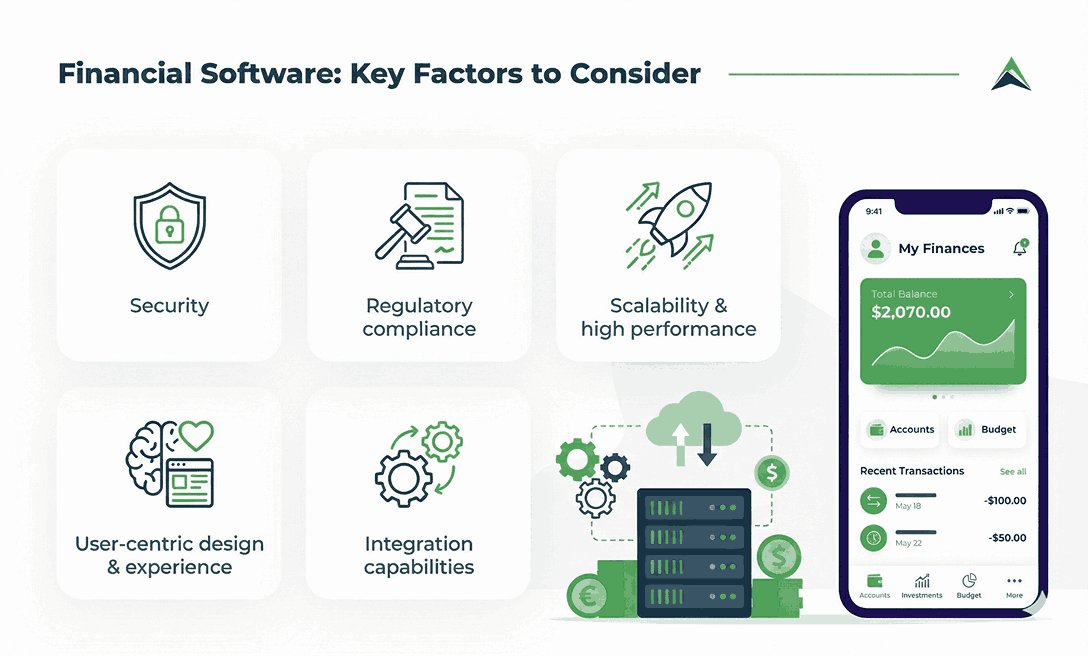
Building financial software tools presents unique challenges and considerations, given the industry’s specificities. Companies that develop financial software usually take these factors into account.
Security
Threats to security in the financial sector are some of the highest across all business profiles. Every workflow, every API call, every piece of stored data has to assume someone is trying to break in.
Developers need to add encryption, granular access controls, and tokenization; adhere to secure coding practices, and monitor the processes constantly for maximum security.
Regulatory compliance
Financial software’s success and performance depend on its ability to stay within the regulatory framework. And compliance shapes the architecture as much as the business logic.
Your software must align with a constantly shifting legal landscape to maintain a good status and a positive public image. Teams have to plan for audit trails, data residency, KYC workflows, and fraud detection models — these have to align with real-world regulations.
Scalability & high performance
Financial workloads change with traffic, business growth, and seasonal fluctuations, and your product must be prepared for this. Does this mean you need an endless list of servers or more instruments and resources than you need? No. It’s about picking the right infrastructure from day one, with scalability and performance spikes in mind.
User-centric design & experience
The key goal of companies that add financial instruments and features to their functionality is to make it as user-friendly as possible. Finance is inherently stressful for most users, so development teams need to make sure they can minimize this friction.
Aim for clear navigation, simple workflow, and intuitive data visualization. Ideally, software like this should take into account user behavior and understanding of the actual interactions with the product.
Integration capabilities
Most financial platforms integrate with third-party services to increase their potential. Some of these include open-banking APIs, core banking systems, and payment gateways — so, the system has to work smoothly together with these integrations.
Customers want a service with multiple features that minimizes the need to switch to other products.

How much does financial software development cost?
Financial software development cost & timeline by type (2026)
| Software Type | MVP Cost | Production Build | Timeline (MVP) | Team Size |
|---|---|---|---|---|
| Personal finance app | $60K – $120K | $120K – $250K | 3–5 months | 4–6 |
| Payment app / digital wallet | $80K – $200K | $200K – $500K | 4–7 months | 5–8 |
| Lending / credit platform | $120K – $250K | $250K – $600K | 5–9 months | 6–9 |
| Insurtech platform | $100K – $200K | $200K – $500K | 4–8 months | 5–8 |
| Wealth / investment platform | $150K – $350K | $350K – $800K | 6–10 months | 7–10 |
| Mobile / digital banking | $150K – $400K | $400K – $1M+ | 6–12 months | 8–12 |
| Core banking platform | $250K – $500K+ | $500K – $2M+ | 8–14 months | 10–15 |
| Regtech / compliance app | $100K – $250K | $250K – $600K | 5–9 months | 5–8 |
These costs reflect a traditional development approach. Depending on your project scope, Eastern Peak’s AI-accelerated development can compress both timeline and cost while senior engineers handle the architecture, compliance, and security decisions fintech requires. Get in touch to find out if this approach fits your project.
Trends in financial software development
Today’s financial software development is facing a market where technologies become smarter and users expect an even smoother experience.
- AI and ML integration. AI and ML in financial software development are here to stay, and they are being integrated into almost every financial product today. The investment in AI in the financial service reached around $45 billion in 2024. Although the financial sector isn’t a leader in AI adoption, it still has a high adoption rate: 52% of companies in the financial services industry adopted Gen AI. Moreover, research indicates that ML has multiple uses in the financial market, improving decision-making and enabling better financial predictions.
- Voice-activated banking. People are constantly on the move. They want to be as hands-off as possible, since their busy lives demand it more often. Because voice interfaces are much more accurate than before, hands-free banking is not a possibility but an actual reality. In 2024, the voice banking market was estimated at $4.18 billion. This trend is only growing further; developers only need to ensure they keep up with demand and maintain the security measures necessary (for example, by implementing voice biometrics and device-level checks).
- Embedded finance. Finances are no longer about banks; they are about everyday expenses happening everywhere, from the comfort of mobile and smart devices. Today, financial operations are becoming modular and API-first. A recent report from McKinsey & Company states that the traditional banking and finance market, as it is, has transformed into embedded finance, and it is one of the key ways for large financial institutions to stay afloat.
- Open banking. In recent years, banks have faced the need to adapt to new market and cultural trends, as users aren’t satisfied with the rigidity of financial institutions. With standardized APIs, customers can securely share their financial data with third-party apps. This provides much greater flexibility and makes it easier for them to integrate other functionality into their accounts. Users get access to multi-bank dashboards, automated saving tools, and innovative payment flows.
Case studies: Eastern Peak’s financial software solutions
To understand the practical value of financial software development, it helps to look at real-world applications. At Eastern Peak, we have partnered with industry leaders to solve specific operational problems.
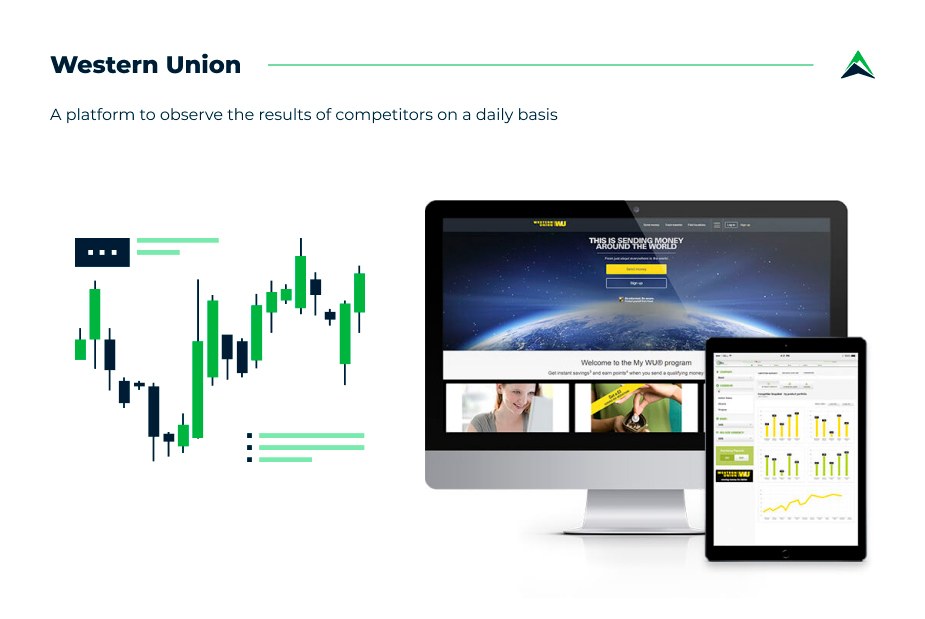
Western Union
Eastern Peak built a custom web crawling and data mining engine that helps Western Union track market activity and financial performance across regions.
The system automatically collects and processes data from multiple sources and presents it through a flexible reporting dashboard, enabling ongoing competitor monitoring and data-driven insights.

Motshelo Mobile
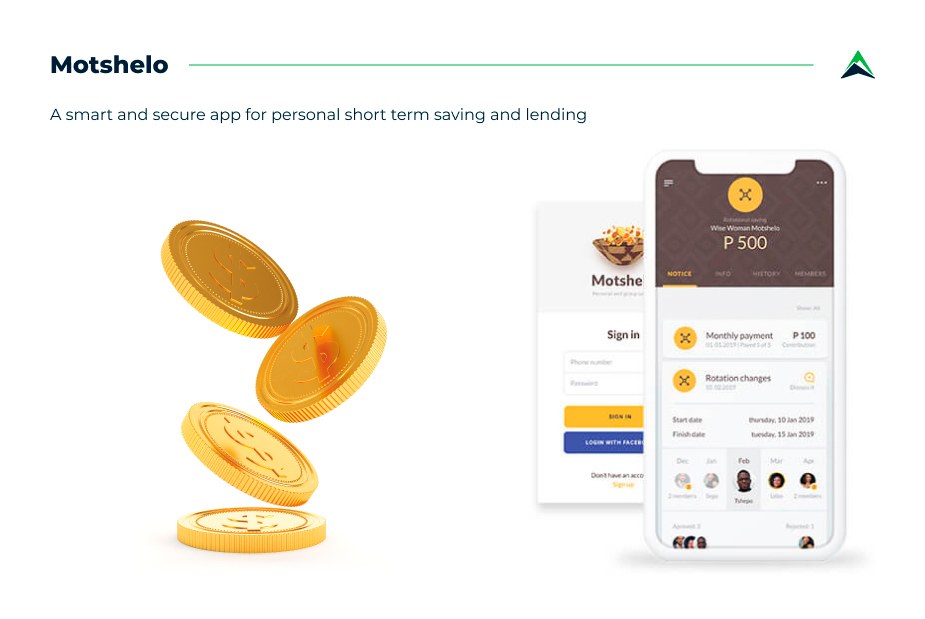
This mobile application focuses on short-term savings and peer-to-peer lending. Users can save, lend, and borrow money, create financial groups, and track individual or shared activity in real time.
The app also supports VISA card access, withdrawals, and detailed transaction reporting.
Talisman
Talisman is a white-label mobile payments platform that allows users to open and manage accounts, make payments, and communicate with contacts within a single app. Built on secure banking architecture, the solution enables financial institutions to launch branded payment apps faster.
Kasefet
Eastern Peak developed an innovative service that aggregates multiple financial accounts into a single interface, helping users organize bills, understand their financial picture, and take action across services.
The system analyzes the data to help users make informed decisions about their expenses and also connects users with service providers who can offer relevant financial products directly through the app using a CPA model.
Conclusion
The changing trends of financial software development don’t just come with demands and complexities — they bring opportunities and new strengths that companies can use. By implementing innovations that create new dynamic systems and keep users at the center, businesses invest in financial technology that becomes a strategic advantage.
Not sure about the first step of building your financial software? We’ll turn your idea into a step-by-step plan with deliverable and practical outcomes. Contact us to start the development.
Financial software development is the process of designing, building, and launching a digital system that supports some sort of financial operation. This can mean anything from creating banking apps to trading platforms. The costs of developing financial software vary depending on factors such as project size and complexity, compliance requirements, and team location. Most financial products take 3-6 months to build an MVP and 9-18 months to build a fully featured, production-ready system. Just as with the price, it’s best to contact potential developer teams to inquire about their rates and deadlines. Look for a partner that specializes in financial software and has a portfolio and positive feedback to back it up. They need to have a thorough understanding of security standards, local regulations, and cloud-native architecture. If you’re not sure which developer to choose, arrange calls with the top candidates and inquire about their vision and potential plan for your product. Frequently Asked Questions
What is financial software development?
How much does financial software development cost?
How long does it take to build financial software?
How to choose a financial software development partner?
Read also: