The article was updated on September 23, 2026.
Enterprise organizations have never been quick to change. Legacy systems and long approval cycles slow things down, and compliance adds its own weight. However, the pace around them has picked up. Employees expect the same convenience from work tools that they get from consumer apps. Thus, mobile solutions have moved from a nice-to-have to a standard part of the enterprise technology budget.
The market for enterprise mobile application development is valued at USD 189.22 billion in 2026 and is expected to reach USD 338.42 billion by 2031, at a CAGR of 12.33%, according to Mordor Intelligence. Companies are spending that money on one goal: getting work out of the office and onto the devices their people already carry.
This article covers the types of enterprise mobile apps, the development process, the seven challenges that derail most projects, and costs. It’s useful for CTOs and operations leaders planning a mobile initiative.
What is enterprise app development?
Enterprise app development is the process of building and maintaining software that supports the internal operations of a large organization.
Unlike consumer products, enterprise applications are built for defined groups of users (employees, partners, contractors, account-based customers) and are typically connected to the core business systems, such as ERP or CRM. Moreover, they have to comply with corporate security policies and industry regulations, which affects almost every technical decision.
So what is the main difference between an enterprise app and a consumer one? First of all, it is the user. While consumers download an app because they want it and delete it as soon as it disappoints them, employees simply get an enterprise app assigned to them. Thus, if the app turns out to be slow or confusing, they will quietly go back to spreadsheets and phone calls, and the whole investment will be wasted.
The table below sums up the key differences.
| Consumer app | Enterprise mobile app | |
|---|---|---|
| Users | Anyone, self-selected | Known roles with set permissions |
| Success metric | Downloads and revenue | Adoption and hours saved |
| Integrations | Payments and analytics | ERP, CRM, HR, identity provider, legacy databases |
| Distribution | Public app stores | MDM with Apple Business Manager or managed Google Play |
| Security | Platform defaults plus app-level protection | SSO, role-based access, device policies, audit logs |
| Offline mode | Optional | Often mandatory for field work |
The state of enterprise mobile apps in 2026
With frontline employees in logistics, retail, healthcare, and field service rarely sitting at a desk, and office staff largely working in a hybrid mode, the age of the mobile worker is already upon us. Thus, enterprise mobility is currently one of the hottest investment opportunities.
Indeed, there are many reasons for enterprises to invest in mobile solutions. Among the most beneficial outcomes are
- better employee productivity and mobility,
- increased process efficiency,
- reduced cost of operation,
- access to new data sources and their advanced management,
- overall higher employee satisfaction, and
- real-time collaboration, which results in simplified decision-making.
Moreover, there are two trends that make the topic even more pressing in 2026. The first one is artificial intelligence. Gartner predicts that 40% of enterprise applications will have task-specific AI agents by the end of 2026, as compared to less than 5% in 2025. For many employees, a mobile app is the place where they will actually meet those agents: for example, a voice note that turns into a structured inspection report or a photo that automatically fills in a claim form.
The second trend is the growing pressure on security. According to IBM’s 2026 Cost of a Data Breach Report, the global average cost of a breach has reached a record $4.99 million, while it takes 247 days on average to identify and contain an incident. Since every smartphone with access to corporate data widens the attack surface, mobility and security budgets now typically grow together.
Types of enterprise mobile apps and use cases
But how are businesses leveraging mobile solutions to their advantage? What are the most popular applications of mobile solutions in enterprise?
Of course, this largely depends on the industry or business domain the company operates in. However, there are some common use cases that can be highlighted. In general, most enterprise apps fall into one of the six groups listed below:
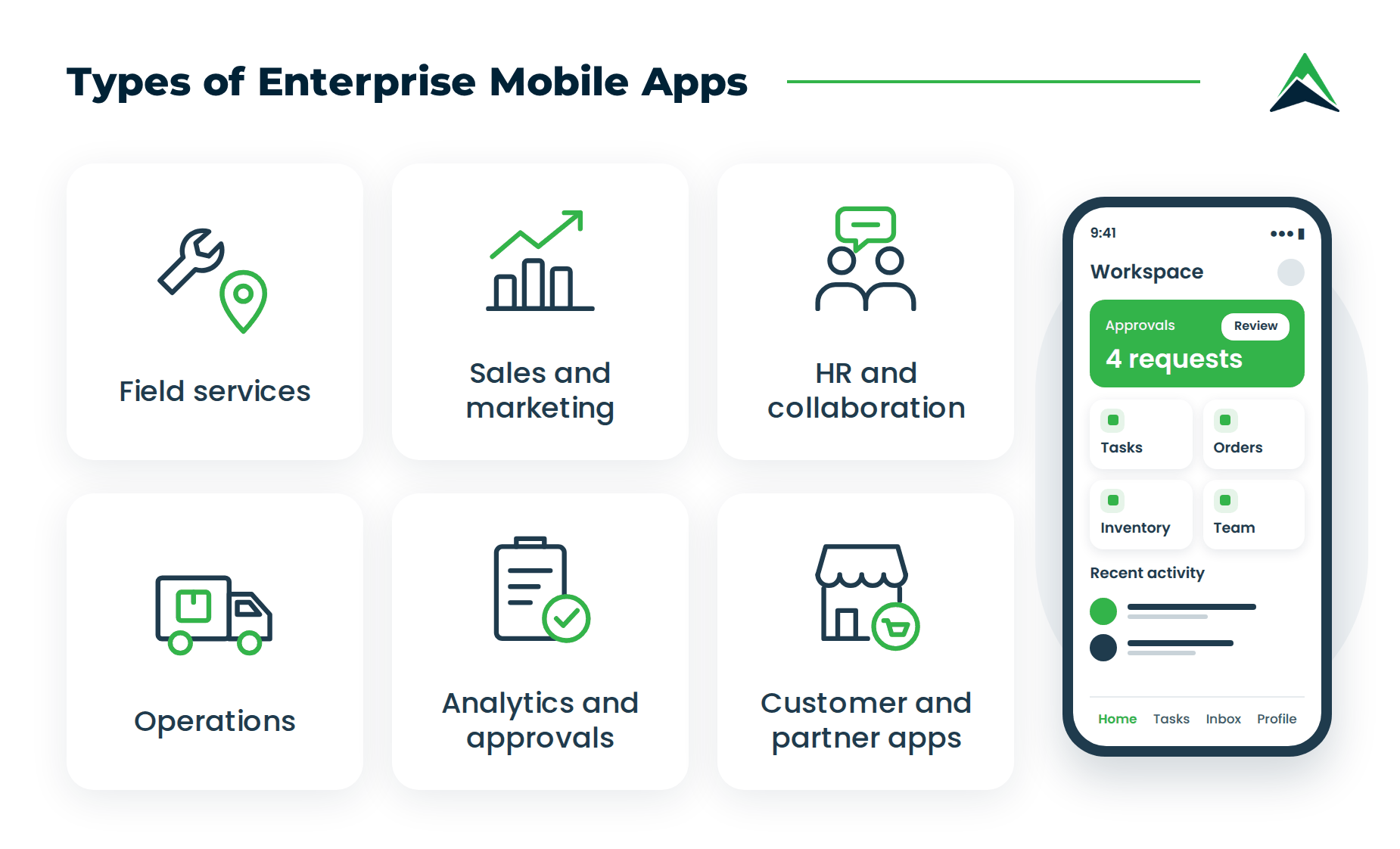
- Field services. Order management, routing, time and asset tracking, and remote access to documents. With such an app, a technician is able to see the jobs for the day, check the equipment history, take photos, and collect the customer’s signature right on the spot. Since field workers often have no signal, offline mode is typically the feature that decides whether the app will be used at all.
- Sales & marketing. CRM and contacts management, inventory access and pricing, order placement, and presentations. The main benefit here is speed: a sales rep who is able to check the stock and place an order during the meeting will typically close the deal faster than the one who promises to send an email later.
- Utilities, HR, and collaboration. Conference software, scheduling and reporting solutions, asset management, time tracking, project and task management, and feedback and rewards are all part of everyday internal work. Shift swaps and leave requests often become the first projects, as they concern every employee and at the same time carry low integration risks.
- Operations. Logistics, security, and inventory management. This group also includes barcode and RFID scanning, dock scheduling, safety inspections, and stock counts.
- Analytics and approvals. Such apps provide managers with KPIs and approval queues right on their smartphones. Being small in scope yet highly visible, they often help win executive support for the larger mobile program.
- Customer and partner apps. B2B ordering portals, dealer apps, distributor tools, and account self-service belong here. While these products are close to consumer apps, they still inherit the requirements typical of enterprise applications, such as account hierarchies, contract pricing, credit limits, and ERP integration.
The enterprise mobile app development process
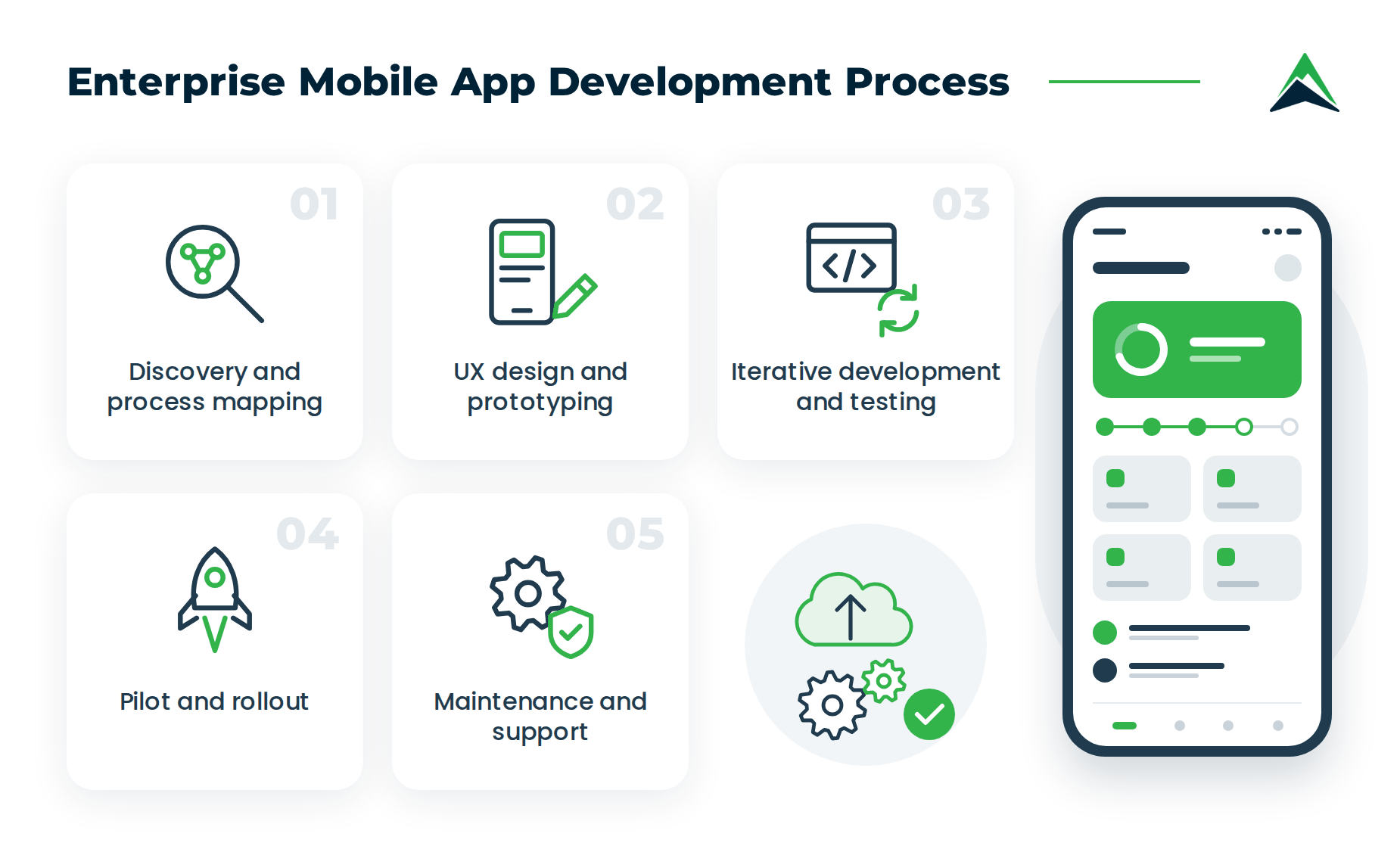
In general, the enterprise mobile app development process consists of the same stages as any other software project. However, in the enterprise environment there are more people to involve and more existing systems to take into account. The key steps are as follows:
- Discovery and process mapping. First of all, you need to observe the people who are going to use the app. At the same stage, you list all the systems the app will read from or write to, along with their owners and available APIs, and agree on the security basics: authentication, device policy, and the regulations you fall under, such as GDPR or HIPAA. As a result, you get a list of prioritized workflows, user roles, success metrics, and the scope of the first release.
- UX design and prototyping. Clickable prototypes should be tested with real users and in real conditions: on the shop floor, in a vehicle, in poor light, or with gloves on. Our UX/UI design process takes these constraints into account from the very beginning.
- Development and testing in short iterations. The API layer and the mobile client are typically built in parallel, with a new build going to a pilot group every two weeks. Each build is tested on the exact device models and OS versions your employees use, including offline sync and security checks.
- Pilot and rollout. It is better to start with one location or team. Once the issues revealed by the pilot are fixed, you can roll the app out in waves, accompanied by short training sessions and visible support.
- Maintenance and further development. The work doesn’t stop at release. OS updates, security patches, and changes in the systems you integrate with all require ongoing attention.
As a rule, a focused first release takes from four to six months, while programs that involve legacy integration or several user roles require more time.
Top 7 challenges companies face when building enterprise mobile apps
While there are many reasons to consider enterprise app development, one should also be aware of the possible challenges that might arise in the process. If you are planning to invest in mobile solutions for your business, be prepared to handle the following challenges.
1. Lack of internal skills
According to the ManpowerGroup 2026 Talent Shortage Survey, 72% of employers have difficulty filling roles, with the largest companies reporting the highest rates and AI skills being the hardest to find.
Hiring local developers has become increasingly hard as the demand for skilled tech professionals continues to grow. Moreover, few enterprises need these specialists full-time forever, as the mobile workload tends to come in waves. Thus, more businesses turn to outsourcing as a proven way to compensate for the lack of internal skills.
Read also: Outsourcing app development benefits
2. Integration and compliance hurdles
When building an enterprise mobile solution, it is important to make sure the new product works well with the existing IT infrastructure. Thus, you need to ensure that the application is seamlessly integrated between all the tools and systems in your portfolio. The challenge becomes especially significant if your business operates on top of legacy systems. Outdated tools and technologies are typically harder to scale.
According to McKinsey, CIOs estimate that technical debt amounts to 20 to 40% of the value of their entire technology estate, and a mobile app tends to expose that debt very quickly.
The most practical solution is to build an integration layer between the app and your back-office systems. With enterprise application integration implemented through an API gateway or middleware, the mobile team is able to work with clean and versioned endpoints, while the legacy systems remain untouched. If a core system is still unable to keep up, enterprise application modernization should become a part of your roadmap, typically in phases so that your operations never stop.
Moreover, some industries, such as healthcare or finance, have pretty heavy regulations. In this case, any solution that you build should comply with the industry norms and requirements. In practice, this means GDPR for personal data in Europe, HIPAA for patient information in the US, PCI DSS for card payments, and SOC 2 requirements coming from your own enterprise customers.
3. Scalability and architecture
An app that performs well for a pilot group of 50 people might fail when 5,000 users come on board. Sync conflicts multiply, while API calls spike at every shift change.
Thus, you should design the solution for the full rollout from the very beginning. This typically includes a cloud backend that scales horizontally, an offline-first data model with clear conflict resolution rules, feature flags for staged releases, and monitoring that reveals problems before your users report them.
4. Data management
Efficient data management is crucial for the long-term ROI of your mobile project, and enterprise organizations typically have loads of data. Yet, it is often scattered across multiple databases, legacy systems, or even physical storage solutions (shared drives, spreadsheets, or even paper documents), which makes it hard if not impossible to collect, organize, and put it to good use.
Mobile applications are a rich source of data. With an efficient data collection and management process in place, you will be able to extract valuable insights about the current state of your business (such as employee performance, asset management, customer care, etc.) and better predict any potential risks or areas for improvement.
Furthermore, it is important to decide early on which system serves as the source of truth for each type of data and who is responsible for data quality. With AI features on your roadmap, this becomes twice as important, as models working with messy records will produce messy answers.
5. Security
A lost smartphone or an employee using public Wi-Fi at the airport might be enough to put your corporate data at risk. Indeed, enterprise mobile security has more weak points than a desktop environment protected by a firewall. Moreover, attackers are getting new tools: the IBM 2026 report has recorded a 56% increase in AI-driven attacks, led by deepfake impersonation and AI-enabled malware.
Fortunately, there are many ways to secure your data and protect your business from cyber-attacks, including the following:
- Identity management. SSO combined with multi-factor authentication and biometric unlock.
- Least-privilege access. Role-based permissions that are verified on the server and never in the app alone.
- Data protection. Encryption in transit and at rest, as well as certificate pinning for sensitive APIs.
- Device control. MDM policies with remote wipe and root detection.
- Regular verification. Penetration testing before every major release.
Thus, enterprise application security should be treated as a design input from the very start, as adding it after the pilot typically costs more and delays the rollout.
6. Employee readiness
While most of your employees might be active smartphone users, they often require additional training to be able to efficiently use enterprise mobile solutions. You can simplify their learning by investing in a friendly UX and intuitive navigation.
However, adoption is the metric that largely defines the ROI of your project, and it rarely takes care of itself. Thus, it is a good idea to involve several respected users from each team in design reviews and to replace classroom training with short in-app walkthroughs. Moreover, you can appoint floor champions for the first weeks and track active use per team so that you can see where the old spreadsheets are still winning.
7. Maintenance
Often overlooked by most business owners, support and maintenance should be a part of your mobile app development strategy from the very beginning. The development process doesn’t stop with the release of the app. If you don’t want to waste your time and money building a throw-away solution, you should include these activities in your budget and plan for ongoing updates and maintenance.
How much does enterprise mobile app development cost?
So how much does it cost to build an enterprise app? The cost largely depends on complexity, and in enterprise projects most of the complexity is hidden in the back end. For example, two apps with identical screens might differ in price by a factor of three if one of them works with a modern REST API, while the other one has to communicate with a 15-year-old on-premise ERP.
Among the main factors that affect the cost of enterprise mobile app development are
- Integrations. Each system requires additional API work and one more round of testing, while systems with no API at all add the most.
- Offline sync. Allowing users to work with no signal and merging their changes afterwards is probably the most underestimated feature in enterprise mobile apps.
- Security and compliance scope. HIPAA or a SOC 2 questionnaire from your customer will add audits and penetration tests to the plan.
- Number of roles and platforms. A driver and a dispatcher, for example, often need different apps built on top of one backend.
- Team model and location. Hourly rates vary widely by region.
Furthermore, keep in mind that cloud hosting and MDM licenses are not included in the development quote, and neither is the maintenance described above.
Read also: How much does it cost to make an app
In-house team or development partner?
An in-house team is a reasonable choice if mobile is a permanent product line for you and if you are able to keep five or more specialists busy all year round. However, for most enterprises the workload comes in waves, so a partnership model typically fits better.
There are two common formats. With team extension, vetted engineers join your existing team and work under your management. With a managed project, the partner takes over the responsibility for delivery within the agreed scope and milestones.
Read also: Hiring enterprise-level developers
Our experience in enterprise mobile app development
Since 2012, we at Eastern Peak have delivered enterprise solutions for companies in logistics, fintech, automotive, eLearning, and on-demand services. Most of them share the same shape: a mobile client for the people in the field, a web console for the office, and an integration layer connecting both to the systems the company already runs. A few examples illustrate what that looks like in practice.
- Fleet management platform. A cloud-based suite with mobile and web editions for individual drivers and a separate enterprise edition for fleet operators, covering real-time vehicle tracking, route history, alerts, and reporting. The same platform is also offered as a white-label product, which required a multi-tenant architecture from the very beginning.
- Corporate mobility platform. A mobile app and back office for a transport company that runs route-optimized employee shuttles, airport rides, and per-organization vehicle pools. Each client organization gets its own pool and rules, while drivers and passengers work from one app.
- Parcel delivery operations for a national carrier. Driver-side mobile tools and dispatcher-side management for last-mile delivery, including scanning, proof of delivery, and route handling in areas with poor connectivity.
- Production and export management system. A bilingual system that tracks lots from the farm to the export warehouse across several countries, with mobile data capture at origin. Our part of this project was the design and architecture of the system.
Aside from mobile solutions, we also build enterprise AI agents that sit on top of existing workflows and complete tasks on their own. Examples include AI agents for legal teams, AI agents for event agencies, AI agents for legacy system modernization, and more. For a mobile app, this means the agent drafts the report or the order, and the person in the field approves it.
The future of enterprise mobile app development
As more businesses come to understand the benefits of mobile in various spheres of business operations, the demand for enterprise app development is soaring. Among the trends that will shape the field in the coming years, we would highlight the following:
- AI agents inside the app. According to Gartner’s best-case projection, agentic AI will drive about 30% of enterprise application software revenue by 2035. On mobile, this might look like an assistant that drafts a service report from a voice note or flags an anomaly in a meter reading before the technician leaves the site. You can learn more about our approach to AI agent development.
- On-device intelligence. Modern smartphones are able to run compact models locally. As a result, sensitive data stays on the device, and AI features keep working offline.
- Composable back ends. With an API-first architecture, one set of services is able to feed the mobile app, the web portal, partner integrations, and any other interface that comes next.
With the staggering growth in mobile adoption among enterprises, savvy business leaders should put mobile strategies at the top of their priorities for 2026. Hiring a dedicated development team with the relevant experience in building enterprise solutions is a good place to start.
Having worked with enterprise companies in logistics, fintech, automotive, eLearning, and on-demand services, we at Eastern Peak have accumulated the experience and skills needed to build reliable, high-performing solutions.
Contact us now to secure your team and drive your business forward with modern mobile solutions.
Frequently Asked Questions
What is enterprise mobile app development?
Enterprise mobile app development is the process of building mobile applications for the internal operations of an organization or for its business customers.
Such apps are connected to the core systems, such as ERP or CRM, and comply with corporate security policies.
What exactly is an enterprise app?
An enterprise app is a piece of software built around the needs of an organization, with defined user roles and integrations with the company’s systems.
Among the common examples are field service tools, warehouse scanning apps, sales enablement apps, and B2B ordering portals.
How long does it take to build an enterprise mobile app?
As a rule, a focused first release takes from four to six months, from discovery to pilot. Larger programs that involve legacy integration or compliance audits might take from eight to twelve months and typically continue in phases.
Read also:
About the author:

Alexey Shalimov, CEO at Eastern Peak
As CEO at Eastern Peak, a professional software consulting and development company, Alexey ensures top quality and cost-effective services to clients from all over the world. Alexey is also a founder and technology evangelist at several technology companies. Previously, as a CEO of the Gett (GetTaxi) technology company, Alexey was in charge of developing the revolutionary Gett service from ground up and deploying the operation across the globe from New York to London and Tel Aviv.