Almost every competitive company has moved toward integrating AI into its operations. The AI Index Report shows that 88% of companies in 2025 used AI for at least one business function.
However, very few businesses have a well-formulated AI strategy that yields promising results. Shifting from experimental or situational AI use to a strategic implementation of its innovative features can be one of the smartest decisions a business can make in 2026.
This article explains what most enterprises do wrong when implementing their AI initiatives, what constitutes an AI strategy framework, and how to build an AI strategy specifically for your business.
What is an enterprise AI strategy?
An enterprise AI strategy is a business-led operational approach that aligns artificial intelligence focus directly with measurable organizational goals and operational capabilities.
This framework evaluates business focus and resources and decides why and how AI will be used, particularly breaking down machine learning and data leverage into practical steps. An AI strategy is used by decision-makers when it comes to:
- Strategic alignment. AI usage happens within a larger strategic context.
- Data and infrastructure readiness. Businesses will adapt their existing data and tools to improve AI data perception and learning.
- Risks and compliance. Since AI has multiple safety concerns, enterprises need to account for them when deciding on further steps.
- Change management. It takes time to prepare staff to trust and understand AI-driven workflows.
Why most enterprise AI initiatives fail before production
Most companies fail in their AI initiatives because they prioritize the AI initiative itself over addressing specific business problems, keeping clean data, and managing operational change.
As frustrating as it might seem, the majority of businesses do struggle with enterprise AI adoption: Research shows that up to 80% of AI projects fail. Some types of AI are particularly disappointing: generative AI was reported to bring zero returns in 95% of companies.
The main reasons for the failure of AI strategies in businesses are:
Not solving the problem
Because AI is so strongly associated with progress, many companies try to hop on a trend rather than consider how to use AI to solve an actual issue. Many businesses don’t know how to begin their AI implementation strategy despite wanting to — and so, they spend money without a plan behind it.
Lacking operational and human readiness
Businesses fail to adopt AI because they haven’t prepared their staff or readjusted their business to the actual technology they plan to introduce. When an AI strategy for business is first introduced, many workers aren’t even prepared for it, which makes adoption far more difficult.
Meanwhile, the operational and technological basis necessary to make AI integration more effective is also missing. Reports repeatedly reveal that businesses aren’t ready internally when starting the adoption process: they haven’t prepared their operations and tools for AI to actually work. That’s why the gap between the new AI projects being investigated (80%) and successfully implemented (40%) is so significant.
Not preparing data for a better foundation
A lack of structured and clean data is often the first barrier businesses face when trying to integrate AI into their procedures. Up to 57% of leaders still see data reliability as a primary barrier to making their AI useful for a company after the piloting.
When an enterprise attempts to train or integrate AI on top of disorganized records and fragmented legacy databases, they spend more time forcing human employees to constantly double-check its work. In this case, the very task AI was meant to speed up ends up being done twice.
The core components of an AI strategy framework
A well-functioning AI business strategy relies on the following four components: strategic business use-case alignment, data and infrastructure readiness, a strong governance basis, and active organizational change management.
Business alignment and use case selection
Business alignment means AI usage targets crucial and high-impact problems in the enterprise and focuses on long-term advantage.
As unpleasant as it is to admit, many businesses adopt AI because they are desperately afraid of falling behind. But trend-chasing isn’t a good predictor of success: although 74% of businesses expect AI to boost their revenue, only one-third (34%) use this tech for deeper business changes.
When planning to use AI, businesses must categorize their priorities into things like cost reduction, operational efficiency, and revenue growth. Doing so will help ensure a business views any potential investment through some of the most promising metrics.
Data and infrastructure readiness
Data and infrastructure readiness ensures that company databases and environments are clean, secure, and structured enough to support AI.
Regardless of how reliable the AI models you choose are, fragmented data and siloed legacy systems will lead to expensive guesswork for your team. Deloitte’s report highlights that only 40% of leaders consider their data preparedness to be sufficient for AI adoption.
Governance and responsible AI
Governance and responsible AI establish clear legal, ethical, and operational guidelines to protect your company and prevent AI errors.
Enterprises that operate without formal AI governance may face regulatory penalties or suffer data privacy breaches — all of this is both financially and reputationally damaging. Governance often touches on data privacy, regular auditing standards, and bias and hallucination monitoring.
Talent, skills, and change management
Talent and change management evaluates the necessary skills and underlying workers’ concerns and develops strategies to help fix this problem for the staff.
Fortune’s survey has shown that more than half of hired professionals prefer performing their jobs manually rather than using AI. More than that, using AI requires skill — and employees aren’t always keeping up with how fast the technology itself is introduced. That’s why, beyond overcoming their initial resistance, many workers need training to readjust to AI implementation and develop competitive skills.
How to build an enterprise AI strategy: a 7-step framework
To build a successful and long-lasting enterprise AI strategy, businesses need to take a structured approach that guides their organization from self-evaluation to sustainable release and maintenance. The answer to the question, “How to implement AI in business?” begins with preparation.
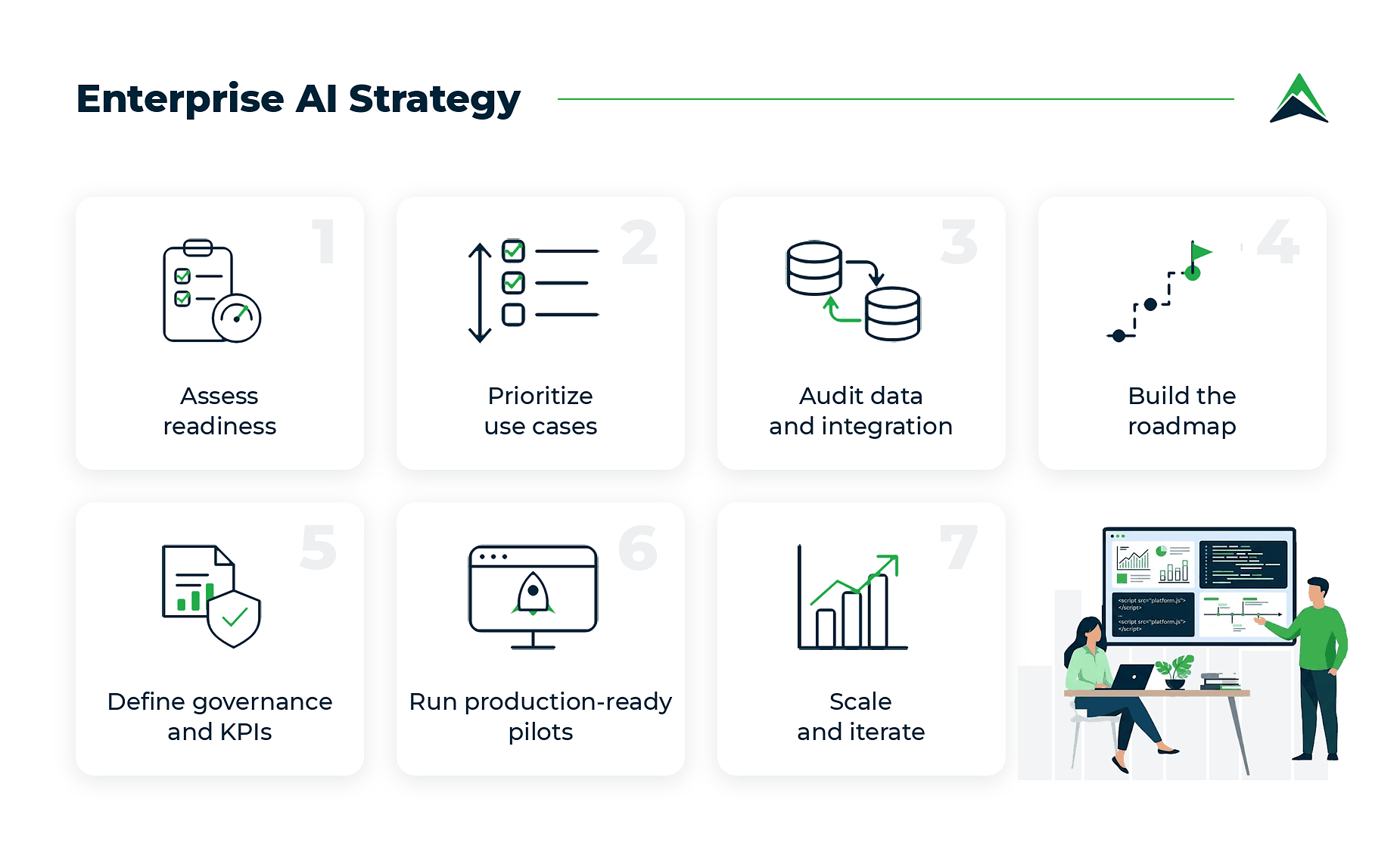
- Step 1. Assess your AI readiness. Assessing AI readiness evaluates your organization’s needs, staff readiness, scope of the problem, and potential barriers. Prior to starting your AI strategy development, ask your team to examine what challenge you want your AI to solve and which direction you need to take. Having a specific focus area and understanding how many people and resources you already dedicate to a task is a strong starting point.
- Step 2. Identify and prioritize use cases. Examine and prioritize use cases to map out potential AI applications for the core tasks. When you have enterprise AI use cases to rely on when narrowing down the focus in your business, you contribute to future ROI — after all, you need high-value solutions for systematic gaps AI can address. Every business is different; for example, Deloitte shows that IT (20%), marketing (20%), and customer strategy (12%) are the most in-demand paths for generative AI.
- Step 3. Audit your data and integration landscape. Auditing your data and integration landscape helps you map sensitive corporate information and connect it to your enterprise’s software. McKinsey’s report on the state of AI reveals that data infrastructure is the core contributor to AI success. When performing this step, businesses first need to catalog their data, then standardize and clean it, and then establish API pipelines.
- Step 4. Build your AI roadmap. A well-designed AI roadmap combines short-term automation improvements with long-term business goals and meaningful technical milestones. An AI strategy cannot (and should not) be executed at once. Forcing it too fast would destroy the reliable structure. A roadmap usually covers setting the foundation, operationalization, and scaling.
- Step 5. Define governance and success metrics upfront. This stage establishes key performance indicators (KPIs) and security. It’s not always entirely clear how exactly AI implementation is supposed to help you — that’s why you have to decide on exact success metrics to evaluate your teams and new technology against. The effectiveness of AI integration is typically examined through the two KPI lenses: operational (e.g., hours saved or improved customer interactions) and financial (e.g., cost reduction or improved sales cycle).
- Step 6. Run pilots designed for production. When an enterprise runs pilots, it explores proofs of concept within real operational environments and machine learning operations (MLOps) architecture. Most pilots fail, but discerning what works from what doesn’t is part of the process. Only 5% of all genAI tools, for example, reach production — MIT calls it the pilot-to-production chasm, and the label fits. With piloting, companies can save plenty of money by trying the technology rather than going all-out and losing their resources.
- Step 7. Scale, measure, and iterate. Scaling and iterating requires continuously monitoring the existing integrations and expanding successful use cases. Businesses labeled as AI high performers are almost three times as likely to have fundamentally redesigned their workflows in their deployment of AI. As your AI transformation strategy proves useful and your operations become more complex, you also grow and redesign your workflows. Update your AI models with fresh data for better performance and accuracy, and collect user feedback to improve the experience.
Common enterprise AI adoption challenges (and how to avoid them)
Enterprise AI adoption might fail because organizations encounter predictable operational barriers like fragmented data, legacy problems, or delayed governance.
Data silos
Data silos prevent AI systems from having a full picture of organizational performance. AI models can deliver limited results when significant pieces of data are hidden inside separate units and departments.
To tackle that, companies have to build centralized data repositories (like data lakes or data warehouses) with clear API connections across departments. Sit down with team leads early on and set firm, company-wide definitions for your key business terms. When you have a well-designed set of rules that accounts for potential barriers, all departments are more likely to adapt as well.
Legacy system integration
This issue occurs when modern AI architectures try to connect with outdated IT infrastructures. Many businesses rely on systems built years ago, and they need modernization — but doing so without losing important information is rarely straightforward. Plus, developers can’t simply hook modern AI solutions into the old, rigid infrastructures. It can often stop businesses from scaling their AI strategy because they aren’t sure how to proceed.
One of the first steps business owners can take is to modernize the specific software components that feed or consume AI insights. This way, they don’t have to rewrite the entire system. Adopting middleware and API gateways will further bridge the gap without drastic changes that could destroy the old system.
Finally, run your heavy AI processing and model training in secure, scalable cloud environments, while keeping your core, sensitive daily records right where they are on-premises.
Unclear ROI
Unclear ROI shows up when organizations deploy AI as an exploratory technical experiment rather than aligning it directly with specific cost reduction or revenue generation metrics. Systematically tracking what AI usage actually delivers is relatively rare, and it’s not clear what this costly adoption does.
Begin by defining a real, quantitative metric for success. Before continuing with measuring things, however, benchmark your team’s current speed, costs, and error rates. Now you will have specific proof of improvement and what to rely on. Lastly, be ready to cut your losses if things don’t work out. Give every pilot a strict and specific window to show real traction toward its financial goals. If it fails, then redirect your funds.
Talent gaps
When it comes to new technologies like AI, internal teams lack the technical skills to build AI systems or the practical training to adopt them day to day. Much of AI transformation is about people, but not all individuals have the necessary skills, especially amid immense AI acceleration. If your workforce doesn’t trust or know how to leverage AI, adoption will stall.
Business owners can overcome talent gaps by attracting new talent for high-tech positions while investing in training the existing staff to manage the system. They need to look for the tech-savvy enthusiasts who are already there in different departments and give them more authority and initiative. To explain how AI actually works (and thus target both resistance and a lack of current skill), managers must walk their employees through real-world scenarios in the exact applications they use daily.
Governance added too late
Adding governance late creates major compliance, legal, and operational risks. This can drastically eliminate any progress gained from introducing effective and financially viable solutions. Ignoring governance will lead to data privacy violations, intellectual property exposure, or model hallucinations.
That’s why prioritizing security from day one is the easiest solution that already sets the pace. Include compliance, legal, and IT security leads in your very first brainstorming sessions so they can help set safe boundaries from the start. Establish a crystal-clear, company-wide policy on what data can and cannot be used with AI, and explain to your employees how it actually works.
Finally, always keep a human in the loop for high-stakes decisions since it’s a strong and relatively easy solution to costly hallucinations.
How Eastern Peak fits into your enterprise AI strategy
Eastern Peak builds custom AI agents for enterprises, and the way we work follows the framework above. One workflow per build, a production-ready version in under two months, and the code stays with you. Where a decision matters, the agent stops and waits for a person; those points are agreed upon before development starts.
The AI Readiness Assessment is an optional first step: seven questions, roughly five minutes, and a verdict on whether the workflow you have in mind is worth automating. It weighs how much of the work involves judgment and how frequently it comes up.
We build agents for a wide range of industries, including legal, events, finance, insurance, procurement, healthcare, logistics, retail, and manufacturing. Some examples:
- AI agents for legal teams: agents that read contracts against the firm’s standards, pull out the clauses that matter, and draft redlines for a lawyer to approve.
- AI agents for event agencies: agents that find venues and vendors matching a brief, check availability and pricing, and assemble the offers into a proposal draft.
- Legacy system modernization with AI agents: agents layered on top of older systems, where only the parts that exchange data with the agent get updated and everything else connects through APIs.
Rewiring your strategy
Companies that take first steps in building a lasting AI strategy for their enterprise might feel disheartened by the gap between their expectations and the challenges reality presents. However, it helps to acknowledge that any technological adoption comes with potential stumbling blocks.
Taking an honest look at your organization’s capabilities and beginning with use cases produces a far more concrete path forward and shows how to address weaknesses of your system and promote rapid growth with new AI solutions.
Seeing your enterprise’s objectives clearly and tapping into the AI potential isn’t always easy. Want to know how to choose the best AI strategy for a company? Contact us, and we’ll help you evaluate your readiness for change and help you build a framework that fits your goals.
Frequently Asked Questions
What is enterprise AI strategy?
An enterprise AI strategy is an operational roadmap that connects artificial intelligence investments directly to measurable business returns and the improvements it provides for the team. It is structured and uniquely adjusted to the business’s objectives.
How to create enterprise AI strategy?
Audit your current AI readiness, prioritize use cases that show high returns, clean up your data, and test pilots before going into full-scale production.
What makes a good AI strategy?
A good AI strategy is specific to the business it is designed for and focuses on specific outcomes rather than abstractions. It also combines gradual change with legacy systems modernization and hands-on change management that targets employee growth.
Read also:
About the author:

Alexey Shalimov, CEO at Eastern Peak
As CEO at Eastern Peak, a professional software consulting and development company, Alexey ensures top quality and cost-effective services to clients from all over the world. Alexey is also a founder and technology evangelist at several technology companies. Previously, as a CEO of the Gett (GetTaxi) technology company, Alexey was in charge of developing the revolutionary Gett service from ground up and deploying the operation across the globe from New York to London and Tel Aviv.