The Edtech market is rapidly growing: while it was valued at $189.15 billion at the end of 2025, projections indicate that it could reach over $588 billion by 2034, with a 13.45% CAGR.
Edtech software development services don’t just cover traditional K-12 or higher education; they also address corporate and governmental needs, each with its specifics. The education software emerging today is set to address a pressing need for long-term education and training: by 2031, 72% of professions in the U.S. alone will require candidates to possess postsecondary education and/or training.
Creating educational software that meets your organization’s training, procedural, and safety requirements ensures long-term growth and provides a unique strategic resource that others can’t replicate.
This article explains the main types of educational software solutions, how one is developed, how much education software development services cost, and the factors that play a critical role in the process.
What is education software development?
Custom education software development involves designing, building, and maintaining digital platforms and tools specifically tailored to the learning and training needs of institutions or organizations.
Despite higher initial costs (custom software is more expensive than off-the-shelf solutions), the long-term benefits of personalized, custom-made solutions are far greater. They provide a company or institution with:
- Zero licensing issues due to total ownership of the software
- Perfect data control and compliance
- Seamless integration with legacy systems
- Possession of a unique asset.
Types of education software solutions
Education software solutions encompass diverse tools and instruments that automate access to training and its administration, deliver engaging learning content, and track students’ performance.
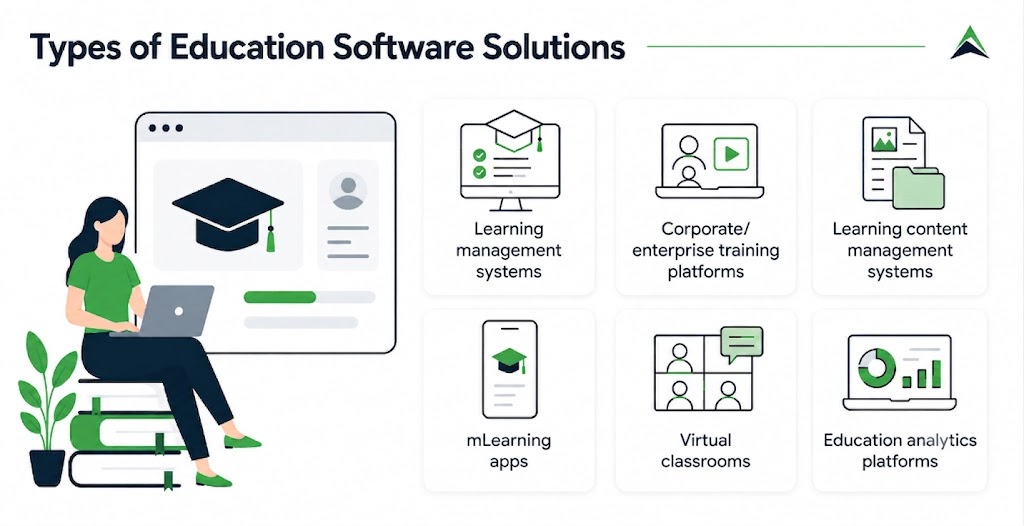

Learning management systems (LMS)
Education software solutions development for the LMS sector enables businesses to build platforms that host, track, and measure educational courses and training programs. The global LMS market was over $24 billion in 2025. In the U.S., the market already exceeds $11 billion, accounting for nearly half of the global industry.
Traditional educational methods are costly in both time and money. LMS automate management and learner tracking/organization, with the corporate sector leading the way. That’s why companies use LMS to maintain compliance and structure their learning delivery.
Read also: Learning Management System: From Idea to Implementation
Corporate/enterprise training platforms
Corporate training platforms are custom-built systems made to either onboard new hires or improve the skills of the existing workforce. Companies with extensive employee training have a 24% higher profit margin. The global market for corporate learning management systems is expected to exceed $11 billion in 2026, and this trend is set to continue.
Businesses build corporate training platforms because generic learning tools usually don’t account for specific business dynamics or the financial return on investment (ROI) of training programs. Thanks to them, companies can create courses aligned with their KPIs, track each employee’s progress, and keep training skill-focused.
Learning content management systems (LCMS)
A learning content management system (LCMS) is a type of custom edtech software that enables content creators, teachers, and instructors to create and manage digital learning assets. Large organizations and institutions frequently deal with outdated training materials found across different branches and the slow, manual process of updating different documents. But with LCMS, handling learning materials becomes more manageable.
While LCMS don’t focus on the learner, they are valuable tools for handling, organizing, and reusing content as a whole. Up to 26% of companies use LCMS in their training. These systems allow content managers to quickly update how they present course materials if a new regulation or rule is introduced. After a quick update, it is reflected across all courses.
mLearning apps
mLearning (mobile learning) apps are applications specifically designed for smartphones and tablets that provide learners with convenient, on-the-go access to educational content. The mobile learning market is worth almost $96 billion in 2026 and includes in-class and corporate education.
Old-fashioned learning is usually longer and requires sustained commitment, which can discourage people from learning. That’s one of the factors that has pushed mobile learning apps to be more diverse. They break both time and commitment barriers with microlearning, audio lectures, and download features. Users can comfortably learn during their commute, downtime, or when performing other tasks, making education more accessible and achievable.
Read also: eLearning & mLearning: Educational App Development Best Practices
Virtual classrooms
Virtual classrooms are online platforms that use collaborative tools such as live video and interactive whiteboards in real time. In 2025, the global virtual classroom market was valued at $23.2 billion, driven by demand for alternatives to self-paced digital learning. Because self-paced learning can lead to low engagement and high dropout rates, developers focus on reintroducing the human element into remote environments while preserving the advantages of online learning.
Today, educational software development heavily targets virtual classrooms due to the fragmentation and diversity of education. Virtual classrooms are regularly used in K-12 and higher education. However, businesses, too, build custom virtual classroom software — it allows them to embed secure video architecture directly into their systems, thereby protecting intellectual property.
Education analytics platforms
Educational analytics platforms collect engagement and learning data and provide useful insights through predictive dashboards. Many organizations and institutions invest in these edtech solutions to prevent data blindness and ensure that their training and teaching efforts address existing issues.
Analytics platforms are typically integrated with other tools; their goal is to maximize ROI. A custom analytics engine uses machine learning to help employees or educators identify which training modules correlate with better learning outcomes and/or professional output. And so, such a platform transforms raw data into practical growth metrics.
Education software development process
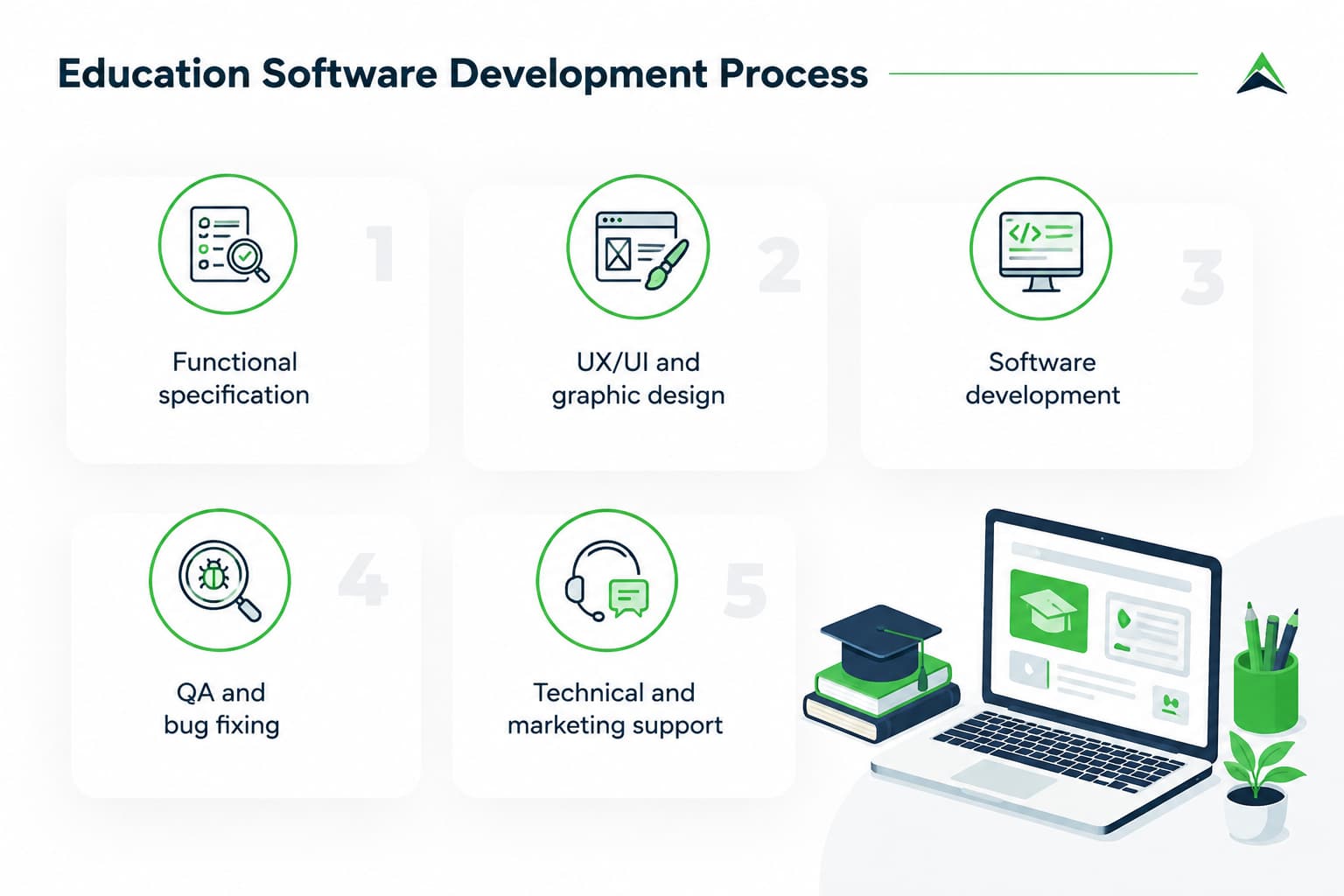
The education software development process comprises multiple steps that bring a learning tool from a vague idea to a final, fully functional digital learning platform.
- Functional specification. This phase establishes a clear product vision by gathering your specific business requirements and identifying your target audience’s needs and pain points. The development team creates user personas, defines the main features to implement, and builds user flows.
- UX/UI and graphic design. Designers construct the user interface (UI) and user experience (UX) to create an intuitive, engaging experience for learners and administrators. This step produces interactive wireframes and visual prototypes so that the client can see how the tool will look.
- Software development. Engineers develop educational software based on decisions made regarding scope, size, and complexity. Developers focus on scalability to support future growth and use proven architectures and languages to build a foolproof, adaptable product.
- QA and bug fixing. Quality assurance (QA) specialists test software under various complex and stressful conditions to verify that everything works as expected. This stage is critical: it identifies vulnerabilities and unforeseen problems and provides maximum stability.
- Technical and marketing support. The partnership between a development team and a client often endures through ongoing performance monitoring and system upgrades. The tech team stays accessible to address emerging issues and keep improving the software.

What to consider before building
Before investing money in custom-made educational software, business owners must evaluate crucial security-related, technical, design, and growth factors.
Security, data privacy & compliance
Businesses need to consider which security measures they need to protect user identities and secure organizational data. EdTech platforms store a large amount of data that can be compromised in a cyberattack or data breach.
A report on data breaches states that the education sector was most commonly targeted by cyberattacks, with schools averaging 4,388 cyberattacks per week. Educational platforms that serve business needs may have even more at stake, as they may contain crucial business information alongside workers’ personal data.
Because custom software development allows engineers to embed security priorities directly into a tool, companies have a unique opportunity to safeguard their information and intellectual property. Entrepreneurs should know what to expect from their developer teams: specialists can apply end-to-end encryption and add role-based access control (RBAC) to make any platform more secure.
AI & personalization
AI and personalization can make training more adaptable and dynamically modify content types based on individual user behavior and performance metrics. Corporate and academic programs alike lose immense value when users check out mentally because the material does not address their specific skill gaps. Therefore, new education and training solutions are being increasingly personalized to support more effective learning and increase user engagement.
Integrating AI and personalization into software adds value and considers users’ experience for better outcomes. Making course learning more flexible helps learners actually complete it, so adding personalization is one of the most effective ways to maximize knowledge retention.
Read also: AI in Education: Personalizing Learning Experiences
Accessibility
Accessibility in software means engineering user interfaces that help users with diverse visual, auditory, motor, and cognitive abilities navigate the platform easily.
Although the exact level of accessibility depends on who will use the software, any company that employs people needs to ensure at least basic accessibility. Most education technology software development teams rely on standards such as Web Content Accessibility Guidelines (WCAG) in their design principles.
Scalability & high performance
Education software needs to be capable of handling sudden, massive spikes in traffic and data processing without losing its performance edge. Many entrepreneurs decide not to consider scalability because it seems relatively distant. But when they have the opportunity to immediately introduce flexibility and high performance into a new instrument, they can save time and money in the long run.
A slow system destroys user participation and disrupts operational workflows. In contrast, developers who plan for continuous usability often opt for cloud-native infrastructure combined with microservices, and this helps them prepare for future surges of users and information.
Integration capabilities
When developing education tools, engineers need to provide seamless integrations with other systems inside and outside the organization. For instance, HR specialists are often tasked with reviewing newbies’ learning progress, so ensuring they can log in or use existing information in their analytics tools is vital.
Aside from internal systems, education software often integrates with third-party APIs — that’s why developers must make integration easy.
User-centric design across age groups
Depending on the target audience, the design of a new educational platform or instrument must be user-centric, grounded in a clear understanding of digital literacy and the needs of the specific age group.
Some companies have employees who prefer a gamified, interactive approach to design, while others might learn best with a more traditional approach. Most of it does depend on age, though people’s unique preferences can vary based on the company’s culture too. Employers should examine which content type and presentation will best suit their workers.
Read also: Top 7 Education App Design Trends and Best Practices to Follow
How much does education software development cost?
The cost of edtech software development varies significantly based on complexity and feature set.
Cost ranges by complexity
It gets more expensive to build software the more complex it is and the more features it has.
- Minimum Viable Product (MVP). If you want just clean core features with a product to temporarily validate the concept, it’ll be the cheapest option. It can secure stakeholders’ support or disprove prior market research findings.
- Mid-tier. This version typically provides learning workflows, administrator dashboards, and interactive content delivery with more personalization. It offers plenty of features while keeping costs relatively steady.
- Enterprise. Software with enterprise-level complexity can handle large volumes of traffic, support multiple complex features, meet strict compliance auditing requirements, and enable rich customization. Although this product costs more, enterprises consider it a useful investment from business and procedural standpoints.
Cost drivers
Since every software project is highly customized, each specific variable will increase the hours spent on your product and the production price quoted by education software development companies.
- Platform type. Platform type dictates how much development work will be put into the product. For example, designing a desktop web portal will be far cheaper than going for a cross-platform mobile application.
- Integrations. If a tool is meant to work on its own, developers won’t need to think about integration. But if you have other tools (e.g., HR systems or internal databases) or legacy systems that you want your new software to integrate with, it’ll require more work and troubleshooting.
- Security and legal compliance. Data encryption, multi-factor authentication, and audit logs that comply with privacy laws such as FERPA or GDPR increase backend complexity, so such educational software solutions will cost considerably more.
- UI/UX design. Although you can have an appealing, clean design at a low cost, it becomes more expensive if you want a highly detailed interface that complies with global accessibility standards or includes complex gamification.
Eastern Peak’s experience with education software
Eastern Peak develops education software for corporate, academic, and consumer audiences, including learning management systems, tutoring platforms, and mobile learning apps. The examples below show a few of these projects in more detail.
- A corporate LMS for an e-learning provider. The client’s platform ran on four separate cloud services, which made hosting expensive and scaling slow, while the previous vendor could not deliver new features fast enough. Eastern Peak consolidated the architecture into a single AWS environment, refactored the codebase, and dockerized the solution to strengthen security. The rebuilt LMS supports interactive learning journeys, targeted task allocation through HR-system synchronization, live audio and video streaming, and KPI dashboards for managers.
- A tutoring management platform for higher education institutions. Students search for lessons and tutors using advanced filters, book sessions based on preferred locations and time ranges, and track both their learning progress and their budget in real time, while administrators manage the program through a dedicated dashboard.
- A scheduling and payment website for a school tutoring company. The site lets students and their parents book intensive math, science, and humanities sessions against teachers’ published schedules and pay for classes online by card or PayPal.
Building your competitive edge
Businesses that are willing to dedicate their resources to custom education software are creating a rather enduring asset, one that remains flexible even as material and market demands change.
A product that scales with a company, easily integrates with other tools, and remains flexible in response to legal and internal changes is a strategic advantage. Building such a tool, then, contributes to both employees’ and the company’s growth.
Want to build a lasting edtech software solution that suits your budget and business plans? Contact us to turn your vision into a practical roadmap.
Frequently Asked Questions
What is education software development?
It is the process of designing, building, and managing edtech software based on organizations’ or businesses’ specific needs and demands. Such software can be anything: a learning portal, a mobile app, or a corporation-wide training system.
How much does edtech software development cost?
The price an edtech development company can charge depends on functionality, complexity, compliance, design, platform type, and integrations.
How long does edtech software development take?
A timeline for making a custom product ranges from 3-4 months for a lean validation prototype to over a year for highly complex systems. Because software development is highly client-specific, you can get a clearer picture after discussing initial plans with your developers.
Read also:
- 10 EdTech Startup Ideas for Education Entrepreneurs in 2025
- eLearning & mLearning: Educational App Development Best Practices
- How to Create an eLearning Platform like Udemy: A Complete Guide
- Learning Management System: From Idea to Implementation
- How to Build a Language Learning App: Essential Features and Best Practices