Ever since the rise of digitization, eCommerce has taken a significant share of the global retail market, comprising close to 24% of total retail. Its global revenue is estimated to exceed around $3.6 trillion worldwide. This rapid pace has transformed eCommerce software from simple online storefronts into rather complex ecosystems.
Our expectations for a reliable eCommerce platform go beyond higher volume and greater customer use. Business owners also need a more agile structure that integrates with third parties. Well-developed software becomes a strategic advantage that requires time and effort.
This article dives into eCommerce software development and its most common solutions, analyzes core features of an eCommerce platform, examines the development process, and taps into the emerging trends.
Whether you are launching a startup, managing a digital transformation, or simply curious about the technology powering modern retail, this guide provides the essential roadmap you need.
What is eCommerce development?
eCommerce development is the process of designing, building, and maintaining software solutions that enable your business to sell products or services online.
Think of it as a force behind your business: it ensures that your sales channels are aligned with your operational workflows, customer experience, and overall strategy. It’s always dynamic: even an ideal system needs maintenance, and custom eCommerce software development is a part of your business trajectory.
Custom eCommerce development vs ready-made platforms
eCommerce software solutions can be built using ready-made platforms or developed from the ground up as custom software. What’s the main difference? Your needs.
The existing platforms, such as Shopify and WooCommerce, offer many benefits: built-in storefront templates and admin panels, standard checkout, payment, and product features, extensions for added functionality, and a relatively simple setup. Many businesses go for this option because it’s faster and may be more convenient.
If you need detailed customization, flexibility, and better control over your finances (e.g., transactions), you may be considering a custom solution. While requiring more upfront costs, working with an eCommerce development company provides businesses with a tailored structure designed specifically for them.
Plus, your own eCommerce solution will allow you to determine your integrations with ERP, CRM, or logistics systems and control how your data is used.
Custom eCommerce development vs ready-made platforms: comparison
| Factor | Ready-made (Shopify, WooCommerce) | Custom Development |
|---|---|---|
| Upfront cost | $5,000–$50,000 | $30,000–$500,000+ |
| Time to launch | 2–8 weeks | 3–12 months |
| Monthly platform fees | $29–$2,000+/mo (Shopify: $39–$399 standard) | Infrastructure only ($50–$2,000+/mo) |
| Transaction fees | 0.5–2% per transaction (unless using native payments) | None beyond payment processor fees |
| Customization | Limited to platform capabilities and plugins | Unlimited, any feature or integration |
| Scalability | Constrained by platform limits | Scales to any volume with right architecture |
| Integrations (ERP, CRM, logistics) | Via plugins; complex integrations often need workarounds | Native, direct integrations to any system |
| Data ownership | Platform controls data infrastructure | Full ownership and control |
| Best for | SMBs, fast launches, standard product catalogs | High-volume, complex, or differentiated businesses |
Types of eCommerce solutions
eCommerce development solutions can be categorized based on how value is delivered to customers, how transactions are structured, and the kind of digital infrastructure required. Each type of eCommerce solution serves a distinct business goal and has distinctive technical and operational requirements.
- eCommerce stores. These stores are designed to sell products from a single company directly to customers. A vendor decides the product listings, pricing, branding, and customer experience. Examples of such stores include various retail brands or niche online shops.
Read also: How to Move Your Brick-and-Mortar Business to an Online Ecommerce Store
- Online marketplaces. An online marketplace is the direct opposite of eCommerce stores — it serves as an eCommerce platform where companies can list and sell their products. Such marketplaces share a digital infrastructure, with one platform owner controlling how the eCommerce website or app works, advertises, and operates. Platforms such as Amazon are the most obvious illustration of this case.
Read also: How to Create an Online Marketplace: A Guide to Building and Launching Your Platform
- Service-based eCommerce platforms. These platforms facilitate online sales and scheduling of services rather than physical goods. As a rule, they offer functionality based on time slots, specific service providers, and a certain niche to focus on. Think healthcare or education, where you can arrange a call or a meeting with a professional.
- Mobile eCommerce apps (mCommerce). Unlike previous types of eCommerce solutions, mCommerce targets businesses that prefer to buy and sell via smartphones and tablets. While they can simply complement a web-based platform, some become replacements for those on the go.
Read also: The Future of mCommerce Apps: Trends to Watch and Lessons to Learn
- Subscription-based platforms. Customers using these solutions pay for access to the products or services on a regular rather than on a one-time basis. SaaS products, digital content platforms, or various subscription boxes are common examples that you might regularly see.
- Digital product platforms. These platforms focus on distributing non-physical goods, such as media, software, or digital prints/designs. They are usually highly dynamic and have a diverse range of functions from digital delivery to licensing management. It can be a B2B ecommerce platform where businesses can buy licenses or software or just an individual-oriented alternative.


Core features of a scalable eCommerce platform
The core features of a scalable eCommerce platform balance customer-facing functionality, admin control, and business operations. How to build an ecommerce platform that offers all the necessary features? While you cannot create a universal platform for all types of eCommerce, you can start from a solid foundation.
Customer-facing features
Customers are using eCommerce so often that not considering their interests at the core of software would place your business at a disadvantage. Most buyers already make online purchases regularly, and this trend will only continue to grow.
Key features include:
- Product discovery and search navigation, which is related to search, filtering, and category browsing (today, they’re often enhanced with AI-driven search relevance and personalization)
- Personalized recommendations based on browsing behavior, purchase history, and preferences
- Shopping and checkout, which cover the shopping cart itself and the guest checkout
- Payment options, supporting multiple payment methods and currencies
- Customer accounts that provide access to order history, wishlists, and saved carts
- Post-purchase features, such as order tracking, notifications, ratings, and reviews
Business features
Businesses often need to cut corners to get more productive. A customized eCommerce solution offers multiple opportunities for improvement where a standard solution falls short. This includes:
- Product and catalog management, encompassing categorization and attributes
- Inventory management with regular stock updates
- Order processing, with smooth order processing, fulfillment, returns, and refunds
- Pricing engine with adjustable pricing and discounts
- Analytics that covers reporting and metric changes
- Marketing tools to expand product reach, including promotions, coupons, and loyalty programs.
- Integrations with third parties for a broader functionality — from CRM to logistics.
Admin features
The admin panel allows a business owner to organize and manage order information, customer data, and content activity. Essentially, this eCommerce app development factor consolidates all owner-controlled procedures in one place. This means:
- User management that accounts for certain permissions for work staff, vendors, and partners based on profile and status
- Order and dispute management, including fraud handling and customer support procedures
- Platform-wide analytics and reporting with real-time performance monitoring and customer behavior analysis
- CMS (content management system), which supports quick and customer-attracting media content creation
Overarching platform features
At a broader level, overarching features form the platform’s technical foundation. They cover all areas/departments, necessitating greater integration across functional areas. Some of these are:
- Security and protection, especially data encryption, user privacy, and fraud prevention
- Scalability and performance that enable a platform to grow and adapt using cloud infrastructure, load balancing, and caching
- Integrations, especially third-party integrations, are necessary for achieving seamless system performance
- Mobile optimization, meaning the platform is to be as effective as the desktop-only platform
- Localization and internationalization, which might mean adjustment to languages, currencies, and regional settings.
- Compliance specifics, including data protection, payment standards, and industry regulations
eCommerce development process
How to build an ecommerce platform? A typical custom eCommerce development process is a full-scope procedure that includes discovery and planning, UI/UX design, development, integration, testing, launch, and maintenance. While each case may be different, this one’s a pretty golden standard for most eCommerce platforms.
Discovery & planning
The scope of a platform’s business in eCommerce is immense. A report from Eurostat shows that, while the number of e-sales has grown, the turnover rates haven’t always been as consistent.
For example, e-sales in 2018 reached around 19.72% of total enterprises and accounted for 18.06% of turnover, while 23.83% of enterprises with e-sales generated around 19.12% turnover in 2023. There’s a gap between the two. That’s why a strong vision can determine how effective your product will be.
The discovery phase typically includes market and competitor analysis, feature scoping, technical feasibility assessment, and architecture planning.
UI/UX design
This stage focuses on how users interact with the platform and on their overall experience. For an eCommerce that depends on how easy and smooth the browsing-to-cart pipeline is, design is key. This means every element is clear and prioritizes conversion.
Frontend & backend development
Now’s the time to put all the ideas and concepts into working software. eCommerce software development companies typically have their preferred tech stack, making it easier for a company to choose the functionality and look that work for them. The development process has two main steps:
- Frontend, which handles everything concerning the customer-facing interface (often built using JavaScript frameworks)
- Backend, which is about your business logic and procedures beneath what the customer sees (using technologies like Node.js, Python, Java, or PHP).
Integrations
A well-developed and effective eCommerce platform incorporates integrations with essential third-party systems that support business operations. So a platform that relies on selling its products will have at least payment gateways, ERP and CRM systems, shipping and logistics providers, and marketing platforms.
Testing & QA
Every eCommerce software development company tests whether its product is ready for launch in real-world scenarios. This means ensuring an eCommerce platform can handle a large number of users in full-on active mode, while each system functions well. A team usually conducts functional, performance, and usability testing, as well as security checks, across all devices and/or platforms.
Launch & deployment
Arguably, it can be one of the most difficult stages in the process since release can reveal various previously undiscovered challenges. That’s why eCommerce development companies often opt for the controlled deployment, which includes soft launches or staged rollouts.
During this stage, a team relies on monitoring tools, detailed cloud configurations, and an environment setup aligned with their user flow expectations.
Maintenance & updates
While it’s the potential end of an eCommerce website development from scratch, real development never comes to an end. A business regularly performs updates as new features are needed or when a team notices a glitch to fix. And there’s always something in security updates or performance optimization that can boost platform efficiency.
Cost of eCommerce software development
How much does ecommerce website development cost? The pricing for eCommerce app development services varies based on the scope, technical complexity, and the project’s long-term goals.
- Features & complexity. Customized solutions don’t have a maximum limit: it all depends on how many features a company wants to add. A small online shop with only a few categories and a “Contact us” button will cost way less than a platform with multiple sellers and thousands of customers.
- Design/UX. Design gets more expensive with more animations or specific user flows. This includes the time the development team spends on the project, so its influence on pricing is understandable. If you need a simple, clean solution without any add-ons, it will decrease the final cost.
- Platform choice vs custom development. It’s usually cheaper to use an existing platform because a business has a pre-made solution that simply needs slight tweaking. This, of course, comes with its consequences: some features or design choices may not be a 100% match. However, custom eCommerce app development, where a company determines all the significant features for the platform, will cost much more but offer more aligned solutions. It’s a matter of balancing convenience and price.
- Integrations. Each integration increases the development effort, and they need to align and connect with an emerging product well. Aside from the shipping providers, payment gateways, marketing, and the ERP and CRM we have mentioned, growing business platforms can also add custom or legacy system integrations. This requires substantial additional engineering and testing.
- Team size and location. The bigger the eCommerce app development company and its team, the higher your numbers are. But the location also plays a crucial role: if you live in a high-earning country and look for local developers, you’ll find significantly higher rates than with an international team that offers more flexible pricing. Again, there might be situations when it’s better to have a local hire, and vice versa. The market, however, moves abroad: Forbes reports that 81% of U.S. engineering leaders plan to hire globally.
- Timeframe. If you need to launch your product fast, it’ll cost more than if you give your development team more time to work. Those businesses that plan in advance can cut a lot of extra expenses on eCommerce web development services just by playing a longer game.
- The hidden costs. Even if you account for all the expenses, there will most likely be more additional costs you may underestimate. This includes server and infrastructure costs that can grow with your traffic. The integrations we’ve mentioned above can also put another financial burden on a business due to third-party API fees. Lastly, maintenance costs need to be accounted for and budgeted for since this project will require in-house or contractor support.
eCommerce software development cost by project type (2025–2026)
| Project Type | Cost Range | Timeline | Team Size | Typical Stack |
|---|---|---|---|---|
| Simple online store (custom, basic catalog) | $15,000–$40,000 | 6–12 weeks | 2–3 devs | WooCommerce custom / Shopify Plus |
| Mid-market eCommerce platform | $50,000–$150,000 | 3–6 months | 4–6 devs | React + Node.js / Magento 2 |
| Marketplace (multi-vendor) | $80,000–$200,000 | 4–8 months | 5–8 devs | Custom React + microservices |
| Enterprise eCommerce platform | $200,000–$500,000+ | 8–18 months | 8–15+ devs | Custom architecture, cloud-native |
| mCommerce app (iOS + Android) | $60,000–$180,000 | 4–9 months | 4–7 devs | React Native / Flutter |
| Subscription / digital product platform | $40,000–$120,000 | 3–6 months | 3–5 devs | Node.js + Stripe / Recurly |
Estimates reflect custom development with core features by a European/Ukrainian engineering team. Based on Clutch benchmarks and Eastern Peak project data. Enterprise builds with advanced integrations may exceed upper range.
These ranges reflect standard custom development. Depending on your product scope, Eastern Peak’s AI-accelerated development can deliver a working eCommerce MVP or marketplace prototype in significantly less time, with senior engineers ensuring the architecture holds up from day one. Get in touch to find out if this approach fits your project.
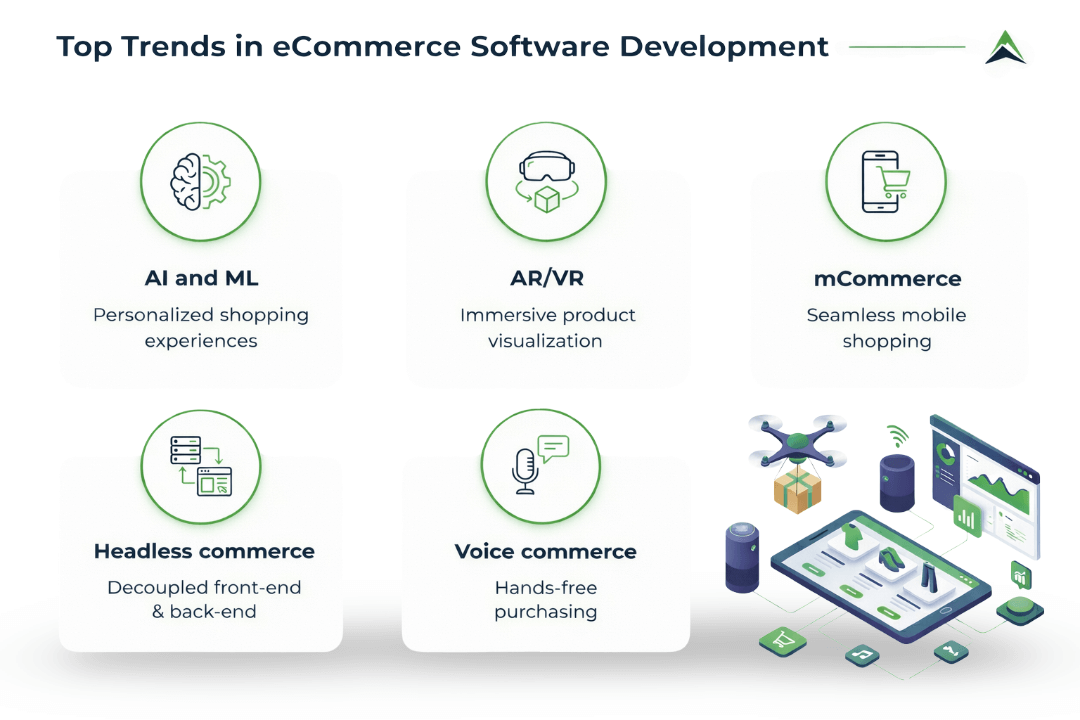
Top trends in eCommerce software development
Today, eCommerce continues to develop in response to growing customer expectations, technological innovation, and consumer behavior. Below are the trends that are shaping eCommerce development.
AI and ML
It’s estimated that by 2030, AI use in eCommerce will be valued at around $17.1 billion. Businesses adopt AI and ML for better personalization, decision-making, and overall operational efficiency. This improves search and filtering for customers and provides them with better, more individualized products/services.
Moreover, more online stores are already using AI-powered chatbots for 24/7 communication. This will expand further.
AR/VR
Although attempts to implement AR and VR have been made before, they didn’t have the same elegance that is possible now. With other technologies moving along, AR and VR are finally more accessible and adjustable. Grand View Research estimates that AR in eCommerce will reach nearly $38.6 million by 2030.
eCommerce and AR/VR are a natural match because users can get an experience as close to a physical store as possible without leaving home. AR allows users to visualize products in their real-world environment, while VR enables fully immersive virtual stores that replicate the in-store experience.
mCommerce
Recent years demonstrate a clear shift from PCs and laptops to mobile-only use. Globally, more people own smartphones than desktops or tablets combined, and even slight fluctuations don’t change the overall gap.
Modern platforms are increasingly designed with a mobile-first mindset, which will further impact eCommerce software development services as more companies adopt this strategy.
Headless commerce
Around 73% of businesses use headless website architecture, according to WP Engine. This practice separates your frontend from your backend, which makes online sales more scalable and flexible.
Voice commerce
In line with mCommerce’s growth, voice commerce will grow as well. With a projected $186 billion by 2030, this market sector is growing rapidly. Customers will want to place orders without spending minutes typing in all the details or figuring out how a website or app works. Companies might want to consider this trend before it becomes more extensive.

Eastern Peak’s eCommerce expertise
Putting the theory of eCommerce development into practice requires a partner who understands the nuances of the digital landscape. At Eastern Peak, we translate complex business requirements into functional, scalable, and secure eCommerce ecosystems.
Our experience spans the full spectrum of the solution types and different industries, demonstrating our capacity to build custom architectures from the ground up:
- Custom retail storefronts: We helped Klim Jewelry build a sophisticated, custom-designed eCommerce store on Magento. By developing unique elements from scratch, we enabled them to showcase their exclusive, handmade assortment with a user experience that mirrors the luxury of their physical products.
- Service-based marketplaces: Maison Sport, a leading platform connecting ski and snowboard instructors with clients across Europe. This solution handles complex scheduling, secure payments, and verified reviews.
- On-demand & beauty services: Freely, a location-based marketplace that allows users to book beauty and wellness practitioners on demand. The system integrates real-time geolocation, booking management, and secure Stripe payments to streamline the connection between independent professionals and their clients.
- Rental & real estate platforms: For Goldfarb Properties, we created a mobile application that simplifies the rental experience. The app features smart lock integration for keyless viewings, real-time notifications, and detailed property profiles, merging IoT technology with eCommerce functionality.
Conclusion
Developing an innovative and user-centric eCommerce platform requires not just what is common now, but also what’s expected ahead, with AI and VR paving the way. Still, as companies realize their ideas into real-life prototypes and a final platform, they build an opening for a new market. Having an agile and effective eCommerce solution will allow you to seize the opportunity before it loses its edge.
How to get started?
In the competitive eCommerce landscape, time-to-market is often the deciding factor between success and irrelevance. However, the path to launch varies greatly depending on your business goals and maturity.
For startups and businesses looking to validate a new concept quickly, the traditional development timeline can be a barrier. To solve this, we offer a specialized AI MVP Marketplace solution.
By combining AI-augmented development tools with more than 15 years of engineering expertise, we drastically reduce manual coding time while maintaining scalability and proper architecture from day one. This modern approach allows us to deliver a working product in just 30 days with a fixed budget. Instead of getting bogged down in a lengthy development cycle, you can enter the market in weeks, testing your business hypothesis with real users and generating revenue sooner.
Please note: to maintain our high standards of delivery, we have limited monthly slots to ensure quality oversight.
Not sure how to build an ecommerce website that distinguishes itself from others? Our team knows how to maximize your business benefit from day one. Reach out to us to get started.
An eCommerce platform is an app or a website that allows businesses to sell their products or services online by managing storefronts, orders, and payments. It’s the process of planning, designing, building, and maintaining a platform that will support digital sales and operations. Building an eCommerce platform starts with mapping out a vision and finding a reliable development partner. Then it moves to design, development, testing, and launch. Prices for custom eCommerce website development depend on the project’s complexity, deadlines, and team size and location. Custom eCommerce development costs range from $15,000 for a simple store to $500,000+ for an enterprise platform. Shopify and WooCommerce work well for businesses with standard product catalogs that need to launch fast and can operate within platform constraints. Custom development is the better choice when you need direct integrations with ERP, CRM, or logistics systems, when transaction volumes make platform fees significant (a business processing $1M+/year in GMV pays $5,000–$20,000 annually in Shopify fees alone, often enough to justify custom development within 2–3 years), or when your business model requires logic the platform cannot support: B2B tiered pricing, multi-vendor marketplace functionality, or custom fulfillment workflows.Frequently Asked Questions
What is an eCommerce platform?
What is eCommerce development?
How to build an eCommerce platform from scratch?
How much does ecommerce website development cost?
Should I build a custom eCommerce platform or use Shopify?
Read also: