According to a 2025 survey of 700 hotel brands published by RateGain, NYU, and HEDNA, online travel agencies (OTAs) generated only 22% of bookings across those branded properties, down from 30% the year before. Meanwhile, Cloudbeds’ 2026 State of Independent Hotels Report tells the opposite story for the independent segment: OTA share climbed to 63.4%, up from 61.3% a year earlier.
The split tracks with who’s invested in their own distribution technology. Brands with direct booking platforms, loyalty programs, and guest apps are pulling reservations back from OTAs. Independents without that infrastructure are leaning on them harder.
Behind that divide is a straightforward question about who owns the guest relationship end-to-end: the hotel, or the OTA.
This article walks through the hospitality software development services that hotels and hospitality businesses typically commission, covering everything from distribution and booking to the guest stay and the systems running behind the scenes.
Why hotels start building their own platforms
The operators who invest in custom software usually reach this decision through four pressures that compound at once. Each of the three big industry examples below shows one of those pressures playing out in practice.
- OTA commissions. Booking.com, Expedia, and similar online travel agencies charge between 15% and 25% per reservation. A hotel doing $5M a year in OTA bookings, for example, hands over $750,000 to $1.25M in commissions before paying a single staff member. At that scale, even a partial shift to direct bookings pays for a purpose-built platform many times over.
Marriott’s own story shows how this math plays out at the top of the market. After years of heavy OTA reliance, the company built Bonvoy, a unified loyalty program paired with a mobile app that includes mobile keys, in-app chat, and an AI booking assistant. The program now has 271 million members and loyalty members account for 68% of room nights globally and 75% in the U.S. and Canada.
- Differentiation that disappears on an OTA. A boutique hotel charging a premium rate appears in the same OTA search grid as 200 mid-tier competitors: same tile size, same image format, same star rating, same review count. The details that justify the price flatten into a search result, and the guest chooses based on price and reviews alone. For hotels whose brand is itself part of the product, that loss is sharpest.
citizenM took the opposite approach. Instead of fighting for visibility on Booking.com’s grid, the boutique chain built its brand around custom tech from day one, with self-check-in kiosks (60-second check-in), a mobile app for booking, check-in and checkout, and room controls, plus mycitizenM+, a subscription that gives members 15% off direct rates for $170 a year. In 2025, Marriott acquired citizenM, specifically citing its tech and AI vision as the reason for the deal.
- Multi-property workflows that don’t fit one template. A group running three or more properties usually finds that the same off-the-shelf PMS behaves differently at every location. Different room types, pricing rules, staffing models, and local market conditions mean the workarounds multiply fast. Instead of solving the real problem, systems built to serve thousands of hotels default to the widest possible configuration, and the edge cases pile up.
- The guest relationship ends at checkout. When a guest books through Booking.com, the contact data, preference history, and repeat-visit signal belong to the OTA. So the hotel has no direct way to reach that guest for a winter promotion, a loyalty invitation, or an upsell on a return stay.
What we build for hotels and hospitality businesses
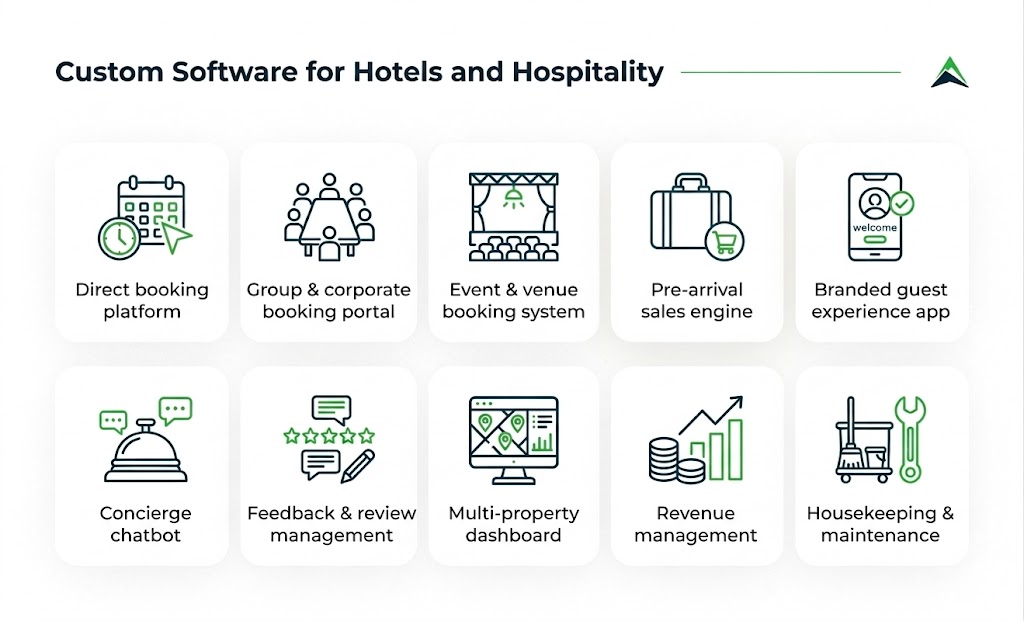
Our hospitality software development services cover the full guest journey and the operations running behind it. The products below, spanning booking engines, guest apps, and multi-property dashboards, are grouped by where each one fits in the hotel’s operation. Most operators start with one or two and expand from there.
Booking and distribution
This is where direct revenue gets reclaimed from OTAs and where specialized booking flows that off-the-shelf PMS tools cannot handle get unlocked. Most hospitality software development services engagements start with one of the products below.
Direct booking platform with own loyalty program
A booking engine on the hotel’s own brand and domain, with a loyalty program that gives guests a specific reason to book direct: member-only rates, tiered perks, and a checkout experience the hotel controls end-to-end. Every reservation through this channel skips the OTA commission.
SiteMinder’s 2026 data shows, for example, that 18% of travelers who begin their search on an OTA ultimately book directly with the hotel once they find it, a gap that a well-designed direct booking engine is built to capture. Our hotel booking app development work typically starts here.
Group and corporate booking portal
Custom rates, contracts, RFP workflows, and approval flows for corporate clients booking 10+ rooms or recurring stays. This replaces the email, PDF, and spreadsheet workflow that most hotels still run for B2B bookings. As a result, the corporate channel finally becomes measurable alongside direct and OTA revenue.
Event and conference booking system for hotel venues
A specialized booking flow for ballrooms, conference rooms, and event spaces, with capacity rules, layout configurations, AV add-ons, and catering integration. Most general-purpose PMS tools treat event inventory as an afterthought, and most OTAs do not carry it at all, so venues with meaningful event revenue usually end up building this piece themselves.
Pre-arrival and check-in
The window between booking and arrival is where most of the incremental per-guest revenue is captured. Meanwhile, the front desk is no longer the only check-in option most guests expect.
Pre-arrival upselling engine
Targeted offers sent between booking and check-in: room upgrades, early check-in, spa packages, and dining reservations. A custom engine lets a hotel segment these offers by guest type, length of stay, and booking channel, instead of sending the same generic upgrade email to everyone.
When the targeting logic is built specifically for the property, guests see offers that actually match their stay context, and the hotel captures ancillary revenue that off-the-shelf upsell tools tend to leave on the table.
The in-stay experience
Then comes the longest stage of the guest journey and the one where most brand differentiation lives. Hotel app development is usually the biggest single build inside a hospitality project, simply because this is where the guest spends their time.
Branded guest experience app
A single guest experience app for the full stay: digital check-in, mobile keys, in-room controls for lighting, temperature and blinds, room service ordering, dining reservations, local recommendations, and post-stay feedback.
The hotel brand owns the entire stay instead of routing it through a generic third-party app template. For hotels where the brand is the product, custom software for hotel guest experience carries that brand into every touchpoint of the stay.
Branded concierge chatbot for guest requests
For hotels not yet committing to a full hotel app development build or running a chatbot alongside one, the chatbot handles extra towels, restaurant recommendations, late checkout, and similar routine requests in real time. It routes to human staff when the request needs judgment and logs every exchange against the guest profile so the next interaction has context.
Post-stay and retention
After checkout comes the stage that most hotels treat as an afterthought. Still, it has the biggest impact on repeat business.
Guest feedback and review management platform
Captures feedback in-app before guests reach TripAdvisor or Google. Routes negative feedback to the right manager for resolution and surfaces positive feedback as review prompts on public platforms.
Retention offers in this system can reference actual stay history (room type, dining patterns, length of stay, and arrival season), rather than the generic “we miss you” emails OTAs cannot send because they do not have the data.
Operations and multi-property management
Meanwhile, running behind the scenes are the systems where chains and property groups feel the limits of off-the-shelf PMS tools first.
Multi-property management dashboard
Centralized visibility across all properties: occupancy, revenue, staffing, guest feedback, and maintenance status. Each property keeps its own workflows, though the group sees a single unified picture. The dashboards we build pull from the PMS, channel manager, and CRM so the data is live, not reconciled at the end of the month.
Revenue management dashboard
Brings together occupancy, dynamic pricing, channel performance, and competitive rate data. It replaces the spreadsheet-and-three-tabs workflow most revenue managers still run, and it integrates with the channel manager and PMS so pricing changes push through automatically.
Housekeeping and maintenance task management system
Real-time room status, task assignment, photo verification of completed work, and maintenance ticket tracking. As a result, housekeeping teams stop waiting on front-desk phone calls, and managers see where rooms are in the turnover cycle without walking the floor.
What a 30-day MVP looks like for a hotel project
For hospitality software development services, the AI-Accelerated MVP breaks the build into four weeks, each with a specific deliverable. The format is fixed-price, code ownership at the end, and enough hotel-specific scoping up front that the team isn’t guessing at what the guest journey or operations should look like.
- Week 1: Scoping. The team captures requirements for each product in scope (for example, what the guest app’s check-in flow needs to cover, or how the multi-property dashboard should handle per-property permissions), locks MVP priorities, writes acceptance criteria, and delivers the technical specification the rest of the build runs against.
- Week 2: Design and prototype. Then UX/UI design for the guest-facing and admin-facing interfaces, architecture planning (including integrations with your PMS, channel manager, or CRM where needed), and a working prototype ready to walk through with your operations team. This is where we decide what ships in v1 and what moves to Phase 2.
- Week 3: Functional MVP. Development builds out the working software using AI-accelerated delivery with senior engineering oversight, followed by QA and polish. The output is production-ready code that the hotel owns, with no templates or vendor lock-in.
- Week 4: Launch and scaling plan. Finally, release, handover, and training for the hotel team. You also receive an architecture roadmap and a feature evolution plan for the next phase, so the v1 ships with a clear path to v2.
Our AI-Accelerated MVP process combines the speed of AI-powered development with the reliability of experienced engineering.
The process runs on a fixed price with limited monthly slots to ensure quality oversight. You stay involved at every milestone.
Working with Eastern Peak
Since 2012, Eastern Peak has delivered over 300 projects across mobile apps, web platforms, marketplaces, and SaaS, with 250+ engineers working from European development hubs.
Our travel and hospitality software development services combine custom engineering with AI-accelerated delivery: senior architects lead design, and AI speeds the build.
Not sure what the right first version looks like for your property? Book a free session to walk through your goals and see if the AI-Accelerated MVP is the right fit.
Frequently Asked Questions
How can hotels increase direct bookings?
The three moves that consistently work are a booking engine on the hotel’s own brand with a member-rate guarantee, a loyalty program that gives guests a clear reason to skip the OTA, and a retargeting flow that reaches past guests using contact data the hotel owns.
What is a hotel booking engine?
A booking engine is the software that handles room availability, pricing, and the reservation checkout on a hotel’s own website or app. It’s the piece that turns a hotel website from a brochure into a direct sales channel.
Custom booking engines let the hotel control the checkout experience, the data, and the commission structure end to end.
How much does it cost to develop a custom hotel booking app?
MVP pricing is fixed before the project starts. The exact number depends on scope (one product vs. multiple, single property vs. multi-property, which integrations, etc.).
Can custom software integrate with our existing PMS?
Yes. A hotel can add a custom booking engine, guest app, or multi-property dashboard without ripping out the PMS that already works.
Read also:
About the author:

Alexey Shalimov, CEO at Eastern Peak
As CEO at Eastern Peak, a professional software consulting and development company, Alexey ensures top quality and cost-effective services to clients from all over the world. Alexey is also a founder and technology evangelist at several technology companies. Previously, as a CEO of the Gett (GetTaxi) technology company, Alexey was in charge of developing the revolutionary Gett service from ground up and deploying the operation across the globe from New York to London and Tel Aviv.