Platforms like Kajabi, Teachable, Circle, and Patreon have made it possible for coaches, educators, and personal brand owners to build an online business with minimal technical effort. For coaches just starting out, these tools cover the essentials: hosting courses, running a community, managing bookings, and taking payments.
However, as the business matures and the model becomes more specific, these platforms start showing their limits. What worked well at the beginning becomes harder to make work at scale. Courses need custom logic. Clients expect a branded experience, not a template. And the business is running on five separate tools that don’t share data with each other.
This article covers the specific types of software that help coaching businesses and personal brands grow past the tools they started on.
When a business outgrows its tools
The move from off-the-shelf to custom rarely happens because of one single problem. Instead, it’s usually a combination of friction points that build up over time:
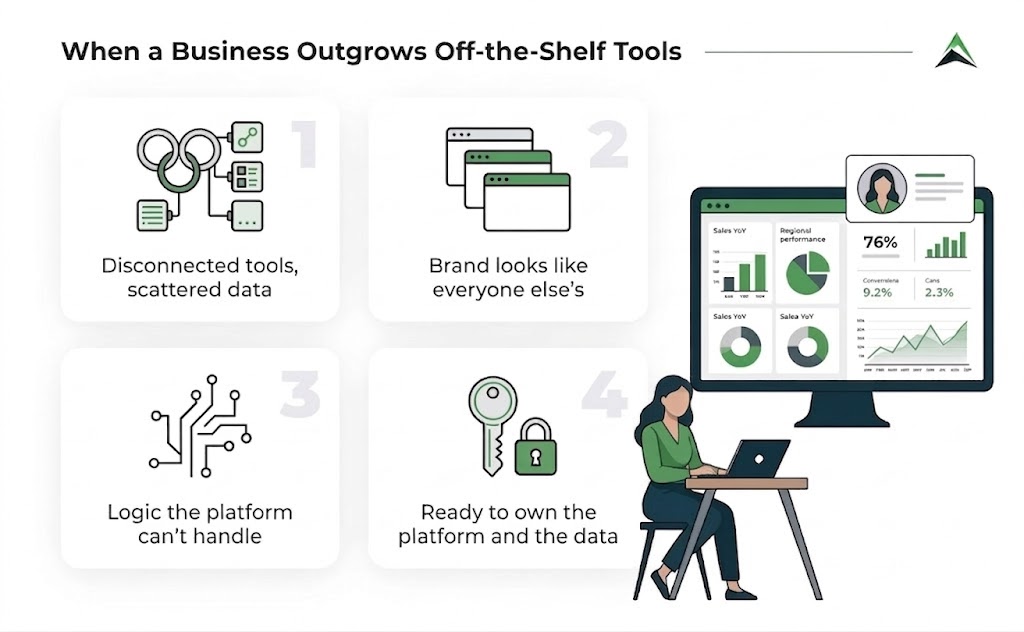

- The business runs on 3+ disconnected tools, with courses on one platform, community on another, bookings on a third, and payments on a fourth. Each tool does its job well enough on its own, but none of them talk to each other. As a result, client data ends up scattered across dashboards (or worse, in spreadsheets), and there’s no way to get a clear picture of who’s paying for what, engaging with which content, or dropping off.
Sam Ovens lived this exact problem. His community ran on Facebook Groups, his courses on a Kajabi-style tool, and the two didn’t talk to each other. So he built Skool.com from scratch. Five years and $700K+ a month in development later, Skool has 15 million+ users.
- A brand that looks like everyone else’s. Template platforms give everyone the same layout, the same checkout, and the same user experience. That’s fine when the business is just starting out, but at a certain point the audience is engaging with the platform’s interface more than with the brand itself. For businesses where the brand is the core product, that gap becomes a real liability.
- Logic the platform can’t handle. This is where the limitations go beyond inconvenience. For example, professional certifications that need competency-based assessments and progress gates, hybrid models that combine coaching with content and product sales, or programs with custom intake workflows and conditional paths. Standard course builders aren’t designed for this level of specificity, and workarounds tend to break as the business grows.
Brendon Burchard was an early Kajabi investor and advisor. He knew the platform inside out. But when he needed journaling, habit tracking, goals, live coaching, and courses all in one app, Kajabi couldn’t get him there. So he built GrowthDay as a custom app for iOS, Android, and web. He still holds his Kajabi investment. His flagship product runs on something he built from scratch.
- The business is ready to own the platform, the data, and the customer relationship. Instead of paying per-student commissions, depending on a third party’s pricing decisions, and building on rented ground.
Stu McLaren co-founded WishList Member, the WordPress membership plugin behind 70,000+ communities. After years of watching coaches struggle to maintain it at scale, he sold his shares and built Membership.io as a dedicated hosted platform. When the person who built the tool says the model has a ceiling, that tells you something.
Of course, none of this means these tools are bad products. Kajabi and Teachable serve millions of coaches well, and for many businesses they remain the right choice. But they’re built for the broadest possible use case, and some businesses eventually need something that fits their specific model.
What we build for coaches and personal brands
Custom development for a coaching or personal brand business typically replaces a fragmented stack of tools with a single, purpose-built platform. Below are the product types we see most often in this space.
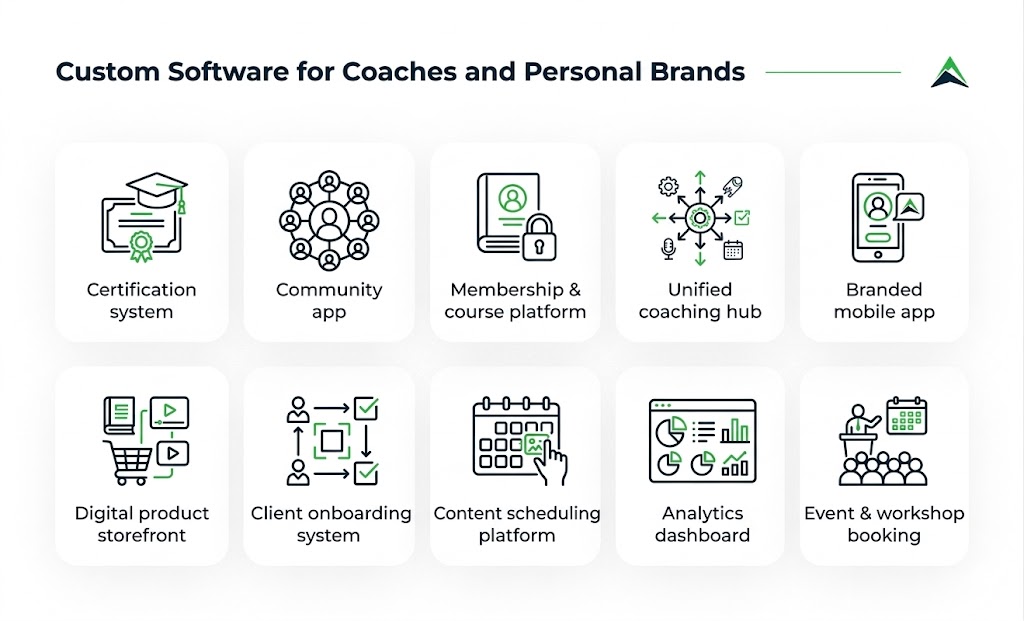

1. Branded membership and course platform
A learning environment built around how a coach actually teaches, with custom learning paths, content drip schedules, and progress tracking designed for their methodology.
Why it matters for the business: unlike template platforms, the creator controls the pricing model, the user experience, and the data without per-student platform fees and creates a learning experience that reflects the brand.
2. Community app with built-in content and coaching
A single application where an audience receives content drops, participates in discussions, attends live sessions, and communicates with the creator directly. This replaces the common setup of running a community tool, a video conferencing platform, and an email marketing service separately.
Why it matters for the business: higher engagement and retention. When an audience interacts with one cohesive experience instead of jumping between four separate products, they stay longer and engage more consistently. Additionally, the coach gets a complete view of how each member participates across all touchpoints, which is something that’s simply not possible when data sits in isolated systems.
3. Certification and credentialing system
A more specialized product type, but an increasingly common one. For businesses running professional development or practitioner programs, the platform needs to support competency-based assessments, progress gates, cohort management, peer review workflows, and verifiable credential issuance.
Why it matters for the business: Off-the-shelf course builders don’t support this kind of logic, because every certification program has its own structure and rules. For instance, a leadership coaching certification works very differently from a nutrition practitioner program, and both require infrastructure that enforces their specific requirements rather than forcing them into a generic course template. Moreover, these programs also tend to command premium pricing, which makes the investment in purpose-built delivery infrastructure a clear business decision.
4. Unified coaching hub
Content, courses, bookings, community, digital product sales, and analytics consolidated into a single platform with one login for the audience and one dashboard for the business.
Why it matters for the business: a business owner running six separate SaaS tools pays six subscriptions, manages six integrations (or none, which means manual data entry), and has no unified view of their audience. In contrast, a consolidated platform reduces operational overhead, gives a complete picture of each customer’s engagement and spending, and creates upsell opportunities that fragmented tools can’t surface.
5. Branded mobile app
A native application published under the coach’s brand in the App Store and Google Play. Content, community, commerce, and communication under one roof.
Why it matters for the business: for creators with large and engaged audiences, a branded mobile app changes how the relationship with the customer works. Specifically, push notifications consistently outperform email in open rates, the brand lives on the home screen instead of competing for attention in a browser tab, and the audience opens the creator’s own app rather than a third-party platform that happens to host their content.
6. Digital product storefront
A custom storefront for selling courses, templates, guides, bundles, and digital downloads. Built-in support for upsells, product bundles, and affiliate tracking, all under the coach’s brand and domain.
Why it matters for the business: this replaces the typical setup of using Gumroad or a Shopify store bolted onto a separate course platform. Essentially, everything lives in one system: the products, the customer accounts, the purchase history, and the referral data.
7. Client onboarding and intake system
For high-ticket programs and consulting-style offers, a dedicated onboarding workflow with custom intake forms, questionnaires, payment plans, agreement signing, and automated welcome sequences.
Why it matters for the business: this is one of those products that personal brands usually build in Notion, Typeform, and email automations stitched together. By comparison, a purpose-built system replaces all of that with a single, professional intake experience that matches the price point of the offer.
8. Automated content scheduling and delivery platform
A platform that manages drip content, scheduled releases, email sequences, and notification workflows in one place. The owner sets the schedule once, and the platform handles delivery across channels.
Why it matters for the business: this matters most for coaches running evergreen programs where new members start at different times. Delivering the right content to the right person at the right time, without manual intervention, is something that breaks down fast on tools not designed for it.
9. Custom analytics dashboard
A single view that shows audience engagement, revenue metrics, program completion rates, and growth trends. Data pulled from the brand’s own platform rather than exported and stitched together from five different tools.
Why it matters for the business: when decisions about which programs to expand, which content performs, and where clients drop off depend on data from one place, spreadsheet reports assembled from multiple exports don’t cut it.
10. Event and workshop booking platform
A custom booking system for live workshops, retreats, masterminds, and in-person events. Waitlists, replay access, time zone handling, group pricing, and capacity management built around how the business actually runs its events.
Why it matters for the business: this replaces the typical Eventbrite-plus-Zoom-plus-email combination with something that keeps the entire event experience inside the brand’s own ecosystem.
How we build it
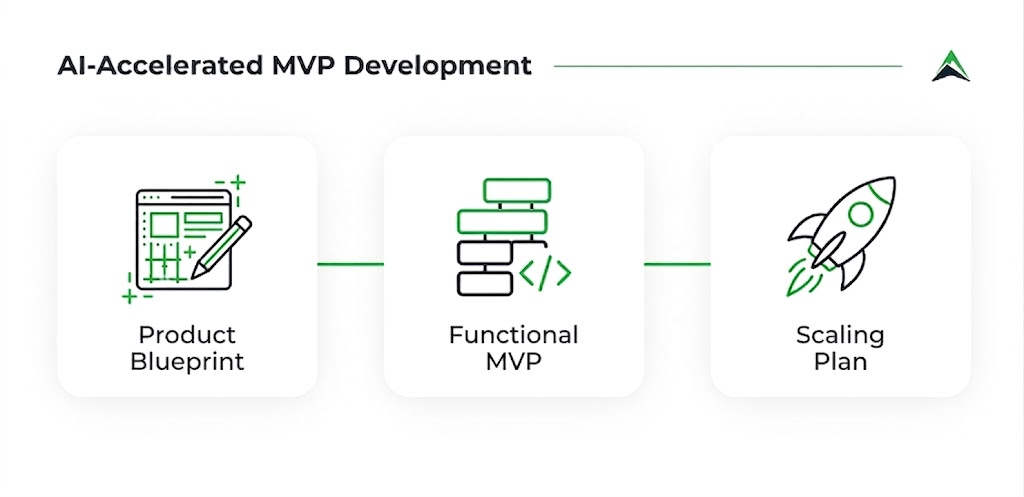
Eastern Peak’s AI-accelerated approach combines the speed of AI-powered development with the reliability of experienced engineering. In practice, this means a working MVP delivered in 30 days across three phases.
- Phase 1: Product blueprint. The first week focuses on scoping: defining user flows, setting MVP priorities and acceptance criteria, and building a UX/UI prototype ready for validation. This ensures alignment on what the first version will include before any production code is written.
- Phase 2: Functional MVP. Next, over weeks two and three, our engineering team builds the product using a hybrid AI and expert engineering workflow. AI accelerates the labor-intensive development steps, while senior engineers oversee architecture, security, and code quality. The result is real, production-ready code with full ownership and no vendor lock-in.
- Phase 3: Post-MVP scaling plan. Week four covers launch, handover, and training. You also receive an architecture roadmap and a feature evolution plan, so you know exactly what Phase 2 looks like and how the product scales from here.

The process runs on a fixed price with limited monthly slots to ensure quality oversight. You stay involved at every milestone.
Why Eastern Peak
Eastern Peak has been delivering software products since 2012, with over 300 successful projects across platforms, mobile apps, SaaS, and marketplace development. Our engineering hubs are based in Europe, and our team of 250+ engineers works across the full development lifecycle.
The AI-accelerated MVP model builds on more than a decade of engineering experience. We use AI as a tool in service of engineering, combining rapid delivery with the architectural decisions that allow a product to scale beyond its first version.
Not sure what your business needs from a technology perspective? Get in touch to explore your product goals and define the right scope for your first version.
Every project runs on a fixed price, determined during the scoping phase. The cost depends on the complexity of the product, the number of core features in the MVP, and the integrations required. Get in touch for a quote based on your specific requirements. Yes. You get full ownership of everything we build: source code, architecture, and data. There’s no vendor lock-in and no ongoing licensing fees for the product itself. Yes. The MVP is built on standard, production-grade architecture designed to scale. Unlike template platforms where growth means higher subscription tiers and more per-user fees, a custom platform scales on infrastructure terms, not on the platform provider’s pricing model. The post-MVP scaling plan delivered in Week 4 maps out exactly how the architecture evolves as the user base grows, so there are no surprises when the business hits its next stage.Frequently Asked Questions
How much does it cost to build a custom platform?
Do I own the code?
Can the platform handle my growth?
Read also: