Online food delivery is projected to reach $355.6 billion in 2026 and pass $505 billion by 2030, growing at 9.4% a year, according to Grand View Research. Most of that money moves through software the restaurant does not own.
Restaurants selling through delivery marketplaces pay a single commission covering two distinct services. One is discovery, meaning the listing that puts a restaurant in front of somebody who has not chosen it yet. The other is fulfillment: the driver, plus the payment handling attached to the order. What the commission does not buy is the customer relationship, which carries no line item and stays with the platform.
The priced half is public. Marketplace delivery orders run 15% to 30% depending on the tier a restaurant sits on. On a million dollars of annual marketplace volume at the top tier, that means $300,000 before food and labor are paid. The unpriced half is harder to see and tends to cost more over time. Contact details, order frequency, basket composition, and repeat behavior all accumulate in the platform database rather than yours, which means a guest who has ordered forty times is still a stranger to your systems.
That is why restaurant app development has moved from a big-chain luxury to the practical way operators of any size take back ordering, data, and margin.
This page covers what custom restaurant app development actually produces for a food business, from direct ordering through to franchise operations, and how we get a first working version live in 30 days.
When a food business outgrows its tools
Off-the-shelf software carries most restaurants a long way. Four signals tell you the ceiling is close, and most businesses that commission a build recognize themselves in at least two of them.
- Delivery commissions compound. Commission on a first order is customer acquisition, which is a perfectly reasonable expense. Now, that works fine as customer acquisition spend while you are opening a new location and nobody in the neighborhood knows your name yet. However, it works a lot less well on the fifth repeat order from the same guest, the one who already knows exactly what they want, orders it most Thursdays, and would happily order it from you directly if you gave them somewhere to do it.
Domino’s started on traditional phone ordering and built a full proprietary digital ecosystem: its own app, website, AnyWare ordering across more than fifteen surfaces, a proprietary POS, and the Pizza Tracker. More than 85% of U.S. retail sales now run through digital channels. Somewhere along the way it became a technology business that happens to sell pizza.
- Losing direct relationships with customers. When someone orders through an aggregator, their email, phone number, and order history stay with the aggregator, and the restaurant only sees an order ticket. Retention, loyalty, and lifetime value all depend on that data. Without it, every order is a first order.
Starbucks was purely in-store and walk-up. It built Mobile Order & Pay inside its own app, tied to the Rewards program, and now runs 31% of all U.S. transactions through that app.
- Running multiple locations with different menus/pricing. Off-the-shelf POS handles one site well. Regional menu variants, location-specific pricing, and staged rollouts across a group are a different challenge. Most groups hit that ceiling somewhere between the fourth and tenth sites. That is usually the moment restaurant franchise management software stops being a nice idea and starts being the thing holding the week together.
- The business model never fitted standard POS in the first place. Meal prep, subscription boxes, and recurring catering involve scheduling, customization, and delivery logistics that conventional restaurant software simply does not support. Businesses in this category reach custom development earlier than conventional restaurants, largely because there was never an off-the-shelf option to outgrow.
None of this means that off-the-shelf tools are bad products. Toast and Square serve hundreds of thousands of restaurants perfectly well, and marketplaces remain a sensible way to reach guests who have never heard of you. Their job is to work for as many restaurants as possible, and they do it well. That same generality is what an unusual model eventually runs into.
What we build for restaurants and food brands
Custom development here usually replaces a scattered stack with a smaller number of purpose-built systems. Below are the product types that come up most often.
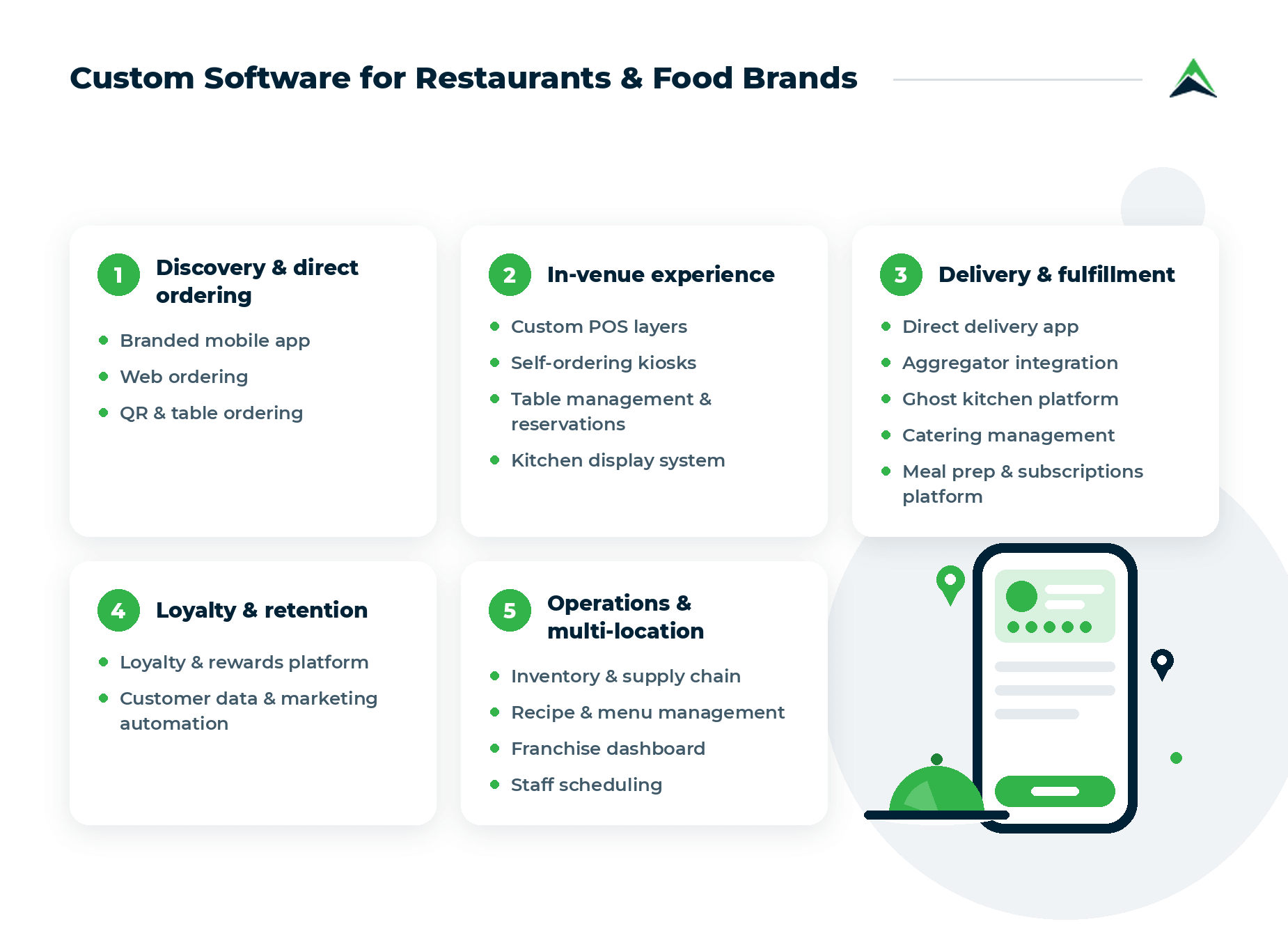
Discovery and direct ordering
Direct channels are usually the first build because the payback is the easiest to measure.
- Branded customer mobile app. An iOS and Android app under the restaurant’s own name, with push notifications, saved favorites, stored payment, and order history. For repeat guests, it replaces the customer-facing role of the aggregator. Restaurant mobile app development at this level usually ships together with the web channel, so both share one menu and one kitchen flow.
- Web ordering with menu and checkout. A full online ordering system on the restaurant’s own website, connected to the existing POS and kitchen workflow. Typical scope covers menu browsing and search, saved payment methods, one-tap reorder, live order tracking, push notifications, and ratings. Restaurant app development at this layer is where most projects begin.
- QR menu and table ordering. Scan-to-order at the table, useful for QSR and casual dining rooms that want faster table turns and less pressure on servers.
For operators who want speed over deep customization, a white label food ordering app gets a branded channel live quickly, with a path to a fully custom build later. Food delivery app development for direct channels follows the same logic: start with the flow that recovers the most commission first.
In-venue experience
Inside the venue, the goal is one connected flow: order, kitchen, table.
- Custom POS layers. For chains that have outgrown Toast or Square or need workflows a generic POS does not support. Most projects are a partial replacement: the POS keeps ringing up orders while custom layers handle loyalty, kitchen routing, and reporting on top.
- Self-ordering kiosks. In-store kiosks with the restaurant’s branding, wired into the POS and kitchen display.
- Table management and reservations. Custom restaurant table management software for bookings, waitlists, and seating, built for operators who want to own the reservation funnel instead of renting it and to connect it to loyalty and CRM.
- Kitchen display systems. Real-time tickets, station routing, and prep timers are most valuable when the restaurant’s own ordering channels feed straight into them.
Delivery and fulfillment
Delivery splits into five situations, and each calls for a different platform.
- Direct delivery app with driver routing. For restaurants with enough volume to justify their own drivers: order assignment, route planning, live driver tracking, and customer notifications. On-demand food delivery app development of this kind starts making sense once direct order volume is steady.
- Aggregator integration layer. For operators staying on DoorDash and Uber Eats but tired of juggling tablets. Restaurant delivery management software of this type pulls orders from every channel into one kitchen flow.
- Ghost kitchen and virtual brand platforms. Ghost kitchen software handles brand-level routing, menu control, and profit-and-loss reporting per virtual brand for operators running several concepts out of one kitchen.
- Catering management system. Quote building, menu configuration for large orders, delivery logistics, and invoicing in one flow for operators whose catering business has outgrown a shared inbox and a spreadsheet. Catering runs on a different sales cycle from service, with lead times measured in weeks and order values an order of magnitude higher.
- Meal prep and subscription food platform. Built for businesses selling scheduled food rather than immediate orders. Scope covers plan configuration and per-meal customization, delivery scheduling across a week or a month, pause and skip handling, dietary filtering, and route planning for batch delivery days. Businesses here arrive at food delivery app development sooner than conventional restaurants.
Loyalty and retention
Loyalty is where first-party data starts paying for itself. Starbucks is the reference point here: Rewards members drove nearly 60% of US company-operated revenue in fiscal 2025, more than $13 billion in spend, through a program built fully in-house.
- Loyalty and rewards platform. Points, tiers, member pricing, prepaid balances, and recurring subscription plans, all running on a customer database you own outright.
- Customer data platform and marketing automation. First-party data unified across mobile, web, in-store, and delivery, feeding segmented email and SMS, win-back campaigns, and abandoned-cart flows for online ordering.
Operations and multi-location management
Behind the guest-facing products sits the operational layer, and this is where custom pays off for growing groups.
- Inventory and supply chain. Restaurant inventory management software with real-time counts across locations, par levels, automated reordering, supplier integrations, and waste tracking.
- Recipe and menu management. A central recipe library with cost-of-goods tracking, plus restaurant menu management software for rolling out changes and regional variants across locations or franchisees.
- Multi-location and franchise dashboard. Roll-up reporting, cross-location KPIs, brand standards, and franchisee performance benchmarking in one place.
- Staff scheduling and labor. Scheduling and labor cost forecasting tied to POS sales data, so labor as a share of revenue is visible per location, per day.
How we build it in 30 days
Agencies ranking for food delivery app development consistently quote three to six months, and they are not being evasive. A full multi-sided platform with dispatch and live payment processing genuinely takes that long to build properly. Our AI-Accelerated MVP breaks the build into four weeks, each with a specific deliverable.
- Phase 1: product blueprint (week 1). We audit whatever you are already running, map the order journeys, identify the integration points, and lock MVP scope together.
- Phase 2: UX prototype and architecture (week 2). We build a clickable prototype of the ordering flow and design the architecture: integrations, data model, security, and the scalability decisions a restaurant platform depends on.
- Phase 3: AI-accelerated build and QA (week 3). The team builds with a hybrid workflow: AI accelerates the labor-intensive implementation, and senior engineers review every piece of it for security, performance, and code quality.
- Phase 4: Launch and roadmap (week 4). Production deployment, integrations with POS, payment, and delivery APIs, handover and training, plus an architecture roadmap for what comes after the MVP.
Our AI-Accelerated MVP process pairs the speed of AI-assisted development with the judgment of senior engineers who have been shipping production systems since 2012. The price is fixed, and we take on a limited number of builds each month so every project gets real engineering oversight. You review every milestone as it lands.
Our expertise in food and restaurant software
At Eastern Peak we have been delivering software products since 2012, with more than 300 completed projects and 250+ engineers across European development hubs. Below are some examples of our work in food and restaurant software development:
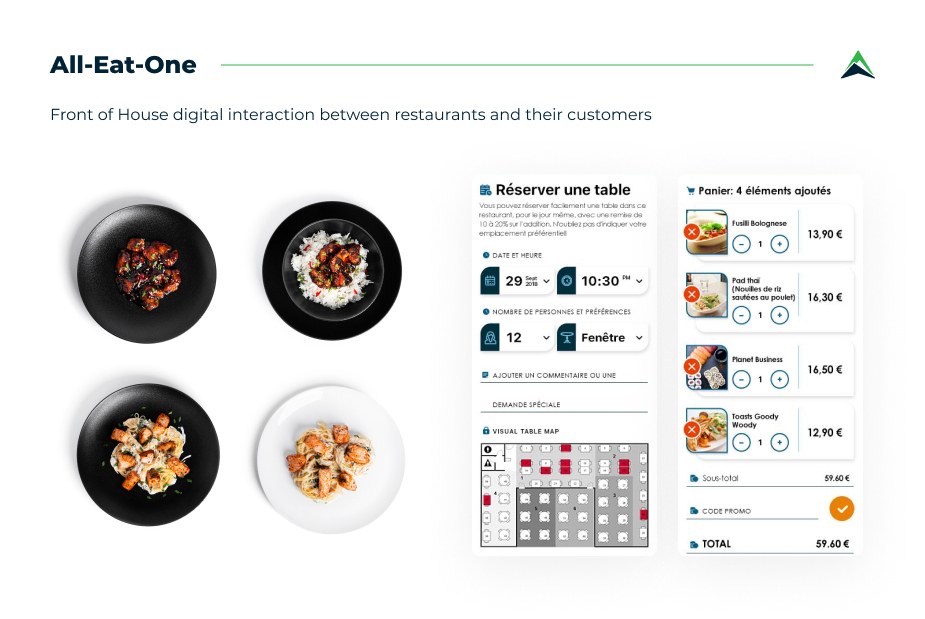
- All-Eat-One. A front-of-house platform for restaurants and bakeries covering online table booking from any device, ordering across delivery, pick-up, and in-diner, waitlist and cancellation handling, on-site waiter interaction, online payment, loyalty, waste management, and CRM. It was built so operators could anticipate order volume during peak service while holding a customer database of their own.
- Commission-free pickup and delivery platform. A system letting local restaurants sell directly through their website, Facebook, Instagram, and Google listings, with a business dashboard covering order and delivery management, delivery booking, discounts and promo codes, loyalty, surveys, and virtual answering, plus tablet and Bluetooth printer hardware.
Building a platform of your own
Off-the-shelf tools will carry a restaurant through its early years, and for many operators, they stay enough. The turning point comes when commissions, missing guest data, and manual workarounds start costing more than a platform of your own would.
Custom ordering, delivery, and operations software puts those pieces back under your control, and with a 30-day MVP as the entry point, the first version fits the budget and the calendar of a single busy restaurant.
Not sure which of these your food business actually needs? Our team builds ordering, delivery, and operations software around how a business really runs rather than how a template assumes it does. Get in touch and we will scope a first version with you.
Frequently Asked Questions
How much does custom restaurant app development cost?
Scope drives the price more than anything else. The main cost factors are the number of channels (web, iOS, Android, kiosk), the integrations required (POS, payments, delivery APIs), and whether the platform serves one location or many.
A single-channel ordering app sits at the low end of the range, a multi-location platform with loyalty and aggregator integrations at the top.
Fixed-scope MVP models keep the first version predictable by locking features and price up front.
Can the platform handle multi-location and franchise growth?
Yes, that is an architecture decision made on day one. Multi-tenant models, location-level configuration, franchisee permissions, and roll-up reporting are standard in our restaurant builds.
Can a custom online ordering system integrate with an existing POS?
Yes. POS, payment, and aggregator integrations are all handled through their standard APIs.
Read also:
About the author:

Alexey Shalimov, CEO at Eastern Peak
As CEO at Eastern Peak, a professional software consulting and development company, Alexey ensures top quality and cost-effective services to clients from all over the world. Alexey is also a founder and technology evangelist at several technology companies. Previously, as a CEO of the Gett (GetTaxi) technology company, Alexey was in charge of developing the revolutionary Gett service from ground up and deploying the operation across the globe from New York to London and Tel Aviv.