
No technology has had such a sharp impact on the global economy as AI. In 2025, 88% of companies used AI in their operations. In 2024 alone, U.S. private AI investment reached $109.1 billion, according to Stanford’s AI Index 2025, a clear signal that businesses are moving to capture the value of the technology.
The numbers are staggering yet encouraging, and they demonstrate a clear trend: companies benefit from AI through improved productivity, faster decision-making, and higher employee satisfaction. AI software development is a process that will impact nearly every company, and business owners have the power to decide how soon they adapt to it.
This article covers the types of AI software development services, how businesses benefit from them, the nuances of AI adoption in software development, and the potential costs.
What is AI development?
AI development is the creation of systems capable of autonomous reasoning and data-driven decision-making. An AI development service scales employees’ expertise and streamlines processes that once took hours or days — now they often take mere minutes (or seconds).
AI development transforms software from a rigid set of instructions into an adaptive asset that learns from organizational data to solve complex problems. This means adding a significant layer of intelligence to merely rule-based instruments.
Whether the goal is to create AI software from scratch or build an AI app on top of existing models, the starting point is the same: understanding what AI can actually do for your business.
That’s exactly what an AI readiness assessment is for: a quick way to see which of your processes are the best place to start.
Types of AI software development services
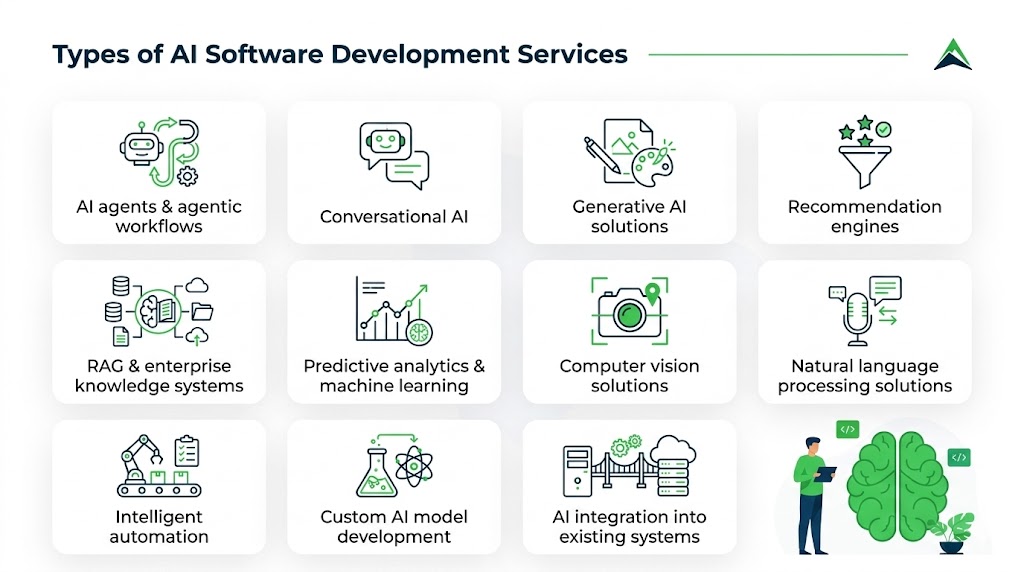
AI agents & agentic workflows
These are autonomous systems designed to execute multi-step business processes with minimal human intervention. McKinsey reports that around 39% of companies in 2025 have begun to use artificial intelligence development services to build agents. Although many agents today still do a limited range of tasks, their scope is growing.
At Eastern Peak, we build these for specific teams, like AI agents for legal teams that handle intake and conflict checks, or AI agents for event agencies that take the routine work around each event off your staff. In both, your people approve anything that goes out.
Conversational AI
Conversational AI uses natural language processing for human-like communication between computers and users. Sometimes, it takes over simpler conversations, allowing human agents to work on more complex tasks. The market size for conversational AI exceeded $14 billion in 2025, and many global giants invest in artificial intelligence app development to ensure 24/7 support and improve issue resolution.
Generative AI solutions
Generative AI systems create original content and generate ideas, including text, visuals, code, and data syntheses. Its popularity has exceeded individual users’ interest and has firmly settled at the business level: 65% of executives expect generative AI to be revolutionary for their business.
Recommendation engines
They analyze large datasets of user behavior to predict and suggest the most relevant products or content for them. AI development companies create recommendation engines to promote products that will attract users’ attention and improve the customer journey.
RAG & enterprise knowledge systems
Retrieval-Augmented Generation (RAG) connects AI models to companies’ data archives, essentially building private knowledge systems. This connects employees to concrete answers tailored to their organizations’ datasets rather than broad or random sources.
Predictive analytics & machine learning
These services use historical data to identify patterns and forecast future outcomes. It can be used in any context: to track market changes, predict equipment failure, or evaluate particular internal procedures.
Companies are increasingly leaning on predictive analytics, and this shift is reflected in the market’s rapid expansion. With a CAGR of 28.3%, the sector is projected to surge from $18.89 billion in 2024 to over $82 billion by 2030.
Computer vision solutions
This branch of AI enables software to interpret and act on visual information from the real world. The development of artificial intelligence, in this case, trains AI to derive data from digital images, videos, and other sources — much like human vision. Businesses can use them for quality control, security monitoring, and even spatial analysis.
Natural language processing solutions
Natural language processing (NLP) helps computers understand and evaluate human language. In 2025, the NLP market was valued at nearly $49 billion. We most often think about NLP being used in chatbots and translation tools, but its potential is vast (e.g., search engines, content classification).
Intelligent automation
Intelligent automation is the combination of Robotic Process Automation (RPA) and AI’s thinking capacity. These AI development solutions can handle not just the predictable tasks but also make decisions and address nonlinear problems.
Custom AI model development
This service builds an AI model tailored to a company’s unique data and niche requirements. It moves beyond off-the-shelf AI tools and offers far greater performance and contextual understanding, translating into a competitive intellectual advantage that other businesses cannot replicate.
Custom AI software development of this kind gives businesses a model no off-the-shelf product can match.
AI integration into existing systems
AI is often integrated into legacy systems to improve their performance. It allows businesses to improve their technological solutions but not destroy what was built before, which saves money and still provides results.
Business impact of AI software
AI software development pays off in two directions: operational gains and a better customer experience. Integrating AI into software improves business operations and also provides a personalized, more relevant experience for your customers.
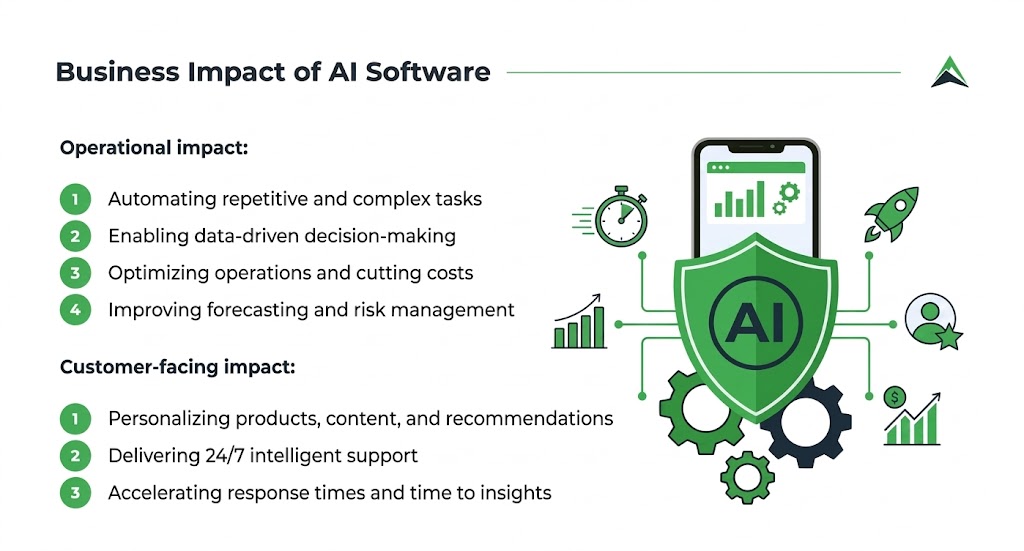
Operational impact
- Automating repetitive and complex tasks. Now, AI systems can manage workflows that previously required constant human control and tracking. An AI app decreases the need for manual human input. Moving from repetitive operations to dealing with more demanding processes, AI helps entire teams improve the overall quality and pace of their work.
- Enabling data-driven decision-making. AI transforms incoming data into practical, sound decisions that benefit business processes. Any human professional needs far more time to process vast datasets of information — AI does it fast, and it combines various sources and trends to make informed suggestions.
- Optimizing operations and cutting costs. AI software can identify and fix problems in operations, supply chains, and communication, thereby saving money, time, and human resources. Human specialists lose valuable hours solving problems that can be delegated to AI. By monitoring operational effectiveness, the software makes micro-adjustments that yield noticeable annual savings. It also helps employees focus on meaningful work that requires their decision-making.
- Improving forecasting and risk management. Thanks to machine learning, AI tools provide accurate predictions of market shifts and hardware failures. This helps businesses move toward proactive prevention rather than reactive crisis-solving.
Customer-facing impact
- Personalizing products, content, and recommendations. AI changes what users see based on history and preferences. This level of hyper-personalization ensures customers see only the most relevant content, which significantly boosts their engagement.
- Delivering 24/7 intelligent support. Modern conversational AI provides instant, high-quality assistance at any hour without the extra costs of a full-time support center. Companies benefit from most repetitive inquiries being answered without a loss of quality while engaging their human support agents for more nuanced challenges.
- Accelerating response times and time to insights. AI-driven software noticeably reduces the time from first contact to problem resolution. Clients often choose the company that responds the fastest, so AI cuts resolution time, increasing brand loyalty and competitive advantage.
AI software development across industries
Today, developers build custom AI solutions that are flexible and can adapt to specific industry challenges.
Fintech
AI tools help fintech companies strengthen risk management and deliver more customer-oriented service. The most popular applications include fraud detection, decision-making, and wealth management.
Today, the market size for AI in fintech is already more than $35 billion, as companies increasingly recognize the value in these products.
Fintech businesses now have far more effective threat prevention systems that can detect fraudulent patterns in real time. But the path toward customer satisfaction is equally valuable: wealth management was far more generic or costly — now users get their insights with greater precision and personalization.
Healthcare
AI software is now used for clinical diagnostics and faster drug and treatment discovery. AI software development companies create devices that help human staff detect certain health conditions faster. It uses existing tech and intelligence capabilities to diagnose and help patients with better accuracy, supporting preventive treatment strategies.
However, AI tools also predict patient admissions and evaluate budgeting opportunities.
Retail and eCommerce
AI enables companies to improve user satisfaction and inventory management. By using personalization and algorithms, businesses get to strengthen their value proposition and suggest better items to potential buyers.
Retail executives are actively adopting AI automation to manage inventory and predict consumer trends, with companies across the sector reporting significant operational gains.
Manufacturing logistics
In manufacturing, businesses can now improve their operations with the help of predictive maintenance, computer vision for quality control, and supply chain optimization.
Artificial intelligence development has moved far beyond digital software, using sensors to identify potential defects or malfunctions. This ensures greater safety during the manufacturing process and reduces costs for repairs or faulty equipment.
Hospitality
AI has bridged the gap between customer needs and the costs of personalization, creating a user-centric guest journey. High-performing hotels use AI to automate routine guest inquiries, especially repetitive ones, and keep their human staff focused on high-touch, empathetic service.
This transformation cuts unnecessary operational costs while increasing customer and client satisfaction.
How does AI software development work?
The AI development process moves from aligning technology and business goals to a self-improving system that optimizes itself based on new real-world data or expectations.
The steps to build AI software are roughly the same across projects — discovery, data preparation, design, training, deployment, and monitoring. Knowing how to develop AI software well comes down to executing each stage with discipline.
Discovery
Discovery identifies a specific business problem that AI can solve. This is the first of the steps to build AI software, and it requires the most engagement from business owners and project leads. They collaborate with developers to define the project scope, technical feasibility, and metrics that demonstrate return on investment (ROI).
While this stage can occur without an AI development agency, developers can suggest more realistic technical solutions.
Data audit & preparation
This stage involves evaluating raw data and organizing it to improve project accuracy and consistency. It often takes significant time because a lack of preparation is a key cause of failure in many cases of AI solutions development.
The team ensures it has access to high-quality data that reflects actual industry/business trends and technical capabilities.
Solution design & architecture
Experts design the structural blueprint of the system, deciding which setup type to focus on. Often, the team chooses between a cloud model and a different decentralized edge setup. Companies develop AI solutions that integrate AI into the infrastructure rather than simply adding it on top.
Model development & training
This step is the moment of teaching in which algorithms are fed prepared data to recognize patterns and learn specific tasks. After choosing the model, developers adjust its internal parameters to minimize errors and maximize performance. This structured training-and-evaluation cycle ensures your model can deal with complex scenarios.
Integration, testing & deployment
Now, the AI solution is added to your workflow and is tested for performance. This often includes integrating AI into testing so that your developers can get bug updates and fix them immediately.
However, the nature of AI itself makes deployment less of a one-and-done solution and more of a transition from a controlled to an unpredictable environment.
Monitoring & continuous improvement
The team evaluates how the tool works so that it remains effective in new market conditions. Without these evaluations, AI can become more prone to error. Feedback loops allow the system to retrain itself on new data and keep its decisions relevant.
Challenges of AI software development
Knowing how to build AI software also requires developers to address friction points that can damage the project’s effectiveness.
- Data quality and availability. High-quality data is necessary to train reliable AI solutions. Around 90% of executive leaders consider this a severe hurdle to their projects, a considerable number of which may be abandoned.
- Model bias. AI can be unintentionally prejudiced if it is trained on subjective data, and this may lead to skewed business decisions or practices. If left unchecked, this can result in legal liabilities or reputational damage. Concerns about AI bias contribute to 49% of the model-quality issues cited as a barrier to AI adoption.
- Integration with legacy systems. AI application development services face the challenge of integrating AI into older, rigid software environments. This problem concerns 60% of AI leaders in 2025.
- Security, privacy, and regulatory compliance. AI introduces new vulnerabilities, from data leaks to the need for strict adherence to quickly changing laws.
- Responsible AI and governance. Governance requires each AI software development service to create complex frameworks that combine accountability, transparency, and ethics. AI is quickly evolving. And despite it being a business advantage, it also makes organizations scramble to ensure these technologies behave ethically.
What determines the cost of AI software development?
The total investment in AI depends on the complexity of the task the system must perform and the characteristics of your development team.
Scope & functional complexity
The cost of an AI project scales directly with the number of features and the intelligence level required for the model to succeed. A simple chatbot with a minimal learning path will cost far less than an agentic system that manages many workflows. If you’d like your system to grow later, you can commission AI software that starts simple but is built with scalability in mind.
Data readiness
The cleanliness and reliability of your data can be a significant hidden factor in costs for your AI software development. If your data is unorganized or unlabeled, the cost of your artificial intelligence software development services will grow. Your team will have to spend more time on cleaning and pipeline development.
System integrations required
If you have a diverse tech stack, the pricing for ensuring compatibility of your AI innovation with all of them will be high. Each custom integration adds more expenditures to the budget, as your AI software development company must build secure APIs and ensure real-time data flow without breaking existing systems.
Team composition & location
The expertise and geography of your AI development company remain the biggest single line items in your budget. US-based teams can be up to 2-3 times more costly than offshore development specialists from Eastern Europe or Asia. Business owners often prefer non-US-based professionals to cut costs while preserving quality.
Our expertise in AI development
At Eastern Peak, our custom AI software development work spans healthcare, hospitality, retail, finance, food service, and more. Our portfolio includes AI-powered safety platforms, precision healthtech, conversational commerce, recommendation systems, and intelligent automation.
Here are a few examples of what we’ve built for clients.
Workplace safety platform
We built an AI-powered fall detection system for a healthtech platform protecting workers in high-risk environments. A self-learning neural network recognizes falls (particularly relevant for older or isolated workers) and triggers automated emergency response even when the user is unconscious. The solution combines real-time GPS tracking, SOS alerts, two-way voice communication, and geofencing for hazardous zones. We partnered with the founders from concept to MVP and later scaled the platform with full AI integration.
Global hospitality platform
For a worldwide network of private clubs and hospitality venues, we implemented AI-driven automation to handle customer support across multiple regions. The system automatically classifies and routes incoming requests, escalates urgent cases instantly, and generates analytics on support trends for better resource allocation. We integrated the AI modules into the client’s existing infrastructure while working alongside their in-house team.
Cancer risk assessment platform
A precision medicine solution used in clinical settings to predict hereditary cancer risk. Our team supported the machine learning models that analyze patient history and genetic data, enabling personalized screening and early intervention strategies. The system delivers clinical decision support aligned with NCCN guidelines, with continuous model updates based on new clinical insights.
AI conversational commerce for restaurants
A commission-free ordering platform where customers order directly through Google, Instagram, Facebook, or the restaurant’s website. We supported the client in scaling the backend, integrating direct channels, and adding AI-powered re-engagement that drives repeat orders. The system also handles automated refunds, real-time order tracking, and customer support.
AI interior design assistant
A virtual assistant that recommends layouts and products based on user style and budget. The system matches furniture and décor from multiple brands in real time, integrates with e-commerce checkout, and lets users build personalized mood boards.
These projects share the same underlying capabilities: discovery, custom model development, data engineering, MLOps, and post-launch support. Our AI & ML development services cover all of these under one roof, with the option to take on the whole project or augment an in-house team.
Building progress
AI software development has surged so much that businesses that don’t hop on this innovation train might risk staying behind. Rather than blindly chasing trends, companies can apply this technology to secure their competitive advantage and drastically foster both employees’ and customers’ satisfaction.
Choosing the path for AI software development might seem intimidating. If you’re looking for AI software development solutions but want to make sure they’ll last and adapt as you grow, contact our team. We’ll help you find where AI can add the most value and start building your smart solutions.
Frequently Asked Questions
How much does it cost to develop AI software?
Prices for AI development services vary depending on how difficult the product is, the team’s location and size, and the complexity of your legacy systems.
How long does it take to develop AI software?
How long it will take your developers to create AI software depends on many factors, but, as a rule, it may take from 3 to 9 months.
Can AI software integrate with our existing legacy systems?
Yes, integrating AI software with the existing legacy systems is a part of custom AI software development.
Read also:
- Examining AI Uses in Banking & Financial Services
- AI in Education: Personalizing Learning Experiences
- Legal AI Software: Revolutionizing Legal Practices with Artificial Intelligence
- Agentic AI Explained: Transforming Industries with Autonomous Intelligence
- How AI Voice Ordering Systems Are Benefiting Restaurants
- The Future of AI in Real Estate: Top 10 Tech-Driven Use Cases
About the author:

Alexey Shalimov, CEO at Eastern Peak
As CEO at Eastern Peak, a professional software consulting and development company, Alexey ensures top quality and cost-effective services to clients from all over the world. Alexey is also a founder and technology evangelist at several technology companies. Previously, as a CEO of the Gett (GetTaxi) technology company, Alexey was in charge of developing the revolutionary Gett service from ground up and deploying the operation across the globe from New York to London and Tel Aviv.